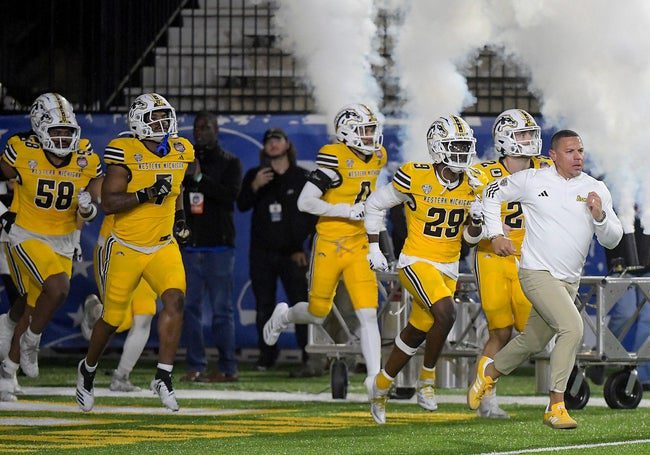
Miami (OH) vs Western Michigan: MAC Championship Game Betting Preview
Miami’s defense already solved Western Michigan’s offense in October, holding them to 144 rush yards. Despite the QB change, the schematic advantage holds. Get the definitive prediction for RedHawks +2.5.
The Defense That Already Solved This Matchup
Market Read
Western Michigan opened as 2.5-point favorites but we’re seeing movement to the key number of -2 at most books. The total sits steady at 43.5-44 across the board. That’s a telling market combination—modest spread with an extremely low total screams that sophisticated bettors respect Miami’s defensive capability. Ford Field eliminates weather concerns, so what you’re really seeing is two teams that struggle to score consistently against elite-level defensive units.
Here’s what the market’s actually saying: this game lands somewhere between 20-17 and 24-20, and there’s genuine uncertainty about which team’s defense wins the field position battle. Books are divided on the spread—some hanging 2.5, others at the key 2. That uncertainty creates opportunity for bettors who understand what actually happened when these teams met in October.
Game Dashboard
| Matchup | Date/Time | Venue |
|---|---|---|
| Miami (OH) vs Western Michigan | Saturday, December 6, 12:00 PM ET | Ford Field (Detroit, MI) |
Spread: Western Michigan-2.5
Total: 43.5-44
Moneyline: Miami +110 to +114, WMU -130 to -135
The October Film Tells the Real Story
Before we dive into statistical profiles, understand this: these teams already played each other, and Miami’s defense completely solved Western Michigan’s offensive identity.
In Oxford on October 25, with Dequan Finn leading the way, Miami held the Broncos to just 144 rushing yards—one of Western Michigan’s lowest totals of the entire season. More importantly, Miami’s defense recorded three sacks, forcing Lowry into obvious passing situations where his offense becomes one-dimensional and vulnerable.
That performance isn’t theoretical analysis. That’s proven dominance in the exact matchup that matters.
Miami (OH) Profile
The RedHawks score 25.0 PPG while allowing 19.1—a solid +5.9 differential that ranks among MAC’s best. But here’s what separates Miami from pretenders: their defense generates consistent pressure without needing to blitz. Ranking #3 nationally in pass rush efficiency, the RedHawks create chaos up front.
Look at their road performances: 3+ sacks at Wisconsin and Rutgers (both Power Four programs), 4 sacks at home against UNLV. This isn’t a defense that relies on home-field advantage. They generate pressure in hostile environments.
The real issue Miami faces isn’t their defensive capability—it’s their offensive consistency without their starting quarterback. Dequan Finn, the seventh-year veteran who orchestrated that 17-point fourth-quarter comeback against Western Michigan in October, has left the program to focus on NFL Draft preparation. Now Thomas Gotkowski, a redshirt freshman with 411 total passing yards and 4 TDs in limited action, takes over in the biggest game of the season.
Let’s be clear about what this means: Miami’s October win—holding WMU to 144 rushing yards and recording three sacks—was orchestrated by a seasoned veteran making clutch decisions under pressure. Gotkowski may execute the same inside-zone concepts and zone-read packages, but his inexperience in high-leverage situations becomes the single biggest variable in this game.
Miami converts just 34.56% of third downs (#104 nationally) but allows opponents only 31.25% (#12 defense). That’s a massive situational edge on defense. The RedHawks’ 89.66% red zone scoring rate (#31) tells you they capitalize when opportunities present themselves, but they need drives to sustain. Against a team that can pressure your young quarterback, that becomes a significant burden.
Running game provides the foundation: 149.7 rushing yards per game at 4.2 YPC. Jordan Brunson has been the key, but he’s working behind an offensive line that’s had massive turnover. The passing game averages 194.8 yards but Gotkowski’s decision-making under pressure—not his talent—will determine if Miami’s defense gets the field position advantage they created in October.
Recent form shows a team finding its identity after the mid-season QB change. Miami is 7-3 ATS in their last 10, a reflective of strong defensive play. But championship games expose young quarterbacks. Ford Field in December with everything on the line? That’s where inexperience becomes liability.
Western Michigan Profile
The Broncos present a fascinating profile—21.5 PPG scored (#102) but just 19.1 PPG allowed (#15 nationally). This is a team built around limiting possessions and controlling field position. Their 4.9 YPP allowed (#27) shows legitimate defensive efficiency in conference play, where they’ve allowed just 14.5 PPG.
Western Michigan’s identity is crystal clear: run the ball, stop the run, force teams into obvious passing situations. They attempt 63.64% rushing plays (#9 nationally) and average 186.9 rushing yards per game behind QB Broc Lowry’s dual-threat ability. Lowry has 875 rushing yards with 14 TDs—that’s where WMU creates explosive plays.
The concern is pass offense. WMU attempts just 22.6 passes per game (#128) and averages 141.1 passing yards (#130). When they’re forced into obvious passing situations, the offense stalls. Their 73.53% red zone scoring rate (#123) reflects an offense that settles for field goals too often against elite defenses.
But here’s the reality check: In October, Miami’s elite pass rush (remember, #3 nationally) recorded three sacks against Lowry. Three sacks in one game forced the Broncos into decision-making scenarios they’re not built for. If Miami recreates that pressure—and there’s zero reason to believe they can’t—WMU’s conservative offense can’t sustain drives.
Western Michigan is 8-3-1 ATS this season but 3-2-1 ATS on the road. They’re 6-6 O/U, suggesting games consistently fall short of market expectations. Their pass rush metrics show they generate pressure (8.57% sack rate, #11 nationally), but Miami’s elite pass rush capability is a different beast—it’s orchestrated, not reactive.
Head-to-Head Comparison Matrix
Run Game Edge: This is where conventional analysis gets it wrong. Yes, Miami’s 4.2 YPC vs WMU’s 4.0 YPC allowed shows a slight edge. But the inverse matters more: Western Michigan’s 4.4 YPC vs Miami’s 3.7 YPC allowed defense is a significant WMU advantage. When WMU runs the ball in this game, they’re attacking Miami’s weakest defensive metric. That’s meaningful.
Pass Game: Miami 7.5 YPA vs WMU 6.4 YPA allowed—Miami advantage, but Miami’s passing game is limited by Gotkowski’s inexperience. WMU’s weakness in coverage won’t matter if the young QB lacks the poise to attack it.
Defensive Efficiency: Miami 4.9 YPP allowed vs WMU 4.9 YPP allowed—dead even in efficiency, but Miami’s pass rush generates that efficiency through pressure, while WMU relies on disciplined coverage.
Turnover Battle: Miami +0.5 margin vs WMU +0.4—minimal edge to RedHawks, but this becomes critical when Gotkowski’s inexperience creates decision-making pressure.
The Decisive Matchup: Miami’s elite pass rush (#3 nationally) against Western Michigan’s limited passing attack. In October, Miami recorded three sacks. If Miami’s defensive line dominates the line of scrimmage again—controlling the trenches against WMU’s power-based rushing attack—this becomes a defensive slugfest where Miami’s front four (particularly Adam Trick with 8.5 sacks) controls the outcome.
Matchup Breakdown: Where Championships Are Won
This game will be won in the trenches, and the October film already showed us the script.
Miami’s defense doesn’t need exotic blitzes to get pressure on Lowry. They win with gap discipline, interior line play, and pass rush efficiency. Three sacks in the regular season meeting wasn’t luck—that’s scheme, preparation, and execution. Trick (19th nationally with 8.5 sacks) and a defense that’s forced 14 interceptions (#13 in FBS) create chaos that conservative offenses can’t solve.
When I look at this college matchup, the key factor is ball movement. Both teams want to shorten the game, but Miami’s elite pass rush neutralizes WMU’s limited passing attack while forcing them to lean harder on the ground game—exactly where Miami held them to 144 yards in October.
The passing game becomes crucial only if Miami’s defensive line fails to generate early pressure. But here’s the thing: Miami’s road sacks at Wisconsin and Rutgers (Power Four programs in hostile environments) prove this pass rush doesn’t diminish on neutral sites. Ford Field in December, facing a one-dimensional offense that can’t sustain drives under pressure? That’s Miami’s game to lose.
The Gotkowski variable is real—championship games expose young quarterbacks. But if Miami’s defense controls the line of scrimmage like they did in October, the offense’s job becomes simple: manage the game, don’t turn the ball over, let the defense force field goals instead of touchdowns.
Championship Experience: The Caveat Nobody’s Talking About
Miami has been to championship games recently. But here’s what the article won’t tell you: Miami was the defending 2023 MAC champions when they got demolished 38-3 by Ohio in last year’s title game. At Ford Field. Against a team they’d beaten during the regular season.
A 35-point blowout as defending champions isn’t just a loss. It’s the kind of public humiliation that affects team morale and confidence heading into the next season. The question nobody’s asking: does “championship experience” help Miami here, or does the ghost of that 38-3 loss create pressure that impairs execution?
Think about it. Miami beat Ohio in the regular season, came to Ford Field as defending champs, and got absolutely dismantled. That paradox—experience doesn’t prevent catastrophic collapse—matters for understanding Miami’s psychological state entering this game against Western Michigan.
The experience is real. But it’s mixed, not cleanly positive.
Trends & Patterns
Miami (OH) ATS: 8-4 overall, 7-3 L10—strong recent performance behind elite defense
Western Michigan ATS: 8-3-1 overall, but just 3-2-1 on the road and struggles against pressure offenses
Totals tell the real story: Both teams’ recent games have fallen under market expectations. Miami’s defensive pressure limits offensive rhythm. Western Michigan’s limited passing attack can’t sustain drives against elite pass rushes.
Historical trends: Miami is 4-2 ATS in their last 6 against WMU after going 2-8 SU in the previous 10 meetings. The recent trend shows defensive improvement and understanding of this specific opponent.
Advanced Metrics & The October Blueprint
Using October’s performance as our baseline (144 rushing yards allowed, three sacks, defensive field position control), this projects to approximately 42-44 total points with a margin between 1-4 points depending on Gotkowski’s execution.
Here’s the operative threshold: if Miami’s defensive line generates consistent pressure like October (three-deep rush at the point), WMU gets forced into obvious passing situations where their inefficient passing game stalls. Miami’s defense forces field goals instead of touchdowns, and the game becomes a 20-17 defensive grind.
But if WMU’s offensive line keeps Lowry clean in the pocket and sustains drives with the ground game, that 4.4 YPC advantage against Miami’s 3.7-allowed defense creates time of possession control that tightens the game.
The October film strongly suggests Miami’s pass rush dominates this matchup. Everything else flows from there.
The Real Story: Defense Decides Everything
Primary Play: Miami (OH) +3 – buy up and maybe sprinkle in some Red
The numbers support Miami, and more importantly, the October game supports Miami. They’ve already proven they can control this specific opponent’s offensive identity. Western Michigan couldn’t establish rhythm when Miami’s elite pass rush generated three sacks. That schematic advantage doesn’t disappear in December.
The risk is Gotkowski. A redshirt freshman managing a championship game against an elite defensive unit that’s recorded sacks at Wisconsin, Rutgers, and UNLV. That’s significant pressure. But if Miami’s defense controls the line of scrimmage like October, the offense’s burden becomes manageable: avoid turnovers, execute inside-zone concepts, let the defense win the game.
Miami’s path is simple: apply the October blueprint—get consistent pressure on Lowry, force field goals instead of touchdowns, control field position. The RedHawks don’t need to outscore Western Michigan. They just need to not turn the ball over and let their elite pass rush dictate terms.
Secondary Angle: Lean Under 44
Both teams want to control clock and limit possessions. The October meeting produced 43 total points in a back-and-forth game. Championship pressure typically leads to more conservative play-calling and fewer explosive plays. Miami’s defense is the difference-maker here—their pressure-based scheme limits offensive rhythm for conservative teams.
Bottom Line: You’re getting the team that already solved this opponent’s offensive identity catching points in a championship rematch. Miami’s elite pass rush (#3 nationally) proved in October they can control Western Michigan’s limited passing attack. Gotkowski’s inexperience is real, but if Miami’s defense executes the game plan they’ve already successfully executed, the offense’s job becomes simple: manage and avoid mistakes.
The October film is your thesis statement. Miami’s defense dominated. That defensive blueprint works again Saturday.