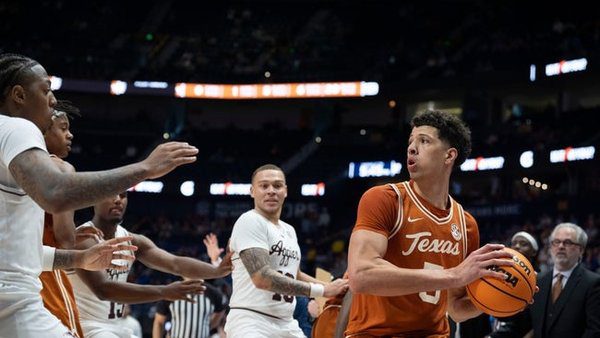
Don’t let the 9-0 record fool you; Vanderbilt is a defensive liability that has survived by out-running opponents in track meets. Texas is fresh off a statement win in Tuscaloosa and has the interior size and transition speed to finally hand the Commodores their first loss of the season.
The Setup: Vanderbilt at Texas
Vanderbilt is currently laying 6 points on the road in Austin on Wednesday, a number that feels remarkably thin for an unbeaten top-10 team—until you look at their non-existent defensive presence. This line is telling you exactly what the market thinks about these two squads, and after digging through the collegebasketballdata.com efficiency numbers, I’m here to tell you the oddsmakers nailed it. This isn’t some mismatch where Vandy should be laying double digits. This is a legitimate top-tier SEC showdown between two teams that can absolutely score the basketball, but one of them has a glaring defensive problem that’s going to rear its ugly head in Austin.
Vanderbilt comes in 9-0 with the nation’s #1 adjusted offensive efficiency rating at 127.7 according to collegebasketballdata.com. They’re an offensive juggernaut averaging 96.8 points per game (#4 nationally). But here’s what nobody’s talking about enough: their defensive rating of 128.3 ranks #359 in the country. That’s not a typo. Three hundred and fifty-nine. Texas, meanwhile, sits at 7-3 with a much more balanced profile – 117.4 adjusted offensive efficiency (#37) and 107.4 adjusted defensive efficiency (#164). The Longhorns can score, and more importantly, they can actually get stops.
Why This Number Makes Sense (or Doesn’t)
Let me walk you through why this spread sits where it does. Vanderbilt’s adjusted net efficiency of 25.7 (#7) looks spectacular on paper, and it should – they’re undefeated. But when you peel back the layers, you see a team that wins by outscoring opponents in track meets, not by playing complete basketball. Their offensive rating of 170.5 (#2) is elite, but that defensive rating is a massive red flag.
Texas’s adjusted net efficiency of 10.0 (#72) doesn’t scream dominance, but their offensive rating of 125.3 (#41) tells me they can hang with Vandy in a shootout. Here’s why this line makes sense: Vanderbilt’s pace ranks #362 nationally at just 56.8 possessions per game. They’re playing slow-burn basketball, which means fewer total possessions for their offensive advantage to compound. Texas, on the other hand, plays at a 71.0 pace (#106) – significantly faster.
Do the math over 70-75 possessions in Austin, and you’re looking at a game where Texas’s home court and faster tempo can absolutely keep this within a possession or two. Vanderbilt’s elite offense will get theirs, but that porous defense is going to give up points in bunches to a Texas squad that shoots 50.7% from the field (#28) and 57.3% effective field goal percentage (#37).
Vanderbilt’s Situation
The Commodores are rolling, no question. Duke Miles leads the charge at 17.8 points per game (#99 nationally), and Tyler Tanner adds 16.2 (#190). But what makes this offense truly special is the distribution – they rank #9 nationally in assists at 20.0 per game, and they protect the basketball beautifully with just 9.3 turnovers per game (#15). That’s elite ball security paired with elite shot-making at 52.7% from the field (#7).
Their effective field goal percentage of 61.2% (#6) and true shooting percentage of 64.5% (#7) tell you everything about how efficiently they convert possessions into points. They’re not just volume scorers – they’re surgical. Recent wins over Alabama (96-90) and LSU (84-73) show they can navigate tough SEC competition.
But here’s the concern that keeps nagging at me: that #267 ranking in offensive rebounding percentage (28.9%) means they’re not generating many second-chance opportunities. Against a Texas team that rebounds well (42.3 boards per game, #25), Vandy’s going to need to score in the half-court without bailouts on the glass.
Texas’s Situation
The Longhorns have some warts in that 7-3 record – losses to Tennessee (71-85) and a wild 98-101 shootout with Mississippi State. But they just went into Tuscaloosa and beat Alabama 92-88, the same Alabama team that hung 90 on Vanderbilt. That tells me something about Texas’s ability to compete with elite SEC offenses.
Matas Vokietaitis (15.9 PPG, #213) and Dailyn Swain (15.7 PPG, 6.9 RPG) give Texas a solid inside-out punch. Swain’s rebounding at 6.9 boards (#184) is crucial because Texas ranks #25 nationally in total rebounds and #182 in offensive rebounding percentage. They’re going to crash the glass against a Vandy team that doesn’t defend it well.
Here’s the matchup that seals it for me on the pace front: Texas generates 192 fast break points compared to Vanderbilt’s 146. The Longhorns want to run, and Vandy’s glacial pace could actually work against them in a hostile road environment where Texas can push tempo off makes and misses.
The Matchup: Where This Gets Decided
This game lives and dies on whether Texas can exploit Vanderbilt’s defensive vulnerabilities while maintaining their own offensive efficiency. Let’s talk three-point shooting: Vanderbilt shoots 38.8% from deep (#27) while Texas allows 36.5% from three (#318). That’s a concerning defensive number for the Longhorns, but Vandy’s slow pace limits the total number of three-point attempts.
Flip it around: Texas shoots 35.2% from three (#125) against a Vanderbilt defense that allows 31.1% (#113). Advantage Vandy on paper, but I keep coming back to those defensive rating numbers because they’re just too extreme to ignore. Vanderbilt ranks #359 in defensive rating – that’s bottom-tier basketball, and Texas has the offensive firepower to exploit it.
The rebounding battle favors Texas significantly. They grab 42.3 boards per game (#25) with a 31.0% offensive rebounding rate (#182). Vanderbilt sits at 38.9 rebounds (#100) with a weak 28.9% offensive rebounding rate (#267). That’s a 15-point swing right there when you factor in second-chance points over 70-75 possessions.
Home court at Moody Center is worth 3-4 points minimum in a conference game of this magnitude. Texas’s faster pace means more possessions for both teams, which actually neutralizes some of Vanderbilt’s efficiency advantage. The historical context shows these teams split last season with the home team winning both meetings.
My Play
Texas +6 for 2 units
I’ve considered Vanderbilt’s perfect record and elite offense, and the defensive numbers are still too massive to ignore. A team ranked #359 in defensive rating laying nearly a touchdown on the road in a conference game against a capable offensive opponent? That’s value on the home dog. Texas can score with anyone – their 117.4 adjusted offensive efficiency (#37) is plenty good enough to keep pace in a shootout, and Vanderbilt’s defense will absolutely let them.
The pace differential works in Texas’s favor. More possessions means more opportunities for the Longhorns to chip away, and their rebounding advantage gives them extra cracks at the basket. I’m projecting something like 91-88 Texas or 93-90 Vanderbilt – a game that stays within one possession throughout the second half.
The main risk here is if Vanderbilt’s offense goes supernova and shoots 55%+ from the field while protecting the ball perfectly. But even in their recent wins over good teams, they’ve allowed 90 to Alabama and 73 to LSU. Texas will score enough to keep this inside the number. Give me the Longhorns catching six at home.