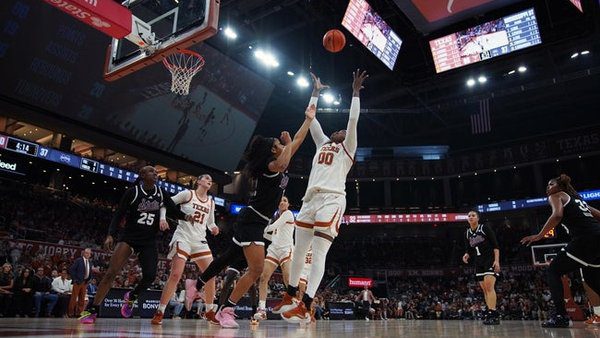
Looking at the efficiency math, the market has completely lost the plot on this 157.5 total. The Over has landed as Bryan Bash’s best bet because while Florida plays elite defense, Texas’s inability to guard the paint (79.1 PPG allowed in SEC play) ensures this game moves at a pace the books aren’t ready for.
The Setup: Florida at Texas
Florida’s laying 6.5 points on the road at Texas, and if you’re scratching your head wondering why a top-10 team isn’t getting more respect in Austin, you haven’t been paying attention to what the Longhorns do at Moody Center. But here’s the thing—when you dig into the collegebasketballdata.com efficiency numbers, this spread feels light for all the wrong reasons. The #7 Gators aren’t just winning; they’re dominating with a +30.8 adjusted net rating that ranks #6 nationally. Texas sits at +18.3 (40th), and that 12.5-point efficiency gap tells you everything about why Florida should theoretically boat race this 17-10 home team. The model projects Florida by 9.9, meaning there’s roughly three points of value on the Longhorns if you believe in home court magic. I don’t, and I’ll explain why the Gators’ defensive excellence makes this number more dangerous than it looks.
Game Info & Betting Lines
Game Time: Wednesday, February 25, 2026, 7:00 PM ET
Location: Moody Center, Austin, TX
Matchup: SEC Conference Game
Current Spread: Florida -6.5
Total: 157.5
Moneyline: Florida -300 | Texas +250
Records:
Florida: 21-6 overall, 12-2 SEC, 7-4 on the road
Texas: 17-10 overall, 8-6 SEC, 14-4 at home
Why This Number Makes Sense (or Doesn’t)
The market landed on 6.5 because Texas is 14-4 at home and books respect Moody Center as a legitimate fortress. Fair enough. But let’s talk about what actually matters here—adjusted efficiency and how these teams generate points. Florida ranks #20 in adjusted offensive efficiency (122.8) and #6 in adjusted defensive efficiency (91.9). Texas checks in at #7 offensively (125.4) but falls to #138 defensively (107.2). That’s a 15.3-point defensive gap between elite and mediocre, and it’s the single biggest factor in this game.
The pace blend projects around 70 possessions, which favors Florida’s 72.2 tempo (#13 nationally) over Texas’s 67.4 (#173). More possessions mean more opportunities for the Gators’ #6-ranked defense to create havoc. The model projects a total of 173.2—nearly 16 points higher than the 157.5 market number. That’s not a typo. When you combine Florida’s offensive rating (119.5) against Texas’s porous defense and Texas’s elite offense (124.3) against a Gators defense that’s still top-25 nationally, you get a game that should cruise past this total. The spread feels about right if you believe home court is worth 5-6 points. I don’t think it’s worth that much against this Florida defense.
Florida Breakdown: The Analytical Edge
The Gators are rolling, winners of nine straight with a five-game road winning streak where they’re 5-0 ATS. Thomas Haugh (18.6 PPG, 7.5 RPG) and Alex Condon (15.4 PPG, 8.6 RPG) form one of the SEC’s most versatile frontcourt tandems, and when you add Rueben Chinyelu’s 11.5 rebounds per game (#5 nationally), you understand why Florida ranks #1 in the country in rebounding at 45.6 boards per game. That’s not a misprint—they’re the best rebounding team in college basketball.
But the real story is defense. Florida holds opponents to 40.4% from the field (#27) and 31.9% from three (#80), and their 91.9 adjusted defensive efficiency is elite-tier. They force you to beat them in the halfcourt, and Texas—despite ranking #7 in adjusted offense—doesn’t have the perimeter shooting consistency to exploit that. The Longhorns shoot 35.6% from three (84th nationally), which is respectable but not explosive. Florida’s defensive rebounding (29.6 per game) will limit second chances, and their 4.9 blocks per game (#22) will protect the rim against Texas’s interior attack.
Texas Breakdown: The Counterpoint
Texas isn’t some pushover at home—they’re 14-4 at Moody Center and 5-1 straight up in their last six home games. The offense is legitimately excellent, ranking #7 in adjusted efficiency with a 61.2% true shooting percentage (#16 nationally) and 56.3% effective field goal percentage (#27). Matas Vokietaitis (15.9 PPG) and Dailyn Swain (15.7 PPG, 6.9 RPG) provide scoring punch, and when Jordan Pope (12.5 PPG) gets going, this backcourt can put up points in bunches.
The problem? That 107.2 adjusted defensive efficiency (#138) is a glaring weakness against elite competition. Texas allows 75.4 points per game (#229) and gives up 44.1% shooting from the field (#178). In conference play, those numbers get worse—79.1 points allowed per game with a measly +3.36 scoring differential. The Longhorns went 4-1 over their last five home games, but the totals went over in eight of their last 12 at Moody Center because they can’t consistently get stops. Lassina Traore is questionable with a knee injury, which could further thin an already suspect defensive rotation.
The Matchup: Where This Gets Decided
This game comes down to whether Texas can exploit Florida’s one weakness—three-point shooting defense. The Gators rank just 30.0% from beyond the arc (#345 nationally), which is legitimately awful. If Texas can get hot from three and push the pace to create transition opportunities, they’ve got a puncher’s chance. But Florida’s rebounding dominance (45.6 RPG vs. 38.3 for Texas) means the Longhorns won’t get many second-chance points, and their offensive rebounding percentage (32.0%, #127) pales compared to Florida’s 35.1% (#20).
The head-to-head history is telling: Florida demolished Texas 84-60 last season, shooting 49.25% from the field while holding the Longhorns to 36.36%. Texas managed just four threes on 16 attempts and got outrebounded 41-33. That’s the blueprint for what happens when Florida’s size and defensive discipline meet Texas’s perimeter-oriented attack. The Gators’ assist-to-turnover ratio (1.38) is also superior to Texas’s 1.15, suggesting better ball security and offensive execution in crunch time.
Florida’s road dominance this season (7-1 ATS away, 5-0 ATS in last five road games) tells you they don’t wilt in hostile environments. Texas is 8-7 ATS at home, which is barely above .500, and their last home loss came against Georgia when they allowed 91 points. If the Longhorns couldn’t slow down Georgia’s offense, what makes you think they’ll contain a Florida attack that scores 86.4 per game and ranks #20 in adjusted offensive efficiency?
Bash’s Best Bet
Florida -6.5 and Over 157.5
I’m laying the points with the Gators and smashing the over. Florida’s defensive excellence and rebounding dominance will control this game’s pace and possessions, and Texas simply doesn’t have the defensive personnel to slow down Haugh, Condon, and Chinyelu in the paint. The model projects Florida by 9.9, which gives us nearly three points of cushion on the 6.5 spread. That’s value on the road favorite, and I’ll take it every time with a team that’s 5-0 ATS in its last five road games.
As for the total, the 157.5 number is disrespectfully low. The model projects 173.2, and both teams have the offensive firepower to contribute. Texas averages 85.1 points per game and just hung 88 on LSU at home. Florida’s averaging 87.6 in conference play. Even if the Gators’ defense slows things down, Texas’s inability to get stops (79.1 PPG allowed in SEC play) means this game should comfortably clear 160. Give me Florida -6.5 and Over 157.5, and let’s watch the Gators continue their march toward a top-four SEC Tournament seed.