Bash sees a pace and efficiency disconnect that has this total inflated by two possessions worth of scoring. The market’s pricing in Chicago’s recent offensive output without accounting for Houston’s deliberate tempo.
The Setup: Houston Rockets at Chicago Bulls
The board has this total sitting at 230, and the projection says we’re looking at closer to 228 possessions worth of offense. Houston comes into the United Center as 8-point road favorites, and while that spread feels about right given the -8.7 net rating gap, the total is where I’m finding the angle Monday night.
The Rockets play at the league’s slowest pace—96.7 possessions per game. Chicago runs at 102.5. When you blend those tempos, you’re looking at roughly 99.6 possessions in this one, which is a deliberate game by any measure. The Bulls have been scoring 115.8 per game this season, but that number comes attached to their faster pace. Houston’s defensive rating of 112.3 isn’t elite, but it’s competent enough to keep this game structured.
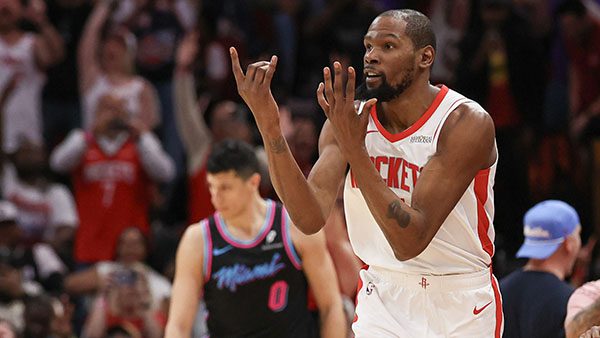
Kevin Durant just passed Michael Jordan on the all-time scoring list Saturday night with that buzzer-beater win over Miami, and Amen Thompson’s tip-in showed you what this Rockets team does—they grind possessions and execute in the half court. That’s not a recipe for 230 points when you’re facing a Bulls team that’s 28-42 and missing real frontcourt depth.
Game Info & Betting Lines
Houston Rockets at Chicago Bulls
When: Monday, March 23, 2026, 8:00 PM ET
Where: United Center
Watch: CHSN (Home), Space City Home Network, NBA League Pass
Records: Houston Rockets 43-27 (18-17 road) | Chicago Bulls 28-42 (17-20 home)
Current Betting Lines (Bovada):
Spread: Chicago Bulls +8.0 (-105) | Houston Rockets -8.0 (-115)
Total: Over 230.0 (-110) | Under 230.0 (-110)
Moneyline: Chicago Bulls +280 | Houston Rockets -360
Why This Line Exists
The 8-point spread is straightforward. Houston’s net rating sits at +4.2 per 100 possessions. Chicago’s at -4.5. That’s your -8.7 gap right there, and when you factor in a modest home court bump, you land right around this number. The Rockets are the better team by every efficiency measure, and the market knows it.
The total at 230 is pricing in Chicago’s recent offensive performances and Houston’s ability to score with Durant and Alperen Sengun. But here’s what the number isn’t accounting for: the Rockets control tempo like few teams in the league. At 96.7 possessions per game, they’re deliberately slowing everything down. Chicago’s 102.5 pace is faster, but not fast enough to overcome Houston’s structural approach to the game.
The offensive rebounding split is worth noting here too. Houston grabs 34.9% of available offensive boards. Chicago’s at 23.2%. That’s an 11.8-percentage-point gap, which means the Rockets will extend possessions when they want to, but they’re doing it in a half-court setting where the shot clock gets worked. More offensive rebounds doesn’t always mean more points when you’re grinding the clock down to single digits every trip.
Chicago’s injury situation adds another layer. Jaden Ivey is questionable, Anfernee Simons is questionable, and Guerschon Yabusele is doubtful with an ankle issue. That’s rotation uncertainty on a team that’s already struggling to defend at 116.8 points allowed per 100 possessions. But uncertainty also means disrupted offensive flow, which tends to favor the under in a pace-down environment.
Houston Rockets Breakdown
The Rockets are 43-27 and sitting fourth in the West, but their 18-17 road record tells you they’re not dominant away from home. What they are is methodical. Durant’s averaging 25.7 points on 51.7% shooting and 40.8% from three. Sengun gives you 20.2 and 8.9 boards with real playmaking at 6.1 assists per game. Amen Thompson adds 18.0 points and 7.9 rebounds, and that trio forms a balanced attack that doesn’t rely on transition buckets.
Houston’s offensive rating of 116.5 is strong, but it’s built on half-court execution, not pace. Their 96.7 possessions per game is a feature, not a bug. They want to control the game, limit transition opportunities, and execute in the set offense. That’s why their effective field goal percentage sits at 53.9% and their true shooting is 57.2%—they’re getting quality looks without needing volume.
Defensively, the 112.3 rating is solid. They’re not locking teams down, but they’re competent enough to keep games structured. Steven Adams is out for the season, which shifts backup center duties to Clint Capela and Dorian Finney-Smith behind Sengun, but that’s not materially changing their defensive identity. They protect the paint, they limit second chances for opponents, and they make you earn everything in the half court.
Chicago Bulls Breakdown
The Bulls are 28-42 and playing out the string at this point. Josh Giddey runs the show with 17.6 points and 9.0 assists per game, and Matas Buzelis gives you 16.1 points and some defensive versatility at 1.5 blocks per contest. Collin Sexton and Anfernee Simons both average in the 14s, but Simons is questionable with a fractured left wrist, and that’s a real blow to their perimeter scoring.
Chicago’s offensive rating of 112.3 is league-average at best, and it’s propped up by their 102.5 pace. When you slow them down—and Houston will—they don’t have the half-court firepower to consistently generate quality looks. Their 54.9% effective field goal percentage is fine, but it’s not elite, and against a Rockets defense that will make them execute possession after possession, you’re looking at a team that could struggle to crack 110.
The defensive rating of 116.8 is bottom-tier, and Cleveland just hung 115 on them Thursday night despite missing Donovan Mitchell. James Harden dropped 36, Evan Mobley added 26 and 14 boards, and the Bulls let a 29-point lead shrink to one in the fourth quarter before losing. That’s not a team with defensive structure or discipline, and Houston will exploit that with Durant and Sengun operating in pick-and-roll situations all night.
Zach Collins is out for the season, Noa Essengue is done for the year, and Isaac Okoro is doubtful. Jalen Smith is questionable with a calf issue. That’s a lot of frontcourt uncertainty, and against a Rockets team that dominates the offensive glass, it’s going to be a long night in the paint for Chicago.
The Matchup
This is a pace mismatch that favors Houston’s style. The Rockets want 96 possessions. The Bulls want 102. When you blend those numbers, you’re looking at right around 99 or 100 possessions, and that’s a deliberate game where both teams are operating in the half court more often than not. Chicago doesn’t have the transition game to push tempo against a Rockets team that’s disciplined in getting back on defense, and Houston has no incentive to speed things up when they’re comfortable grinding in the set offense.
The offensive rebounding gap is massive—11.8 percentage points in Houston’s favor—but that actually works against the total here. More offensive rebounds means longer possessions, and longer possessions means fewer total possessions. The Rockets will crash the glass, grab second-chance opportunities, and then work the shot clock down to single digits before taking their shot. That’s not a recipe for 230 points.
The shooting quality is basically even. Chicago’s effective field goal percentage is 1.1 points higher than Houston’s, which is within noise. True shooting favors the Bulls by 1.0 percentage point, also within noise. Turnover rates are similar—Chicago’s slightly better at 13.2% compared to Houston’s 13.6%, but we’re talking about a 0.4-point gap that’s not moving the needle. The offensive and defensive matchups are basically priced correctly by the market, with Chicago’s offense against Houston’s defense landing right around even and Houston’s offense against Chicago’s defense showing a 0.3-point gap that’s within noise.
My model projects Houston to score 116.2 and Chicago to land around 111.9, which gives you a total of 228.1. That’s two points under the market number of 230, and in a game where pace is going to be controlled by the slower team, that gap matters. You’re looking at roughly two fewer possessions than the total is pricing in, and over the course of 48 minutes, that’s the difference between covering and missing.
Bash’s Best Bet & The Play
The Play: Under 230 (-110)
I’m taking the under at 230. The projection sits at 228.1, and that’s built on a pace blend of 99.6 possessions—a deliberate game where Houston controls the tempo and Chicago doesn’t have the firepower or depth to consistently generate easy offense. The Rockets are going to grind this one in the half court, dominate the offensive glass, and extend possessions without necessarily adding points. Chicago’s injury situation creates offensive uncertainty, and against a competent Houston defense, I don’t see them cracking 112.
The market’s pricing in Chicago’s season-long scoring average without adjusting for the pace disconnect. The Bulls score 115.8 per game, but that’s at 102.5 possessions. Houston’s going to slow this down to the high 90s, and when you do that, the math changes. You’re looking at two fewer possessions worth of scoring opportunities, and in a game where both teams are executing in the half court, that’s enough to stay under the number.
The risk here is if Chicago’s questionable players—Ivey, Simons, Smith—all suit up and provide an offensive spark that pushes them over 115. But even if that happens, you’d need Houston to get to 115-plus to beat this total, and I don’t see the Rockets pushing tempo in a game they should control from start to finish. This is a grind-it-out road win for Houston, something in the 114-108 range, and that keeps us comfortably under 230.
Lock in the under and let Houston’s pace do the work.