Bash sees No. 1 seed Arizona laying double digits against a No. 9 seed Utah State squad that’s battle-tested but facing an efficiency chasm in the NCAA Tournament’s second round.
The Line That Tells the Story
Arizona’s sitting at -11.5 against Utah State in Sunday’s NCAA Tournament second-round clash at Viejas Arena, and the spread reflects exactly what the advanced metrics suggest: a substantial talent gap between the tournament’s top overall seed and a scrappy Mountain West program. According to collegebasketballdata.com, the Wildcats rank #9 nationally in adjusted offensive efficiency (126.4) and #2 in adjusted defensive efficiency (88.9), creating a net rating advantage of +13.8 points over the Aggies. That’s not hype—that’s mathematical dominance.
This is a classic NCAA Tournament efficiency mismatch where the committee’s seeding perfectly captures the metric reality. No. 1 seed Arizona (33-2, AP #2) earned that top line through a brutal Big 12 gauntlet, while No. 9 seed Utah State (29-6, AP #23) dominated the Mountain West but faces a significant step up in class on a neutral floor.
Breaking Down the Spread
The market landed on 11.5 because Arizona’s defensive excellence creates separation that Utah State hasn’t seen all season. The Wildcats allow just 39.0% from the field (#6 nationally) and 31.4% from three (#47), while the Aggies’ offense—efficient as it is at 124.3 adjusted rating (#17)—hasn’t faced this caliber of perimeter defense outside of their Villanova win in the first round.
Utah State’s #10 RPI and 5-3 Quadrant 1 record demonstrate legitimate quality, but context matters: Arizona’s #2 RPI includes a 16-2 Q1 record against a #7 strength of schedule. The Wildcats didn’t just beat elite competition—they dominated it, going 10-0 in their last ten games while covering 6-4 ATS.
The total of 155.5 accounts for a projected 69.1 possessions based on the pace blend. Arizona runs at 70.7 tempo (#30) while Utah State sits at 67.5 (#153), creating a moderate-paced tournament game where defensive execution determines outcomes.
Tournament Context and Motivation
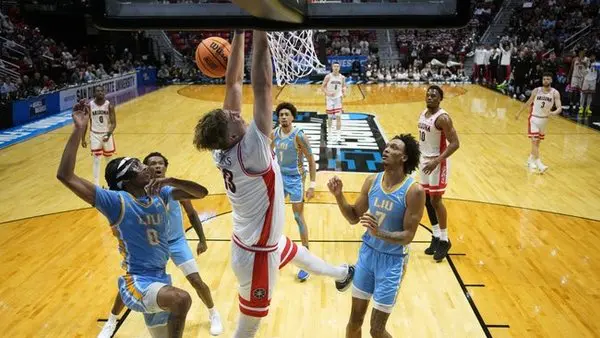
This is where NCAA Tournament dynamics override regular-season patterns. Arizona’s 21-14 ATS record looks pedestrian, but tournament basketball rewards efficiency over covering inflated regular-season numbers. The Wildcats crushed Long Island 92-58 in the opener, then immediately refocused—that’s championship-caliber program discipline.
Utah State’s 16-18 ATS mark reveals a team that consistently wins but struggles to cover as favorites. In March, that doesn’t matter—survival is the only metric. The Aggies’ 86-76 first-round win over Villanova showed their ceiling, shooting 54.9% from the field, but replicating that efficiency against Arizona’s #2-ranked adjusted defense is a different proposition entirely.
I’m not dismissing Utah State’s legitimacy. Their 17.7 assists per game (#16) and 1.66 assist-to-turnover ratio demonstrate offensive cohesion. But tournament advancement requires executing against elite defenses, and Arizona’s 42.8 rebounds per game (#2 nationally) will limit second-chance opportunities that keep underdogs competitive.
The Matchup That Matters
Arizona’s rebounding dominance creates the clearest separation point. The Wildcats grab 42.8 boards per game compared to Utah State’s 34.7 (#221), and that 8.1-rebound differential translates directly to possession advantage. In a 69-possession game, extra opportunities become the margin between covering and falling short.
The personnel matchup favors Arizona across the board. Koa Peat (15.9 PPG, 5.5 RPG) and Motiejus Krivas (9.8 PPG, 7.9 RPG) give the Wildcats interior size that Utah State’s frontcourt—led by Garry Clark (9.7 PPG, 7.8 RPG)—can’t match physically. MJ Collins Jr. leads the Aggies at 20.7 PPG, but he’ll face constant ball pressure from Jaden Bradley (14.5 PPG, 3.8 APG) and a defense that forces 16.7% turnovers.
Utah State’s 5-3 Q1 record proves they can compete with quality opponents, but Arizona’s 16-2 Q1 mark demonstrates a different level of consistency against elite competition. The Wildcats didn’t just survive tough games—they dominated them, evidenced by their +37.5 net rating (#3 nationally).
Comparative Analytics
| Metric | Utah State | Arizona |
|---|---|---|
| KenPom Rank | #29 | #1 |
| RPI Rank | #10 | #2 |
| Strength of Schedule | #39 | #7 |
| Q1 Record | 5-3 | 16-2 |
| Adj. Offensive Efficiency | 122.7 (#27) | 127.8 (#5) |
| Adj. Defensive Efficiency | 101.3 (#43) | 90.0 (#3) |
| Tempo | 67.8 (#157) | 69.9 (#55) |
The pace differential isn’t dramatic enough to create possessions chaos, but Arizona’s ability to control tempo while maintaining offensive efficiency is the separator. The Wildcats shoot 55.4% on twos and 36.3% from three, creating balanced scoring that prevents Utah State from loading up defensively in any single area.
Utah State’s 34.4% opponent three-point percentage (#228) is a legitimate concern against Arizona’s perimeter shooting. The Wildcats don’t rely on the three—they shoot just 5.88 threes per game compared to Utah State’s 8.62—but when they do shoot it, they convert efficiently enough to punish sagging defenses.
The Bottom Line
BASH’S BEST BET: Arizona -11.5 for 2 units.
The efficiency gap is real, the rebounding advantage is decisive, and Arizona’s tournament pedigree under Tommy Lloyd has been consistently excellent. Utah State’s 86-76 win over Villanova showed they can score against quality opponents, but Arizona’s #2 adjusted defense represents a different challenge entirely. The Wildcats’ 16-2 Q1 record against a #7 strength of schedule proves they don’t just show up in big games—they dominate them.
The primary risk is Utah State’s three-point variance. If Collins Jr. and Mason Falslev (15.2 PPG) get hot from deep and the Aggies replicate their 54.9% shooting performance from the first round, this stays competitive. But betting on shooting variance against the nation’s best defense in a second-round NCAA Tournament game is hoping for lightning to strike twice.
Arizona’s path to covering is straightforward: control the glass, limit transition opportunities, and execute in the halfcourt. The Wildcats do all three at an elite level, and the 11.5-point spread reflects legitimate talent separation, not public perception inflation. I’m laying the points with the top seed.