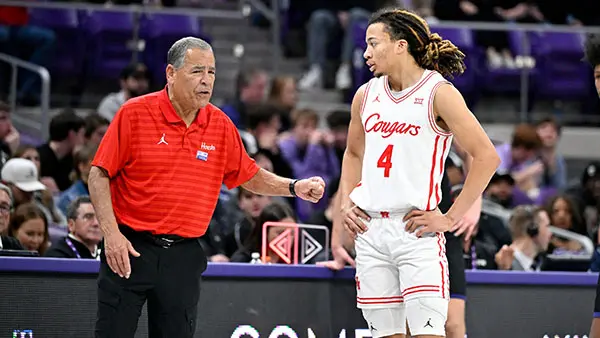
After digging into the transition data, the play here is to fade the offensive hype and focus on the nation’s best defenses. Bryan Bash explains why Koa Peat’s absence reshapes the entire analytical profile of this matchup.
The Setup: Arizona at Houston
Houston’s laying 5 at home against Arizona on Saturday afternoon, and if you’re surprised the number isn’t higher, you haven’t been paying attention to what the efficiency metrics are screaming at you. This is #4 Arizona traveling to face #2 Houston at Fertitta Center, and the market is treating this like the elite defensive slugfest it’s going to be. When you dig into the collegebasketballdata.com numbers, both teams rank in the top five nationally in adjusted defensive efficiency—Arizona at #3 (90.2) and Houston at #5 (91.5). That’s not a coincidence. That’s why this total is sitting at 141, and that’s why this spread isn’t in double digits despite Houston’s fortress of a home court.
The Wildcats are 24-2 and rolling with the #15 adjusted offensive efficiency in the country at 123.6. The Cougars are 23-3 with a #25 offensive rating of 122.3. This is a Big 12 battle between two teams that can score when they need to, but both are built on the defensive end first. Arizona snapped a two-game skid with a 75-68 win over BYU on Wednesday before making this trip, while Houston just dropped a road game at Iowa State on Monday. Both teams need this one badly, and the efficiency gap is razor-thin at just 2.7 points in net rating favoring Arizona.
Game Info & Betting Lines
Game Time: Saturday, February 21, 2026 at 3:00 PM ET
Location: Fertitta Center, Houston, TX
Rankings: #4 Arizona (24-2) at #2 Houston (23-3)
Spread: Houston -5 (DraftKings -5.5)
Total: 141 (DraftKings 141.5)
Moneyline: Houston -220, Arizona +180
The Injury That Changes Everything
Before you read another word of analysis, you need to know this: Koa Peat is out for this game. Arizona’s freshman forward — their most dynamic interior threat and second-leading scorer at 13.8 points and 5.4 rebounds per game — is sitting with a lower-leg muscle strain suffered in the Texas Tech loss. He missed the BYU game Wednesday and won’t play Saturday either. This isn’t a footnote. It reshapes every analytical layer of this matchup, from rebounding projections to Arizona’s offensive ceiling to the pace dynamics. Factor it into everything that follows.
With Peat shelved, senior Tobe Awaka slides into the starting lineup. Awaka is a legitimate rebounder — 9.7 boards per game on 60.5% shooting — but he doesn’t replicate Peat’s scoring punch or transition impact. Arizona’s also dealing with freshman wing Dwayne Aristode (illness), though his availability for Saturday is unconfirmed. The Wildcats are navigating their toughest four-game stretch of the season shorthanded, and it shows in the line movement — this number opened around -3.5 and has crept toward -5 to -5.5 across most books.
Why This Number Makes Sense (or Doesn’t)
Let’s talk about why Houston is getting 5 points at home against a team they’re ranked ahead of. The answer is simple even without Peat: Arizona’s defense is legitimately elite. That #3 ranking in adjusted defensive efficiency isn’t a fluke — they’re holding opponents to just 39.1% from the field (#8 nationally) and a 94.1 defensive rating (#5). When you’re facing an offense like Houston’s that ranks just #25 in adjusted efficiency and struggles with shooting quality (52.4% eFG%, #160 nationally), you don’t need to lay double digits.
The pace projection of 67.9 possessions tells you everything about how this game will be played. Houston operates at 64.1 pace (#309 nationally), which is glacial. Arizona runs at 71.7 (#16), but they’re not going to dictate tempo in this building — and without Peat’s transition presence, that pace gap matters even more. The Cougars are 16-1 at home and 8-5 ATS at Fertitta Center this season. They protect the ball better than anyone in the country with just 8.2 turnovers per game (#1) and a turnover ratio of 0.1 (#1). That’s a 10-point edge in turnover percentage over Arizona, and in a game projected for 68 possessions, that matters.
The market landed at 5 because the efficiency numbers say this should be tight even with Arizona shorthanded. The model projection of Houston by 0.9 was built on a full Arizona roster — remove Peat and that number shifts. Arizona’s net rating of +33.4 (#4) versus Houston’s +30.7 (#8) creates a 2.7-point gap that essentially evaporates with home court and an injury-depleted Wildcat rotation.
Arizona Breakdown: Working Without Their Centerpiece
The Wildcats are built on two things: elite defense and rebounding dominance. They’re averaging 43.7 rebounds per game (#2 nationally) and posting a true shooting percentage of 59.6% (#39). With Peat out, Jaden Bradley (13.3 PPG) and the backcourt carry the scoring load, while Awaka anchors the paint with 9.7 rebounds per game and Motiejus Krivas provides rim presence at 8.7 boards per game. Anthony Dell’Orso is worth watching — he erupted for 22 off the bench against BYU on Wednesday and has the green light with the rotation thinned.
Where Arizona can still win this game is if they exploit Houston’s defensive rebounding. The Cougars are allowing 23.81 defensive rebounds per game, and Arizona pulls down 30.42 per game even with personnel adjustments. Arizona also shoots 50.5% from the field (#11) compared to Houston’s 45.2% (#178). The shooting quality gap is real — Arizona’s 55.3% eFG% ranks #48 nationally versus Houston’s #160 ranking. The question is whether a Peat-less lineup can sustain that efficiency against the best defense they’ve seen all year.
The concern? Arizona is 4-6 ATS in their last 10 games overall and just 1-3 ATS in road games over that same stretch. They’re 7-6 ATS in conference play, which tells you they’ve had trouble covering numbers consistently against Big 12 competition. Their last 5 games have all gone UNDER (0-5 O/U), and the offense dropped to 82.3 PPG over their last 10 — a meaningful dip from their 87.7 season average that doesn’t get talked about enough.
Houston Breakdown: The Counterpoint
Houston’s calling card is suffocating defense and ball security. That 8.2 turnovers per game is absurd — they simply don’t beat themselves. Kingston Flemings (16.6 PPG, 5.3 APG) and Emanuel Sharp (16.5 PPG) provide the offensive firepower, while Milos Uzan (11.2 PPG, 4.1 APG) runs the show. Chris Cenac Jr. controls the glass at 7.6 rebounds per game, and the Cougars rank #16 nationally in offensive rebounding percentage at 35.5%.
The Cougars’ defensive rating of 94.8 is elite, and they’re holding opponents to 61.6 points per game (#2 nationally). They’ve gone UNDER in 6 of their last 7 home games — a sharp and real trend — though it’s worth noting that Houston’s season-long home O/U record is 3-10 OVER, meaning this UNDER run represents a genuine recent shift after an OVER-heavy early schedule. The recent trend is legitimate and carries more predictive weight as conference competition has tightened, but the full-season context is part of the honest picture.
Houston’s 8-5 ATS at home and 4-1 ATS in their last 5 home games shows they’re covering when it matters most. They’re also 4-2 ATS in conference home games. The Cougars protect home court, and right now they’re getting an Arizona team that’s shorthanded and coming off a high-effort comeback win on Wednesday.
The Matchup: Where This Gets Decided
This game comes down to three things: rebounding, pace, and shooting efficiency. Arizona wants to crash the glass and push tempo to 70+ possessions. Houston wants to grind this into the mud at 65 possessions and force Arizona into contested jumpers. The Wildcats’ 1.56 assist-to-turnover ratio versus Houston’s 1.86 tells you who’s better at protecting the ball, and in a game this tight, that matters.
The series history in the modern era (since 2005) shows Houston up 4-3 straight up, with a 4-3 ATS edge as well. Houston leads the all-time series 8-6. The total has gone UNDER in 5 of 7 modern-era meetings, which aligns perfectly with what both teams do. Arizona’s averaging 87.7 points per game (#13) — but only 73.6 PPG in the seven modern-era series games. Houston’s averaging 77.8 PPG (#141) but only 71.1 in this matchup. These teams bring out the worst in each other offensively, and that was before Arizona lost its most offensively efficient rotation player.
The key player matchup is Awaka versus Cenac Jr. in the paint — not Krivas versus Cenac as originally projected. Peat’s absence removes the most dangerous mismatch Arizona could have created in the post. Arizona is also going to need Bradley and Dell’Orso to knock down perimeter shots against Houston’s defense, which allows just 31.5% from three (#63).
Bash’s Best Bet
I’m taking UNDER 141 and laying the points with a small lean on Houston -5. The total is the play I love here. Both teams rank top-7 in defensive rating, the pace projection is 67.9 possessions, and the historical trend screams UNDER. These teams have gone UNDER in 5 of 7 modern-era meetings. The recent Houston home UNDER trend — 6 of their last 7 at Fertitta — is a genuine shift, not noise, reflecting tighter conference competition holding games down. Arizona’s own last 5 games have all gone UNDER. And now remove Peat, Arizona’s most dynamic interior scorer, from the equation. The offense that was averaging 85.2 in conference play just got thinner.
The model projects 167 points, but that’s not accounting for how these specific teams match up — or who’s missing. Houston’s turnover advantage and home court defense should keep Arizona in the low-to-mid 70s. The Cougars will struggle to crack 70 themselves against that #3 adjusted defense. Give me 136-142 points total and Houston winning by 5-8.
If you’re playing the spread, Houston -5 makes sense because Arizona is 1-3 ATS in their last 4 road games and Houston is 4-1 ATS in their last 5 home games. The Cougars protect home court. And Arizona is now asking a Peat-less lineup to win at the toughest venue in the Big 12. This number feels right, maybe even a touch low given the injury news.