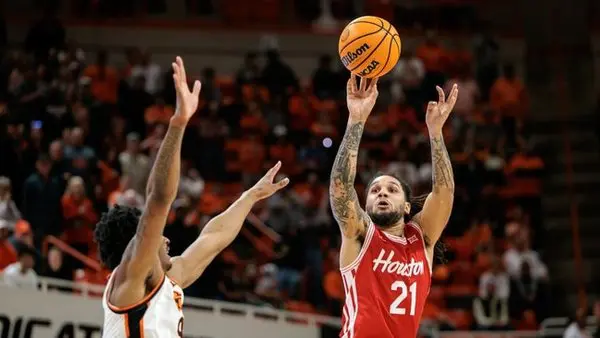
Bash sees a Houston squad that’s 3-7 ATS in its last 10 games getting overvalued at -9, while BYU’s elite offensive efficiency and March experience create a live-dog scenario in Kansas City.
The Line That Doesn’t Match the Metrics
Houston’s laying 9 at a neutral site against BYU in the Big 12 Tournament quarterfinals Thursday night, and I’m already hearing the Kelvin Sampson faithful warming up their takes. Look, I get it—the Cougars are #5 in both polls, they’ve got that suffocating defense ranked #4 nationally in adjusted efficiency, and they’ve beaten BYU in seven of the last eight meetings. But when you dig into the collegebasketballdata.com numbers, this spread doesn’t reflect what’s actually happening on the floor right now.
Houston’s 26-5 overall, but they’re just 3-7 ATS in their last 10 games and 15-16 ATS on the season. BYU checks in at 23-10 with a 6-4 ATS mark over that same recent stretch. The Cougars are getting nine points of respect they haven’t earned at the betting window, and that’s before we even talk about what BYU does on offense.
The Betting Card
Spread: Houston -9
Total: 146
Moneyline: Houston -480 / BYU +350
Game Time: Thursday, March 12, 2026, 7:00 PM ET
Location: T-Mobile Center, Kansas City, MO
Why This Number Landed at 9
The market’s pricing Houston’s elite defense and BYU’s defensive vulnerabilities. The Cougars rank #4 in adjusted defensive efficiency at 90.4, while BYU sits at #43 (101.6). That’s an 11.2-point gap on that side of the ball, and it’s real. Houston allows just 62.7 points per game (#3 nationally) and forces turnovers at an elite rate—21.4% forced turnover percentage (#10) per KenPom.
But here’s what the market’s missing: BYU’s offense is #10 in adjusted efficiency at 125.8, nearly three spots ahead of Houston’s #25 ranking at 123.5. The Cougars score 77.6 PPG, but they do it at a glacial 64.4 pace (#298). BYU pushes at 67.5 (#155), and that tempo split matters. The projected possession count sits around 66, which tilts closer to BYU’s preferred speed than Houston’s grind-it-out style.
Warren Nolan’s RPI data tells another story: BYU’s #24 RPI with a #11 strength of schedule, while Houston’s #8 RPI comes with a softer #134 non-conference SOS. The Cougars haven’t been battle-tested the way the Cougars from Provo have.
The Richie Saunders Factor Nobody’s Pricing
Here’s the elephant in the gym: Richie Saunders, BYU’s second-leading scorer at 19.1 PPG, has been out since mid-February with a knee injury and isn’t coming back. That’s a massive loss—Saunders was their most efficient wing scorer and a critical secondary creator alongside Robert Wright III (17.0 PPG, 6.1 APG).
But BYU’s 6-4 in their last 10 games without him, and they just hung 105 on Kansas State five days ago. AJ Dybantsa (19.4 PPG) has stepped into a larger role, and Wright’s become the primary initiator. The Cougars aren’t the same team, but they’re not collapsing either. I’m not giving Houston nine points of credit for an injury that’s already baked into BYU’s recent results.
This is a bubble-adjacent spot for both teams in terms of seeding, but it’s not a must-win survival game. BYU’s 6-7 in Quadrant 1 games with quality wins already banked. Houston’s 5-5 in Q1, and they’ve dropped two of their last five. Neither team’s playing with desperation—this is about positioning, not panic.
The Matchup That Matters
Houston’s going to make BYU work for every possession. The Cougars’ 1.80 assist-to-turnover ratio is elite, and they protect the ball better than anyone in the country at 12.7% turnover rate (#3). BYU turns it over at a manageable 15.0% (#68), but Houston’s pressure—7.8 steals per game (#70)—will test Wright and Kennard Davis Jr. (10.4 PPG) in the backcourt.
But here’s the counter: BYU’s 54.8% effective field goal percentage (#60) and 58.7% true shooting (#57) mean they don’t need a ton of possessions to score. They’re efficient in the halfcourt, and Keba Keita (7.5 PPG, 7.1 RPG) gives them size to attack Houston’s 23.65 defensive rebounds per game. The Cougars aren’t getting run off the floor—they’re built to hang in a 66-possession slugfest.
Houston’s offense is good, not great. Emanuel Sharp (17.6 PPG) and Kingston Flemings (15.9 PPG, 5.0 APG) are capable, but they’re shooting just 45.1% from the field (#190) and 34.5% from three (#159). Against BYU’s #43 adjusted defense, this isn’t a spot where Houston’s going to blow the doors off. The Cougars have scored 77 or fewer in four of their last five games.
The Numbers Behind the Call
TCU vs Kansas Prediction: Jayhawks Overvalued in Big 12 Tournament Neutral Site Spot
KenPom projects this game at Houston 78, BYU 72 with a 71% win probability for the Cougars. That’s a six-point spread in the model, not nine. The market’s giving you three points of value on a BYU team that’s 1-6 ATS historically against Houston but 6-4 ATS in their last 10 games this season.
The pace dynamic is critical here. At 66 possessions, Houston’s not getting enough trips to leverage their defensive dominance into a double-digit win. BYU’s going to slow this thing down, execute in the halfcourt, and keep it within a possession or two deep into the second half. Wright’s one of the better late-game decision-makers in the Big 12, and BYU shoots 74.3% from the free-throw line (#107)—not elite, but good enough to close if they’re within striking distance.
The Pick
I’m taking BYU plus the points. Houston’s the better team on paper, but nine points is too many in a neutral-site conference tournament game between two top-25 squads playing at a crawl. The Cougars’ recent ATS struggles aren’t a fluke—they’re a reflection of a team that grinds out wins but doesn’t blow people away. BYU’s got the offensive firepower to hang around, and the market’s overreacting to the head-to-head history.
The risk is obvious: Houston’s defense is legitimately elite, and if they force BYU into 18% turnover territory, this could get ugly. But I trust Wright to manage possessions, and I think BYU’s experience in tight Big 12 games—11-9 in conference play—gives them the poise to stay within the number.
BASH’S BEST BET: BYU +9 for 2 units.