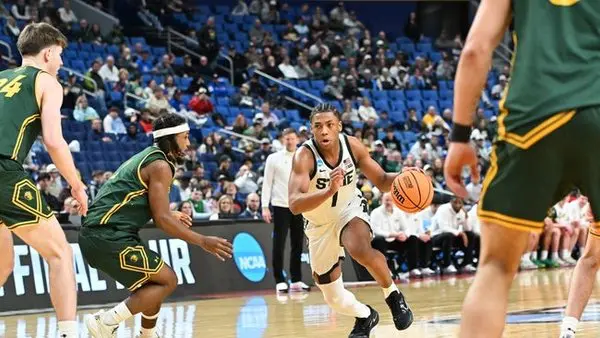
Bash sees a March Madness Sweet 16 matchup where the market is overvaluing Michigan State’s defensive reputation and undervaluing Louisville’s offensive firepower in a neutral-site setting that neutralizes the Spartans’ traditional edge.
The Line and the Thesis
No. 3 seed Michigan State is laying 4.5 points against No. 6 seed Louisville in this NCAA Tournament Sweet 16 clash at KeyBank Center in Buffalo, and I’m not buying the Spartans as a comfortable favorite. This is a neutral-site NCAA Tournament game where home-court advantage evaporates, and when you dig into the collegebasketballdata.com numbers, the gap between these teams is razor-thin. Louisville checks in at #13 in adjusted net rating (+26.0) while Michigan State sits at #10 (+27.2)—a 1.2-point difference that my model projects as a 0.4-point Michigan State edge on a neutral floor. The market is asking you to lay 4.5. That’s a 4.1-point gap between what the numbers say and what you’re being asked to pay, and in March, that’s significant value on the underdog.
This qualifies as a mid-major metric gap situation—except Louisville isn’t a mid-major. They’re a power conference team being treated like one by a market that’s fallen in love with Tom Izzo’s tournament pedigree and Michigan State’s #10 adjusted defensive efficiency ranking. I get the appeal. But the Cardinals bring the #17 adjusted offensive efficiency in the country, and that’s an elite unit going against a very good defense in a setting where neither team gets a crowd boost.
Why the Market Landed Here
The 4.5-point spread reflects two things: Michigan State’s superior defensive metrics and their slight edge in overall resume quality. The Spartans rank #8 in RPI with a strength of schedule at #14, while Louisville sits at #25 in RPI with a #22 SOS. Michigan State’s 5-6 record in Quadrant 1 games shows they’ve been battle-tested against elite competition, even if they didn’t always win those matchups. Louisville’s 4-10 Q1 record is uglier on paper, but those ten losses came against legitimate top-tier opponents, and the Cardinals went 8-0 in Q2 games—they don’t slip up against good-but-not-great teams.
The total of 151.5 is interesting because it suggests the market expects a moderate-paced game with both defenses clamping down in a March environment. My model projects 148.9 points on 68.2 possessions, which means the market is pricing in about three more points than the tempo blend suggests. Louisville plays at the #25 pace nationally (70.9 possessions per game) while Michigan State crawls at #246 (65.4). The Spartans will dictate tempo here, and that 68-possession environment favors the team that can execute in the halfcourt. Both teams shoot 76-plus percent from the free-throw line, so late-game execution shouldn’t be a disaster for either side.
What Louisville Brings
The Cardinals are an offensive machine that ranks #20 nationally in points per game (84.7) and #17 in adjusted offensive efficiency (123.4). Ryan Conwell leads the way at 19.7 points per game, and the backcourt duo of Conwell and Isaac McKneely (12.4 PPG) gives Louisville multiple perimeter threats who can space the floor. The concern here is Mikel Brown Jr., who’s listed as OUT with a back injury. Brown is a key player averaging 16.7 points and 5.3 assists per game, and his absence removes Louisville’s primary facilitator. That’s a legitimate blow to the Cardinals’ offensive flow, and it’s probably baked into this 4.5-point spread.
But Louisville’s shooting metrics hold up even without Brown. They’re #15 in effective field goal percentage (56.7%) and #17 in true shooting percentage (60.6%), which means they generate quality looks and convert them at an elite rate. The Cardinals also rank #24 nationally in assists per game (17.1), so the ball movement doesn’t rely solely on Brown’s creation. Kasean Pryor is listed as QUESTIONABLE with an undisclosed injury, but he’s not a key player in the rotation, so his status doesn’t move the needle.
The Matchup Contrast
Michigan State’s calling card is defense. They rank #10 in adjusted defensive efficiency (94.5) and #13 nationally in KenPom’s overall metrics. Jaxon Kohler (14.2 PPG, 9.6 RPG) anchors the interior, and Jeremy Fears Jr. leads the nation in assists per game (9.7). That assist rate of 67.4% is absurd—it means the Spartans are getting a helper on more than two-thirds of their made baskets. They’re unselfish, disciplined, and they don’t beat themselves. The Spartans rank #9 in offensive rebounding percentage (37.9%), which is a massive edge on the glass. Louisville sits at #244 nationally in offensive rebounding percentage (29.4%), so second-chance points could be a deciding factor if Michigan State controls the boards.
But here’s the thing: Louisville’s defense is no joke either. They rank #20 in adjusted defensive efficiency (97.4) and #49 in defensive rating (102.2). The Cardinals allow just 72.4 points per game, and they’ve held opponents to 42.2% shooting from the field and 32.0% from three. This isn’t a situation where Michigan State’s offense is going to run wild. The Spartans score 79.3 points per game, which ranks #95 nationally—they’re not a high-volume scoring team. In a 68-possession game, both offenses are going to have to grind, and I trust Louisville’s elite shooting efficiency to keep this within a possession or two.
The Numbers Head-to-Head
| Metric | Louisville | Michigan State |
|---|---|---|
| KenPom Rank | #20 | #9 |
| RPI Rank | #25 | #8 |
| Strength of Schedule | #22 | #14 |
| Q1 Record | 4-10 | 5-6 |
| Adj. Offensive Efficiency | 123.4 (#17) | 121.7 (#33) |
| Adj. Defensive Efficiency | 97.4 (#20) | 94.5 (#10) |
| Pace | 70.9 (#25) | 65.4 (#246) |
The style clash here is clear: Louisville wants to push tempo and create transition opportunities, while Michigan State wants to slow it down and execute in the halfcourt. The Spartans will win that battle—they always do. But in a 68-possession game, Louisville’s offensive efficiency advantage (#17 vs. #33) matters. The Cardinals generate better shots, and their 56.7% effective field goal percentage is 2.7 points higher than Michigan State’s 54.0%. Over 68 possessions, that gap adds up. My model projects Michigan State to score 74.7 points and Louisville to score 74.2 points, which is essentially a pick’em on a neutral floor. The market is asking you to lay 4.5 with the Spartans, and I don’t see where those extra points come from unless the Mikel Brown Jr. absence is more catastrophic than the numbers suggest.
Bash’s Best Bet
BASH’S BEST BET: Louisville +4.5 for 2 units.
This is a Sweet 16 matchup where the seed differential (No. 3 vs. No. 6) creates a perception gap that doesn’t match the underlying metrics. Louisville is an elite offensive team that can score against anyone, and their defensive efficiency is good enough to keep Michigan State’s offense in check. The Spartans have the better resume and the better defense, but on a neutral floor in March, I’ll take the 4.5 points with a team that ranks #13 in adjusted net rating and has the offensive firepower to stay within a possession. The primary risk is Louisville’s lack of a true facilitator with Mikel Brown Jr. out—if the Cardinals struggle to generate clean looks in the halfcourt, Michigan State’s defense could suffocate them late. But I trust the shooting metrics and the tempo blend to keep this close. Give me the Cardinals and the points in Buffalo on Saturday at 2:45 ET.