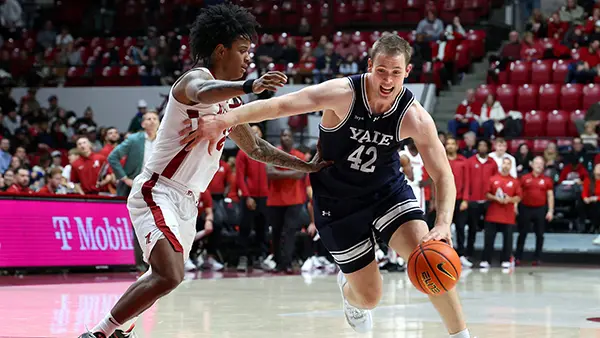
Columbia looks to bounce back in New Haven, but our expert prediction focuses on whether the Lions’ perimeter defense can survive against a Yale offense that ranks top-10 nationally in efficiency.
The Setup: Columbia at Yale
Yale’s laying 8.5 to 9 points at home against Columbia in an Ivy League showdown that’s got more intrigue than the number suggests. Both teams waltz into this one with gaudy records—Columbia at 9-1, Yale at 10-1—but when you dig into the collegebasketballdata.com efficiency numbers, this spread isn’t about records. It’s about offensive firepower meeting defensive vulnerability, and Yale’s got the profile that should exploit Columbia’s soft underbelly. The Bulldogs rank 9th nationally in adjusted offensive efficiency at 123.4, while Columbia’s adjusted defensive rating sits at 104.1, good for just 102nd. That’s a 19-point gap in the metrics that matter, and it’s why the market isn’t sweating Columbia’s nine wins.
Here’s the thing: Yale shoots the ball like a team that’s got no business in the Ivy League. They’re hitting 44.0% from three (2nd nationally) and posting a 64.5% true shooting percentage (7th). Columbia’s defensive numbers look respectable on the surface—96.3 defensive rating ranks 44th—but that’s built on playing slow and limiting possessions, not on elite defense. When they’ve faced teams that can actually score, like Harvard (79 points allowed) and Brown (86 points allowed) in their last five, the wheels came off. Yale’s exactly the kind of team that should cook them.
Game Info & Betting Lines
Matchup: Columbia (9-1) @ Yale (10-1)
Date: January 19, 2026
Time: 2:00 PM ET
Venue: John J. Lee Amphitheater, New Haven, CT
Betting Lines:
- Point Spread: Yale -8.5 to -9
- Over/Under: 154 to 154.5
- Moneyline: Yale -440, Columbia +330
Why This Number Makes Sense (or Doesn’t)
The spread sits at 8.5 to 9, and the market’s telling you something clear: efficiency trumps record. Yale’s adjusted net rating of 13.7 (47th nationally) beats Columbia’s 9.9 (74th) by nearly four points, and home court adds another 3-4 points to the equation. That gets you right into this range without breaking a sweat. The total at 154 to 154.5 makes even more sense when you consider both teams play at a crawl—Columbia’s pace ranks 196th at 68.1, Yale’s sits 247th at 66.8. We’re looking at roughly 67 possessions, and with Yale’s offensive rating at 129.8 (22nd) and Columbia’s at 119.4 (79th), you can project around 87 points for Yale and 80 for Columbia in a vacuum.
But here’s where it gets interesting: Yale’s defensive rating of 104.9 (165th) is nothing to write home about, and they just gave up 102 to Alabama and 82 to UAlbany in their last five. Columbia can score—they put up 104 at Cornell and 90 at North Florida recently. The question isn’t whether Columbia can score; it’s whether they can keep Yale under 90. And when Yale’s shooting 52.5% from the field (9th nationally) and 60.3% effective field goal percentage (11th), good luck with that.
Columbia Breakdown: The Analytical Edge
Columbia’s got some real weapons, starting with Kenny Noland at 17.1 points per game and Zine Eddine Bedri controlling the glass at 7.4 boards. They shoot it well—50.2% from the field (34th) and 39.6% from three (20th)—and their 57.7% effective field goal percentage (33rd) suggests they’re not just chucking. The Lions also dominate the boards at 43.6 rebounds per game (9th nationally), which could be a factor against a Yale team that ranks just 291st in rebounding at 33.8 per game.
The problem? Columbia turns the ball over like they’re allergic to possession. Their 13.5 turnovers per game rank 277th, and their turnover ratio of 0.2 ranks 274th. Against a Yale team that’s taking care of the ball—9.3 turnovers per game (14th nationally)—that’s a possession problem that compounds quickly. Columbia’s also not forcing turnovers themselves, ranking 307th in steals at 5.6 per game. When you can’t create extra possessions and you’re giving them away, you’re fighting uphill against elite efficiency.
Yale Breakdown: The Counterpoint
Yale’s offensive profile is borderline obscene for the Ivy League. Nick Townsend (17.4 PPG, 7.5 RPG, 4.7 APG) is a do-everything forward, and the Bulldogs have three guys averaging double figures who can all shoot. That 44.0% three-point shooting (2nd nationally) isn’t a fluke—it’s built on quality looks from a team that ranks 40th in assists at 17.6 per game. They also shoot 80.1% from the free throw line (5th), so if this gets tight late, they’re not giving points back at the stripe.
The concern is defense. Yale’s adjusted defensive efficiency of 109.7 ranks 223rd, and they’re allowing 70.1 points per game (115th). Opponents are shooting 43.2% from the field against them (168th) and 33.9% from three (240th). Those aren’t numbers that inspire confidence against a Columbia team that can shoot. Yale’s also getting crushed on the glass—that 291st ranking in rebounding is a real issue against Columbia’s 9th-ranked rebounding attack. If Columbia gets second chances, this number shrinks fast.
The Matchup: Where This Gets Decided
This game lives and dies on whether Columbia can protect the ball and control the glass. Yale’s going to score—there’s no mystery there. The Bulldogs have the 9th-ranked adjusted offensive efficiency and shoot it too well to be slowed down significantly. The question is whether Columbia can generate enough second-chance points and limit their own turnovers to keep pace. Columbia’s 30.7% offensive rebounding percentage (195th) isn’t elite, but against Yale’s poor defensive glass, they should get opportunities.
The other factor is three-point variance. Both teams live beyond the arc—Columbia at 39.6% (20th), Yale at 44.0% (2nd). If Columbia gets hot and Yale cools off even slightly, this spread evaporates. But Yale’s shooting percentages aren’t built on small samples—they’re shooting 60.3% effective field goal percentage (11th) and have the 7th-best true shooting percentage in the country. That’s sustainable excellence, not variance.
The pace also matters. Both teams play slow, which means fewer possessions and less room for error. In a 67-possession game, every turnover is magnified, and Columbia’s turnover issues become a bigger problem. Yale’s 9.3 turnovers per game (14th) versus Columbia’s 13.5 (277th) is a four-turnover swing that translates to 8-10 points in a game this slow.
Bash’s Best Bet
I’m laying the points with Yale -8.5. Columbia’s got the talent to make this interesting, but the efficiency gap is real, and Yale’s offensive firepower should overwhelm Columbia’s mediocre defense. The Lions have given up 79 and 86 in their last two conference losses, and Yale’s a better offensive team than both Harvard and Brown. Columbia’s rebounding edge matters, but not enough to overcome a 19-point gap in adjusted efficiency metrics.
The total at 154.5 is tempting to the over, given both teams can score and Yale’s defensive issues, but the pace is too slow to trust it. I’m sticking with the side. Yale wins this one 85-73, covering the 8.5 comfortably. Take the Bulldogs and don’t overthink it.