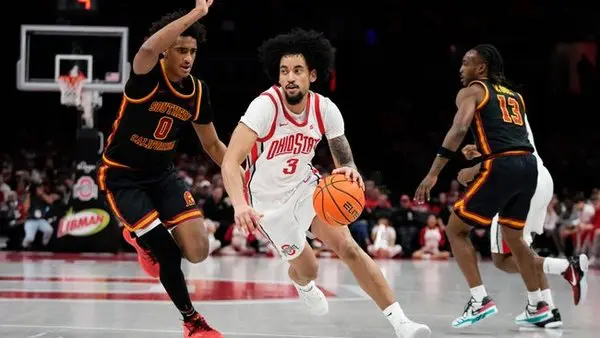
Illinois entered Wednesday’s clash boasting a +33.4 net rating, a metric that suggested the 8.5-point spread was far too low. The Illini validated the efficiency math by scoring 101 points in Los Angeles, making them a clear ATS pick for anyone tracking the gap between their elite offense and USC’s inconsistent defensive rotation.
The Setup: Illinois at USC
Illinois is laying 8.5 points at USC on Wednesday night, and if you’re squinting at that number wondering if it’s too small, you’re not alone. The Illini roll into the Smith-Hammond-Middleton Center with the nation’s #1 adjusted offensive efficiency at 131.9, per collegebasketballdata.com, while USC checks in at #80. That’s not a gap—that’s a chasm. Illinois sits at #10 in both polls with a 21-5 record, while the Trojans are hanging onto #24 at 18-7. This is a Big Ten conference game, and the efficiency numbers suggest Illinois should be laying closer to two touchdowns than a single-digit spread. The market landed at 8.5, and I’m here to explain why that feels light given the underlying metrics.
Game Info & Betting Lines
Game Time: February 18, 2026, 8:00 ET
Location: Smith-Hammond-Middleton Center
TV: N/A
Spread: Illinois -8.5
Total: 151.5
Moneyline: Illinois -430 | USC +320
Why This Number Makes Sense (or Doesn’t)
Let’s start with the efficiency math, because that’s where this line starts to look generous to USC. Illinois holds a +33.4 net rating compared to USC’s +13.2—that’s a 20.2-point gap in adjusted efficiency. When you factor in a standard 3.5-point home-court advantage for the Trojans, the model projects Illinois winning by around 18 points. So why is the market only asking them to cover 8.5?
Part of it is pace. Illinois plays at a glacial 61.4 possessions per game (#359 nationally), while USC pushes it a bit more at 69.2. The blended pace sits around 65 possessions, which means fewer opportunities for variance and fewer chances for Illinois to blow this open. When you’re dealing with a grind-it-out tempo, single-digit spreads make more sense even when the talent gap is significant.
But here’s the thing: Illinois doesn’t just win games—they suffocate opponents with elite efficiency. Their offensive rating of 133.1 ranks #3 nationally, and their adjusted defensive rating of 98.5 sits at #25. USC’s 114.7 offensive rating is respectable but nowhere near elite, and their 101.5 defensive rating isn’t stopping a top-tier offense. The total of 151.5 also feels light when you consider the model projects around 161 points. This sets up as a potential over situation if Illinois can push tempo even slightly.
Illinois Breakdown: The Analytical Edge
The Illini are elite on both ends, but it’s the offense that makes them special. That #1 adjusted offensive efficiency isn’t a typo—they score 131.9 points per 100 possessions when you adjust for opponent quality. They shoot 59.9% true shooting and 55.6% effective field goal percentage, both top-40 nationally. They don’t turn the ball over, ranking #7 in turnovers per game at 9.2 and #10 in turnover ratio.
Kylan Boswell leads the way at 17.0 points per game, while Andrej Stojakovic adds 14.9 and David Mirkovic chips in 13.8 points and 9.6 rebounds. Mirkovic’s rebounding is crucial—Illinois ranks #12 in rebounds per game at 41.2. They’re also excellent at the free-throw line at 78.4% (#9), which matters late in close games.
Defensively, they hold opponents to 40.4% shooting (#26) and 31.8% from three (#76). They block 4.8 shots per game (#29) and force opponents into uncomfortable possessions. The last five games show their range: a 20-point win over Indiana, a blowout of Northwestern, and two close losses to Wisconsin and Michigan State. They’re battle-tested in Big Ten play.
USC Breakdown: The Counterpoint
USC has talent, no question. Chad Baker-Mazara is a legitimate star at 20.9 points per game (#18 nationally), and Rodney Rice adds 20.3 points with 6.0 assists. That’s a dangerous backcourt duo that can score in bunches. Ezra Ausar provides a third scoring option at 15.9 points, giving the Trojans enough firepower to hang around.
The problem is efficiency. USC’s 114.7 adjusted offensive rating is solid but not elite, and their 52.3% effective field goal percentage and 57.3% true shooting lag behind Illinois. They shoot just 32.1% from three (#282), which is a problem when you need to keep pace with a team that doesn’t turn the ball over. They also cough it up 12.6 times per game (#279), which gives Illinois extra possessions they don’t need.
Defensively, USC is respectable at 101.5 adjusted defensive rating (#49), but that’s not stopping the nation’s best offense. They block 5.6 shots per game (#9) and hold opponents to 30.4% from three (#30), but their overall defensive field goal percentage of 42.1% isn’t elite. Recent results show inconsistency: losses to Ohio State and Iowa, narrow wins over Penn State and Rutgers. They’re not playing at a level that suggests they can hang with a top-10 team.
The Matchup: Where This Gets Decided
This game comes down to whether USC can force turnovers and speed up the pace. Illinois wants to play in the low 60s possession-wise, where their efficiency advantage becomes overwhelming. USC needs to push it into the high 60s or low 70s and create chaos. The problem? Illinois ranks #10 in turnover ratio, meaning they protect the ball better than almost anyone in the country.
The rebounding battle matters too. Illinois grabs 41.2 boards per game compared to USC’s 37.3, and their offensive rebounding percentage of 32.0% gives them second-chance opportunities. Mirkovic’s 9.6 rebounds per game could be the difference if USC can’t control the glass.
USC’s best path is getting hot from three and forcing Illinois into an up-tempo game. But they shoot 32.1% from deep, and Illinois defends the three at 31.8%. That’s not a recipe for an upset. If this game stays in the low-to-mid 60s possession range, Illinois wins by double digits. If USC pushes it into the 70s, they might keep it closer, but they’re still dealing with a 20-point efficiency gap.
Bash’s Best Bet
I’m taking Illinois -8.5 and feeling good about it. The efficiency gap is too large, and the pace favors Illinois’s style. USC has the talent to score, but they don’t have the defensive chops to slow down the nation’s best offense. The model projects Illinois by 18, and even with some home-court regression, I see them winning this by 12-15.
I’m also looking at the over 151.5. The model projects 161 points, and if USC pushes pace even slightly, we’re getting there. Illinois scores 84.2 per game, USC scores 81.3, and even in a slower game, 152 points feels reachable. Give me Illinois to cover and the over to cash. This is a ranked-versus-ranked Big Ten clash, and the better team wins convincingly.