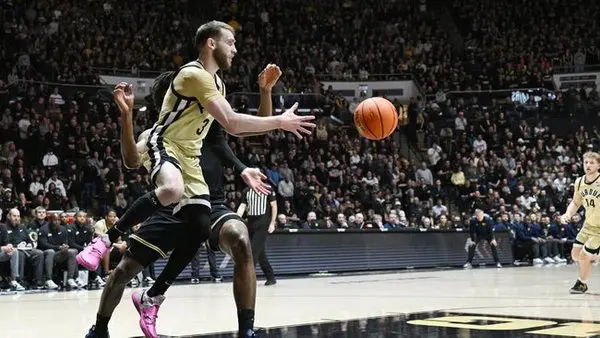
The situational spot here heavily favors the underdog. With Purdue struggling to cover at Mackey and Indiana already owning a win in this series, locking in an ATS pick on the visitors is the sharp move.
The Setup: Indiana at Purdue
Purdue’s laying 12 points at home against Indiana on Friday night, and the first thing you need to know is this: the Boilermakers are 0-5 ATS in their last five home games. Yeah, you read that right. Zero and five. But here’s the thing—when you dig into the collegebasketballdata.com efficiency numbers, this spread isn’t some Vegas trap. It’s actually pretty damn rational.
Purdue checks in at #9 nationally in adjusted net rating at +29.9, while Indiana sits at #30 with a +20.4 mark. That’s a 9.5-point gap in pure efficiency, and we’re getting a 12-point spread at Mackey Arena. The Boilermakers own the #3 adjusted offensive efficiency in the country at 128.6—elite doesn’t even begin to cover it. Indiana’s defensive rating of 100.9 ranks #40 nationally, which is solid, but when you’re facing the third-best offense in college basketball, solid might not cut it.
This is a ranked-versus-ranked Big Ten clash with real stakes. AP #22 Indiana at AP #7 Purdue. Friday night at Mackey. The line makes sense. The question is whether the Boilermakers can finally cover one at home.
Game Info & Betting Lines
Game Time: February 20, 2026, 8:00 PM ET
Location: Mackey Arena, West Lafayette, IN
Records: Indiana 17-9 (13-13 ATS) | Purdue 21-5 (12-14 ATS)
Bovada:
Spread: Purdue -12
Total: 150
Moneyline: Purdue -750, Indiana +500
DraftKings:
Spread: Purdue -11.5
Total: 150.5
Moneyline: Purdue -650, Indiana +470
Why This Number Makes Sense (or Doesn’t)
The market landed on 12 because the efficiency gap is real and quantifiable. Purdue’s 128.6 adjusted offensive rating against Indiana’s 100.9 defensive rating creates a projected offensive output advantage of 27.7 points. Flip it around: Indiana’s 121.3 offensive rating (#31 nationally) against Purdue’s 98.7 defensive rating (#28) yields a 22.6-point edge for the Hoosiers. The net difference favors Purdue by about 5 points on neutral court, add 3.5 for home court, and you’re at 8.5 before conference adjustments.
But here’s where it gets interesting. The pace projection is 65.3 possessions—both teams play deliberate, methodical basketball. Indiana ranks #243 in pace at 65.6, Purdue #272 at 65.1. This isn’t going to be a track meet. In a slower game, each possession matters more, and Purdue’s ball security (9.2 turnovers per game, #10 nationally) gives them a massive edge over Indiana’s 10.2 turnovers.
The total at 150 is fascinating because both teams rank in the top 60 in points per game, but the pace says this stays controlled. Purdue’s averaging 82.5 PPG, Indiana 80.3, but those numbers come with different possession counts against varying competition. The adjusted numbers suggest both offenses can score, but in 65 possessions, you need efficiency, not volume.
Indiana Breakdown: The Analytical Edge
The Hoosiers bring a top-35 adjusted offensive efficiency to West Lafayette, led by Tucker DeVries at 17.8 PPG and Lamar Wilkerson at 16.0 PPG. What stands out is Indiana’s true shooting percentage of 60.5% (#24 nationally) and their effective field goal percentage of 55.9% (#34). They don’t just chuck shots—they take quality attempts.
Indiana’s assist-to-turnover ratio of 1.71 is solid, with 17.3 assists per game (#29) against 10.2 turnovers. But the rebounding numbers are concerning. They rank #333 in offensive rebounding percentage at just 26.0%, and they’re pulling down only 34.0 boards per game (#266). Against Purdue’s 11.42 offensive rebounds per game, that’s a problem.
The Hoosiers are 7-2 ATS in their last nine against Purdue, which tells you they’ve been undervalued in this matchup historically. They just beat Wisconsin 78-77 at home and dropped 92 on Oregon. The offense can produce. But that 51-71 loss at Illinois three games ago? That’s what happens when the shooting goes cold on the road.
Purdue Breakdown: The Counterpoint
Braden Smith is the engine here—13.1 PPG with 8.7 assists per game, which ranks #2 nationally. That’s absurd. Purdue’s 19.5 assists per game rank #3 in the country, and their assist-to-turnover ratio of 2.13 is elite. They don’t beat themselves, and they create quality looks for everyone.
Trey Kaufman-Renn gives them 13.9 PPG and 10.7 rebounds (#11 nationally), while Fletcher Loyer provides perimeter scoring at 14.4 PPG. The Boilermakers shoot 49.7% from the field (#21) and 37.5% from three (#26). They’re balanced, efficient, and nearly impossible to fluster.
But that 0-5 ATS mark at home isn’t noise. They just lost to Michigan 80-91 at Mackey, failing to cover as a 2.5-point favorite. Before that, they beat Oregon 68-64 but were laying 18.5—a massive miss. They’re 4-10 ATS at home overall and 1-6 ATS at home in conference play. They win, but they don’t cover. That’s the pattern.
The Matchup: Where This Gets Decided
This comes down to possessions and execution. In a 65-possession game, Purdue’s turnover edge is massive. They’re committing one fewer turnover per game, which in a tight contest equals 2-3 extra scoring opportunities. Indiana’s #333 offensive rebounding percentage means they’re not getting second chances, while Purdue’s 31.2% offensive rebounding rate (#168) gives them multiple bites at the apple.
The shooting matchup favors Purdue slightly—their 57.3% effective field goal percentage edges Indiana’s 55.9%, and their three-point shooting at 37.5% is significantly better than Indiana’s 34.8% (#142). In a slower game where you can’t rely on transition buckets, half-court execution matters, and Purdue’s ball movement (19.5 APG) creates better looks.
Indiana’s best path to covering is simple: make Purdue uncomfortable. They need to defend without fouling—Purdue’s getting to the line plenty—and they need DeVries and Wilkerson to carry the scoring load. The Hoosiers are 7-2 ATS in their last nine against Purdue because they’ve found ways to stay competitive even when losing. They won the last meeting 72-67 back in January.
The total is the sneaky play here. Both teams rank top-60 in offensive rating, and while the pace is slow, the efficiency suggests scoring. The under has hit in 11 of Indiana’s last 15 road games, and it’s 5-2 in the last seven head-to-head meetings at Mackey. But 150 feels low when you’ve got two top-35 offenses and defenses that rank #40 and #28.
Bash’s Best Bet
The Play: Indiana +12 (-110)
I’m fading Purdue’s home spread for the sixth straight time, and yeah, I know how that sounds. But 0-5 ATS at home isn’t a fluke—it’s a pricing inefficiency. The market keeps overvaluing Purdue at Mackey, and bettors keep getting burned. Indiana’s 7-2 ATS in the last nine meetings tells you they show up in this rivalry, and that 72-67 win in January proves they can hang.
The efficiency gap is real at 9.5 points, but 12 is too many points in a 65-possession game between two teams that take care of the ball. Indiana’s true shooting percentage matches Purdue’s, and while the Boilermakers have the better offense, the Hoosiers have enough firepower to stay within striking distance. DeVries and Wilkerson can score, and if Indiana’s defense shows up like it did against Wisconsin, this stays tight.
Take the points. Purdue wins, but Indiana covers. Again.