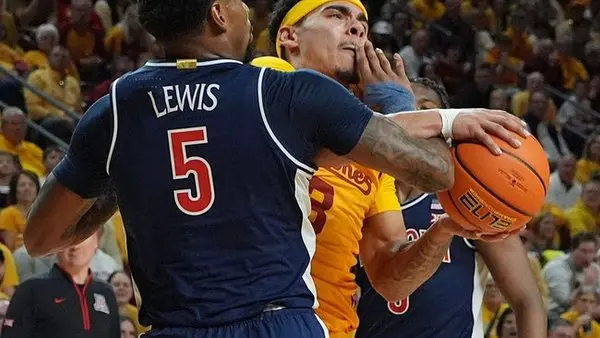
The situational spot here heavily favors the underdog, especially with Arizona’s Koa Peat hampered by injury, making Kansas the strongest best bet on Saturday’s slate.
The Setup: Kansas at Arizona
Arizona’s laying 9.5 at McKale on Saturday afternoon, and the market’s telling you this #2 Wildcats squad is supposed to handle #14 Kansas by double digits. Here’s the thing—Kansas already beat this Arizona team three weeks ago in Lawrence, 82-78. Same rosters, same conference, and now the Wildcats are suddenly 9.5-point favorites? I’m not buying it at face value.
When you dig into the collegebasketballdata.com efficiency numbers, Arizona’s the superior team on paper. The Wildcats check in at #3 in adjusted net rating (+33.7) while Kansas sits at #19 (+24.8). That’s an 8.9-point gap in net efficiency, which would suggest Arizona by about 5-6 points after factoring home court. So where’s the market getting 9.5? That’s the question we need to answer, because this number feels inflated—and that’s exactly where betting value lives.
This is a Big 12 conference game with massive tournament seeding implications. Arizona’s 26-2 overall and 13-2 in conference play. Kansas sits at 21-7 and 11-4 in the Big 12. Both teams are safely in the NCAA Tournament, but this game matters for positioning. And with Koa Peat’s status uncertain for Arizona, we’ve got legitimate handicapping angles to exploit.
Game Info & Betting Lines
Game: Kansas Jayhawks at Arizona Wildcats
Date: Saturday, February 28, 2026
Time: 4:00 PM ET
Location: McKale Memorial Center, Tucson, AZ
TV: TBD
Betting Lines (Bovada):
Spread: Arizona -9.5
Total: 149.5
Moneyline: Arizona -525, Kansas +375
Why This Number Makes Sense (or Doesn’t)
Let’s start with what the efficiency metrics actually tell us. Arizona ranks #12 nationally in adjusted offensive efficiency (124.2) compared to Kansas at #54 (118.5). That’s a significant offensive gap. But here’s where it gets interesting—Kansas owns the #10 adjusted defensive efficiency (93.7) while Arizona checks in at #3 (90.5). Both teams are elite defensively, with only a 3.2-point separation.
The pace factor matters here. Arizona plays at 71.2 possessions per game (#25 nationally) while Kansas grinds at 66.5 (#204). When these styles collide, you’re looking at roughly 69 possessions. That’s a rock fight, and in rock fights, the team that can’t score efficiently gets exposed. Kansas averages just 76.6 points per game (#159 nationally) while Arizona puts up 87.2 (#13). That 10.6-point scoring gap is real.
But here’s what the market might be missing: Kansas is 4-1 ATS in their last five road games and just beat this Arizona team three weeks ago. The betting trends show Arizona is just 7-8 ATS at home this season. The Wildcats are an elite team, but they haven’t been a covering machine at McKale. Meanwhile, Kansas is 18-10 ATS overall and has shown they can compete with Arizona’s talent level.
The 9.5-point spread assumes Arizona dominates. The efficiency gap suggests 5-6 points. That’s a 3-4 point discrepancy, and in college basketball, that’s massive.
Kansas Breakdown: The Analytical Edge
Kansas wins with defense and rebounding. The Jayhawks rank #6 nationally in opponent field goal percentage (38.5%) and #15 in opponent three-point percentage (29.8%). They’re also #5 in blocks per game (6.0), led by Flory Bidunga’s interior presence. Bidunga averages 14.7 points and 9.0 rebounds, and he’s the defensive anchor that allows Kansas to protect the rim.
Offensively, Kansas leans on Darryn Peterson’s 20.0 points per game, but the real story is their shooting efficiency. They hit 77.1% from the free-throw line (#30 nationally) and maintain a 57.6% true shooting percentage. They don’t take bad shots, and they don’t turn the ball over—just 10.6 turnovers per game with a 0.1 turnover ratio that ranks #34 nationally.
The concern is Kansas’s offensive rebounding. They rank #350 nationally in offensive rebound percentage (24.3%), which means they’re not getting second-chance points. Against Arizona’s rebounding dominance (43.2 boards per game, #2 nationally), that’s a problem. Kansas needs to convert on first-chance opportunities because they won’t get many second looks.
Injury-wise, Kansas has four players listed as questionable with undisclosed injuries, but none are key rotation players. The core is healthy.
Arizona Breakdown: The Counterpoint
Arizona’s efficiency profile is elite across the board. The Wildcats rank #12 in adjusted offensive efficiency and #3 in adjusted defensive efficiency, giving them the #3 net rating nationally. They score 87.2 points per game, rebound at an elite level (43.2 RPG, #2), and force turnovers with 8.1 steals per game (#54).
Koa Peat is the key question mark. Arizona’s leading scorer at 15.9 points per game is listed as questionable with a leg injury. If Peat can’t go, Arizona loses its most versatile offensive weapon—a guy who can score inside, facilitate (3.1 assists per game), and rebound (5.5 RPG). Jaden Bradley (14.5 PPG) and Anthony Dell’Orso (11.2 PPG) would need to pick up the slack, but neither has Peat’s two-way impact.
Arizona’s shooting numbers are excellent—50.3% from the field (#13) and 59.4% true shooting (#40). But their recent form shows some cracks. They’re just 5-5 ATS in their last 10 games, and they’ve failed to cover in three of their last five. Against Kansas specifically, Arizona is 5-2 ATS in the last seven meetings, but they’ve lost two of the last three head-to-head matchups straight up.
The total has gone under in five straight Arizona home games, which tells you McKale hasn’t been the high-scoring environment you’d expect from a team averaging 87 points per game.
The Matchup: Where This Gets Decided
This game comes down to three factors: Peat’s availability, rebounding, and Kansas’s ability to slow the pace.
If Peat plays, Arizona has the offensive firepower to exploit Kansas’s #350-ranked offensive rebounding. The Wildcats rank #193 in offensive rebound percentage (30.5%), which means they’ll get second-chance opportunities that Kansas won’t. In a 69-possession game, those extra possessions are worth 4-6 points.
But if Peat sits or plays limited minutes, this spread becomes untenable. Kansas already proved they can beat Arizona when both teams are healthy. Take away Arizona’s best scorer, and suddenly this game looks like a pick’em with home court.
The pace battle favors Kansas. The Jayhawks want to grind this into the mid-60s in possessions, limit transition opportunities, and make Arizona execute in the halfcourt. Arizona’s elite defense can handle that, but their offense becomes more predictable without Peat’s versatility.
Defensively, this is strength-on-strength. Kansas’s #10 adjusted defense against Arizona’s #12 adjusted offense. Arizona’s #3 adjusted defense against Kansas’s #54 adjusted offense. The efficiency metrics suggest a final score in the low 70s, which tracks with the 149.5 total.
Bash’s Best Bet
Kansas +9.5 (-110)
I’m taking the points with Kansas, and I’m doing it with confidence. The market’s asking me to believe Arizona wins this game by double digits when Kansas just beat them three weeks ago. The efficiency gap suggests a 5-6 point Arizona win, not 9.5. And with Peat’s status uncertain, there’s legitimate injury risk baked into this number.
Kansas is 18-10 ATS this season and 4-1 ATS in their last five road games. They defend at an elite level, they don’t turn the ball over, and they’ve shown they can hang with Arizona’s talent. Even if Arizona wins this game, I need to see them do it by 10+ to lose this bet. That’s not happening.
The total is interesting—five straight unders at McKale, and both teams rank in the top 50 defensively. But I’m staying away from the total and riding Kansas plus the points. This number’s inflated, and we’re getting value on a team that’s already proven it can win this matchup outright.
Final Pick: Kansas +9.5