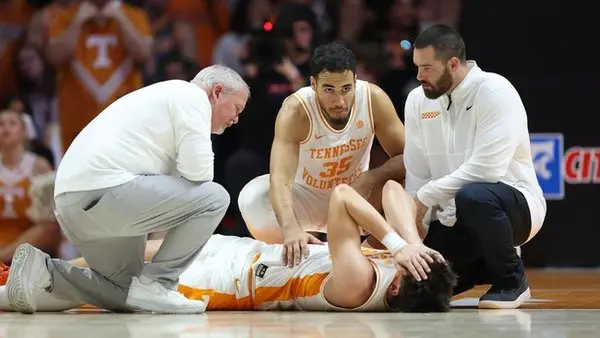
Tennessee has yet to lose a game at Food City Center this season, but is a 6.5-point cushion too much against a Kentucky team that just hit a 92-point heater? Bash asks if Rick Barnes’ elite offensive rebounding can ruin the best bet for a Kentucky squad that leads the SEC in defensive rebounding rate.
The Setup: Kentucky at Tennessee
Tennessee’s laying 6.5 at home against Kentucky in a noon tip at Food City Center, and the market’s telling you something loud and clear: this isn’t the Kentucky team you’re used to seeing. The Wildcats come in at 5-4, and while that record might shock the casual observer, the underlying numbers from collegebasketballdata.com paint a picture of a team that’s legitimately good on defense but offensively inconsistent. Tennessee sits at 7-3 with nearly identical efficiency metrics, but they’re getting the home bump and the benefit of the doubt. Here’s my thesis: this spread undersells Kentucky’s defensive identity while overrating Tennessee’s ability to pull away from elite defensive competition.
Both teams rank inside the top 32 nationally in adjusted defensive efficiency—Kentucky at #21 (97.2) and Tennessee at #32 (98.5). When two teams defend like this, you’re not getting the 85-82 shootout the casual bettor expects. You’re getting a grind-it-out SEC battle where possessions matter and the total might be the smarter play than the side.
Game Info & Betting Lines
Matchup: Kentucky at Tennessee
Date: January 17, 2026
Time: 12:00 PM ET
Venue: Food City Center, Knoxville, TN
Point Spread: Tennessee -6.5
Over/Under: 146.5
Moneyline: Tennessee -270, Kentucky +220
Why This Number Makes Sense (or Doesn’t)
Let’s start with what the market got right: Tennessee deserves to be favored at home. Food City Center is a legitimate home-court advantage, and the Vols have the better overall record. The adjusted efficiency numbers support a Tennessee edge—their adjusted net rating of 16.8 (#30 nationally) versus Kentucky’s 18.7 (#24) is closer than you’d think, but Kentucky’s ranking is actually better. Wait, what?
That’s the first red flag with this 6.5-point spread. Kentucky’s adjusted net efficiency ranks six spots higher nationally than Tennessee’s. The Wildcats are #24 in the country by that metric; Tennessee is #30. Home court is worth roughly 3-4 points in college basketball, which means the market is giving Tennessee an additional 2-3 points just… because. Because of the record? Because of reputation?
Now let’s talk tempo. Kentucky plays at 71.5 possessions per game (#89 nationally), while Tennessee slows it down even more at 69.3 (#155). When you combine two elite defenses with below-average pace, you’re looking at a game that might struggle to hit 140 total points, let alone 146.5. The offensive ratings are nearly identical—Kentucky at 116.2 (#113) and Tennessee at 116.1 (#118)—but those numbers were compiled against varying competition. The adjusted offensive efficiency tells a more accurate story: Kentucky at 116.0 (#54) versus Tennessee at 115.3 (#61). Kentucky’s actually been slightly better offensively against quality competition.
The spread makes sense if you’re betting on Tennessee’s home court and recent momentum. It doesn’t make sense if you’re betting on efficiency metrics and defensive matchups. This number feels like it’s giving Tennessee credit for being Tennessee while ignoring what Kentucky actually is: a top-25 team nationally by adjusted net efficiency that plays suffocating defense.
Kentucky Breakdown: The Analytical Edge
Kentucky’s calling card is defense, full stop. That 94.2 defensive rating ranks #31 nationally, and they’re holding opponents to just 38.7% from the field (#31) and 29.5% from three (#64). When you can defend like that in a slow-paced game, you’re always live as an underdog.
The offensive concerns are real—they rank #245 nationally in three-point shooting at 31.9%—but they compensate with excellent rebounding (42.8 RPG, #19 nationally) and ball security (10.4 turnovers per game, #52). Otega Oweh leads the scoring at 13.7 PPG, with Denzel Aberdeen (12.9 PPG) and Collin Chandler (11.7 PPG) providing secondary options. Malachi Moreno gives them interior presence at 7.1 rebounds per game (#162 nationally).
Kentucky’s recent form shows resilience: they won a one-point thriller at LSU (75-74) and dismantled Mississippi State (92-68). The losses to Missouri and Alabama were on the road against quality competition. This isn’t a team in freefall; this is a team finding its identity on the defensive end while the offense catches up.
Tennessee Breakdown: The Counterpoint
Tennessee counters with balance and a legitimate star in Ja’Kobi Gillespie, who’s averaging 17.3 PPG (#118 nationally) and 5.4 APG (#50). Nate Ament provides a double-double threat at 16.3 PPG and 7.1 RPG (#169), giving the Vols two legitimate scoring options that Kentucky will have to account for.
Where Tennessee separates itself is on the offensive glass—they rank #31 nationally in offensive rebounding percentage at 36.0%. That’s a massive advantage over Kentucky’s #285 ranking (28.3%). Second-chance points could be the difference in a low-possession game.
The concern? Turnovers. Tennessee coughs it up 13.2 times per game (#251 nationally), and their turnover ratio of 0.2 ranks #228. Against Kentucky’s disciplined defense, those extra possessions could swing a tight game. Tennessee’s also shooting just 72.7% from the free-throw line (#143), which matters in close games down the stretch.
The Matchup: Where This Gets Decided
This game will be won or lost in three specific areas: offensive rebounding, turnover margin, and three-point shooting variance.
Tennessee’s #31 ranking in offensive rebounding percentage against Kentucky’s #285 ranking is the single biggest mismatch in this game. If the Vols can generate 12-15 second-chance points, they’ll control the pace and put Kentucky in catch-up mode. But here’s the thing: Kentucky’s overall rebounding (42.8 RPG, #19) suggests they’re not getting destroyed on the glass every night. They’re just not crashing the offensive boards themselves.
Turnover margin favors Kentucky significantly. The Wildcats rank #38 in turnover ratio versus Tennessee’s #228. In a game with 68-70 possessions, every extra possession matters. If Tennessee has their typical 13 turnovers against this Kentucky defense, the Wildcats could generate 15-18 points off those mistakes.
Three-point shooting is the wildcard. Neither team shoots it particularly well—Kentucky at 31.9% (#245) and Tennessee at 34.6% (#144)—but variance matters. If Tennessee gets hot from deep and hits 8-10 threes, they cover easily. If both teams shoot their averages, this stays within a possession or two.
The pace and efficiency metrics suggest a final score somewhere around Tennessee 72, Kentucky 68. That’s a four-point game that doesn’t cover the 6.5.
Bash’s Best Bet
Kentucky +6.5
I’m backing the better team by adjusted net efficiency getting nearly a touchdown at a neutral-site-caliber venue. Yes, Food City Center is Tennessee’s home court, but in a noon Saturday game, the crowd advantage diminishes. Kentucky’s #21 adjusted defense against Tennessee’s #61 adjusted offense is a mismatch the market isn’t properly pricing.
The secondary play is Under 146.5, and honestly, I like it just as much as the side. Two top-35 defenses, both playing below-average pace, with offensive ratings that are nearly identical? This game has 138-142 total points written all over it. Both teams struggle from three, both teams protect the ball reasonably well, and neither wants to run.
If forced to pick one, I’m taking Kentucky plus the points. But the sharp play might be building a two-team parlay with Kentucky +6.5 and Under 146.5. When the numbers tell you a story this clearly, you listen.