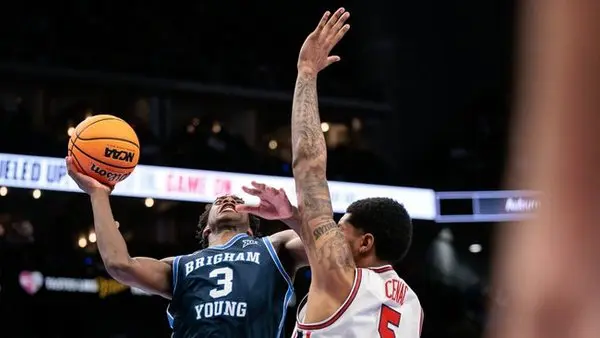
Bash is ignoring the five-seed gap and treating this NCAA first-round matchup like the coin flip the numbers suggest it actually is.
No. 6 seed BYU is laying 2.5 points against No. 11 seed Texas on Thursday night at the Moda Center in Portland, and if you’re betting the NCAA Tournament based on seed differential alone, you’re already behind. The market landed here because the advanced metrics don’t care about bracket position—they care about net rating, and these two teams are separated by just 5.9 points in adjusted efficiency. According to collegebasketballdata.com, BYU checks in at #24 in net rating (+24.2) while Texas sits at #41 (+18.3). That’s a legitimate gap, but not the chasm you’d expect from a 6-versus-11 NCAA Tournament matchup. This is a classic March spot where the committee’s seeding process overvalues conference tournament performance and underweights the full-season efficiency profile.
Breaking Down the Spread
BYU -2.5 at a neutral site makes sense when you dig into the tempo-neutral numbers. The Cougars rank #10 nationally in adjusted offensive efficiency (125.5), while Texas checks in at #21 (123.9). That 1.6-point offensive edge is real, but the defensive gap is where BYU separates—the Cougars sit at #44 in adjusted defensive efficiency (101.2) compared to Texas at #109 (105.6). That’s a 4.4-point advantage on the defensive end, and it’s the reason this spread isn’t a pick’em despite the tight net rating differential.
The Warren Nolan data adds context: BYU’s RPI of #25 was built on the #11 strength of schedule nationally, while Texas limped into the NCAA Tournament at RPI #83 with an SOS of #64. The Cougars went 7-8 in Quadrant 1 games and 5-3 in Quadrant 2—that’s 12 quality wins against tournament-caliber opponents. Texas counters with a 6-9 Q1 record and just 2-2 in Q2. The market is pricing in BYU’s battle-tested resume against elite competition, and that’s why the Cougars are favored despite the modest seed gap.
The Richie Saunders Factor
Here’s the wrinkle that changes everything: Richie Saunders (19.1 PPG, 5.8 RPG) is out for BYU with a season-ending knee injury. Saunders was the Cougars’ second-leading scorer and a critical floor-spacing forward who allowed AJ Dybantsa to operate with more space. Without him, BYU’s offensive rating in their last 10 games dropped to 78.1 points per game compared to their season average of 83.9. That’s a five-point dip, and it’s why this NCAA Tournament matchup feels tighter than the full-season metrics suggest.
Texas doesn’t have a comparable injury concern—Lassina Traore is questionable with a knee issue, but he’s not a key player in their rotation. The Longhorns are running their full offensive arsenal, led by Matas Vokietaitis (15.9 PPG) and Dailyn Swain (15.7 PPG, 6.9 RPG). Texas ranks #32 in true shooting percentage (59.7%), and their ability to get to the free-throw line is elite—they rank #4 nationally in free-throw rate per KenPom’s four factors. That’s a massive edge in a close NCAA Tournament game where possessions shrink and the whistle tightens.
Matchup Dynamics and Tournament Context
The pace projection here is critical: both teams operate in the mid-60s in tempo, with BYU at 67.5 possessions per game (#152) and Texas at 67.3 (#162). The model projects 67.4 possessions, which means this NCAA Tournament game will be decided in the half-court. BYU’s advantage in that environment is their 11.9% block rate (Texas sits at just 7.6%), and their ability to protect the rim with Keba Keita anchoring the interior. But Texas counters with a 35.7% offensive rebounding rate (#34 nationally), which is a top-tier mark that creates second-chance opportunities even when the initial shot doesn’t fall.
The Quadrant 1 data tells me BYU has seen this level of competition before—they went 7-8 against elite opponents, meaning they’ve been in tight games against tournament teams all season. Texas, meanwhile, went 6-9 in Q1 but showed resilience in their NCAA play-in win over NC State (68-66). That’s a team that knows how to win ugly in March, and their 17-15 ATS record suggests they’ve been undervalued by the market all season. BYU, by contrast, is just 16-18 ATS and has failed to cover in 11 of their 15 home games this year.
Key Metrics Comparison
| Metric | Texas | BYU |
|---|---|---|
| KenPom Rank | #37 | #23 |
| RPI (Warren Nolan) | #83 | #25 |
| Strength of Schedule | #64 | #11 |
| Quadrant 1 Record | 6-9 | 7-8 |
| Adj. Offensive Efficiency | 123.9 (#21) | 125.5 (#10) |
| Adj. Defensive Efficiency | 105.6 (#109) | 101.2 (#44) |
| Free Throw Rate | 46.3% (#4) | 34.2% (#205) |
The style clash here favors Texas in the margins. BYU’s inability to get to the free-throw line—ranking #205 in FT rate—is a glaring weakness in a tournament setting where games are decided by two or three possessions. Texas, meanwhile, ranks #4 nationally in drawing fouls, and that’s a sustainable edge when the game slows down and every possession matters. The Longhorns also have a 2.75-year average experience level compared to BYU’s 1.61 years, and that veteran presence matters in March when the stakes are elimination.
The Pick
I’m not laying 2.5 points with a BYU team missing their second-leading scorer in an NCAA Tournament game against a battle-tested Texas squad that thrives in the half-court. The metrics suggest a two-point game, and the model projects BYU by exactly 2.0 at a neutral site. That means the market is efficiently priced, but the injury to Saunders tips the scale toward Texas. The Longhorns have the experience edge, the free-throw rate advantage, and the offensive rebounding prowess to stay within a possession throughout.
The risk here is BYU’s elite offensive efficiency overwhelming Texas’s #109 defensive rating, but the Cougars haven’t been the same offensive team without Saunders. Their last 10 games show a team averaging just 78.1 points per game, and that’s a far cry from the 83.9 they posted over the full season. Texas, meanwhile, is 8-4 ATS as an underdog this season and has shown the ability to hang around in tight games.
BASH’S BEST BET: Texas +2.5 for 1.5 units. This NCAA Tournament matchup is a coin flip with the injury context, and I’ll take the points with the more experienced team that gets to the line at an elite rate.