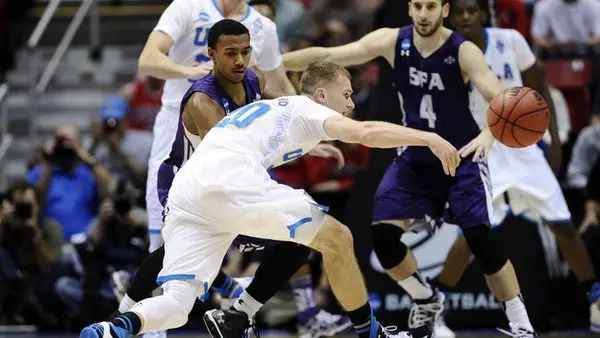
Bash is leaning into the turnover battle in this Southland Conference tournament opener, where McNeese’s elite ball security and defensive pressure create separation value against a Stephen F. Austin squad that’s been less consistent protecting the rock in high-leverage moments.
McNeese’s laying 1.5 at the Legacy Center in this Southland Conference tournament neutral-site opener, and the market’s telling you these teams are dead even. I’m not buying it. When you dig into the collegebasketballdata.com numbers, this isn’t a coin flip—it’s a matchup where ball security and defensive intensity separate two otherwise similar mid-major programs. McNeese ranks #22 nationally in turnovers per game (9.5) and #2 in steals (10.6), while Stephen F. Austin sits at #11 in turnovers (9.1) but only #147 in steals (7.0). That’s not a negligible gap when you’re talking about a projected 65-possession game where every extra possession matters. This qualifies as a conference tournament situational spot where the team that protects the ball and generates extra opportunities typically covers these razor-thin spreads.
Breaking Down the Spread
The market landed on McNeese -1.5 because the adjusted efficiency numbers suggest these programs are tightly matched. McNeese checks in at #64 in adjusted net rating (+12.3) with an offensive rating of 115.0 (#79) and defensive rating of 102.6 (#56). Stephen F. Austin sits at #84 in adjusted net rating (+9.5) with offensive and defensive ratings of 113.6 (#97) and 104.1 (#76) respectively. That 2.8-point net rating gap translates to roughly a 1-2 point spread on a neutral floor, which is exactly where Bovada has this number. But here’s what the market isn’t adequately pricing: McNeese’s #35 turnover ratio (0.1) compared to Stephen F. Austin’s #9 ranking (0.1) looks similar on paper, but the Cowboys’ ability to force turnovers at an elite rate (24.8% forced turnover percentage per KenPom, #1 nationally) creates a massive stylistic advantage. Stephen F. Austin forces turnovers at just 17.5% (#123). When McNeese gets into their defensive pressure, they generate 725 points off turnovers compared to Stephen F. Austin’s 469—that’s a 256-point season differential that screams sustainable edge in a tournament setting where possessions become gold.
McNeese’s Tournament-Ready Profile
I’m backing McNeese here because their resume suggests they’re built for these moments. Bill Armstrong’s squad sits at #38 in RPI with a strength of schedule ranked #215—not elite, but respectable for a mid-major program. More importantly, they’ve dominated the Southland at 19-3 in conference play and carry a 27-5 overall record. Yes, they’re 0-3 in Quadrant 1 games, but they’re 2-0 in Q2 matchups and 17-1 against Q4 opponents, which tells me they take care of business against inferior competition. That matters in a conference tournament where focus and execution separate contenders from pretenders. Larry Johnson leads this group at 16.4 PPG (#174 nationally), but the real story is the balanced scoring attack with four guards averaging double figures. Garwey Dual’s 4.3 assists per game (#125) keeps the offense humming, and when you combine that with the team’s 36.3% offensive rebounding rate (#6 nationally), they generate second-chance opportunities that extend possessions and wear down opponents.
Stephen F. Austin’s Structural Weaknesses
Stephen F. Austin enters at 28-4 with a slightly faster pace (66.3 possessions, #204 versus McNeese’s 64.0, #313), but their inability to protect the ball against elite defensive pressure concerns me. They rank #22 in turnover percentage (13.96%) per KenPom, which is excellent in a vacuum, but McNeese’s #1 forced turnover rate creates a mismatch that the Lumberjacks haven’t seen consistently in Southland play. Keon Thompson’s a legitimate weapon at 18.3 PPG (#81) with 4.4 APG (#117), and Lateef Patrick adds 15.1 PPG (#285), but this team’s 67.6% free throw shooting (#333) is a legitimate liability in a close game. When you’re shooting that poorly from the stripe and facing a team that forces you into tough decisions with defensive pressure, the math doesn’t favor you covering a short spread. Stephen F. Austin’s #76 adjusted defensive efficiency is solid, but they allow opponents to shoot 49.09% on two-pointers per KenPom, and McNeese converts 52.87% inside the arc. That’s a recipe for the Cowboys getting quality looks in the paint throughout this game.
Matchup Dynamics and Resume Context
The head-to-head history tells a split story—Stephen F. Austin won the February 3rd meeting 67-60, while McNeese took the January 6th game 66-64. Both games stayed under 137.5 total points, which suggests the 65-possession pace projection holds water. But here’s the tournament context that matters: McNeese’s RPI of #38 versus Stephen F. Austin’s lack of a listed RPI ranking in the Warren Nolan data suggests the Cowboys have built a stronger overall resume. McNeese’s non-conference RPI of #8 with a non-conference SOS of #11 demonstrates they scheduled aggressively and held their own against better competition. That experience matters when you’re playing a neutral-site tournament game where familiarity with high-pressure environments separates teams. Stephen F. Austin’s Q1 record isn’t provided, but their -3.93 strength of schedule (#252) per KenPom suggests they haven’t been tested the same way McNeese has. When the game tightens in the final four minutes—and it will—I trust the team that’s seen better competition and executes with precision in crunch time.
Statistical Comparison
| Metric | McNeese | Stephen F. Austin |
|---|---|---|
| KenPom Ranking | #69 | #90 |
| RPI Ranking | #38 | data pending |
| Strength of Schedule | #215 | #252 (KenPom) |
| Q1 Record | 0-3 | data pending |
| Adj. Offensive Efficiency | 115.0 (#79) | 113.6 (#97) |
| Adj. Defensive Efficiency | 102.6 (#56) | 104.1 (#76) |
| Forced TO% (KenPom) | 24.8% (#1) | 17.5% (#123) |
The pace blend projects to 65.2 possessions, which favors McNeese’s grind-it-out style. When you’re forcing turnovers at a historic rate and limiting possessions, you control the game flow and dictate terms. Stephen F. Austin’s 36.7% three-point shooting (#38) is dangerous, but McNeese defends the arc at a respectable 32.6% clip (#108) and forces opponents into 40.8% field goal shooting overall (#30 nationally). That defensive versatility—switching between pressure defense that generates steals and disciplined halfcourt sets that limit quality looks—gives the Cowboys multiple ways to win this game.
The Bottom Line
BASH’S BEST BET: McNeese -1.5 for 2 units. The turnover margin and defensive pressure create a legitimate edge that the market’s undervaluing by a half-point to a full point. McNeese’s #1 forced turnover rate against Stephen F. Austin’s inability to generate similar defensive chaos gives the Cowboys control of possessions, and their #6 offensive rebounding rate extends possessions when shots don’t fall. The primary risk is Stephen F. Austin getting hot from three—they’ve got the shooters to swing a game quickly if Keon Thompson and Lateef Patrick catch fire—but I trust McNeese’s defensive versatility to make those looks contested. This number should be closer to -2.5 or -3 based on the style matchup, and I’m laying the short number with confidence. Conference tournament basketball rewards teams that protect the ball and generate extra possessions through defense. McNeese does both at an elite level, and that’s enough to cover a field goal spread in a 65-possession game.