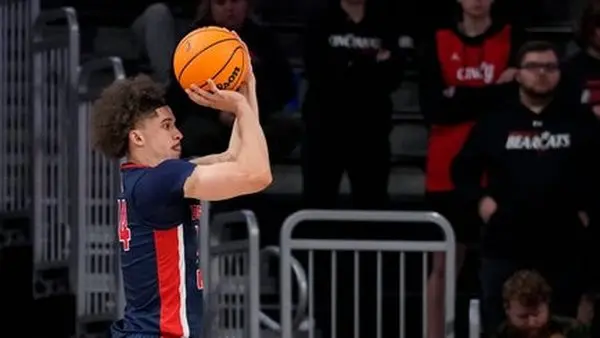
After digging into the transition data, the play here is to look at the situational spot for the home favorites. Bryan Bash breaks down why the 1.5-point spread reflects a paper-thin margin between these two programs.
The Setup: Milwaukee at Detroit Mercy
Detroit Mercy’s laying 1.5 at home against Milwaukee on Friday night, and honestly? That’s barely a spread at all. We’re talking about two Horizon League teams sitting at nearly identical efficiency profiles—Milwaukee checks in at #259 in adjusted net rating (-7.6), while Detroit Mercy sits just six spots higher at #253 (-7.0). When you dig into the collegebasketballdata.com numbers, this is essentially a pick ’em with home court being the only real separator. The Panthers already beat Milwaukee 76-63 earlier this month, but that margin feels inflated when you consider these teams are statistical twins in almost every meaningful category.
Here’s what matters: Both squads are hovering around 107 in adjusted offensive efficiency, both defend at a bottom-third level nationally (Milwaukee #286, Detroit Mercy #280), and both play at a moderate pace in the high 60s to low 70s. This isn’t a game where one team has a glaring systemic advantage. It’s a game where execution and home court could swing a possession or two, and that’s the difference between covering and pushing.
Game Info & Betting Lines
Game Time: 7:00 PM ET
Location: Calihan Hall, Detroit, MI
Records: Milwaukee (11-17) @ Detroit Mercy (12-13)
Conference: Horizon League
Spread: Detroit Mercy -1.5
Total: 152/152.5
Moneyline: Detroit Mercy -135, Milwaukee +115
Why This Number Makes Sense (or Doesn’t)
The market landed on Detroit Mercy -1.5, which basically translates to: “These teams are dead even, so we’ll give the home team the standard 3-point bump and call it a day.” And you know what? The efficiency data backs that up. Detroit Mercy’s adjusted net rating sits at -7.0 compared to Milwaukee’s -7.6—a gap of just 0.6 points. Their offensive ratings are virtually identical (107.2 vs 106.9), their defensive ratings are both dumpster fires in the 114-115 range, and their tempo profiles suggest around 70 possessions.
But here’s where it gets interesting: The model I’m working with projects Detroit Mercy by 4.5 points, which includes a 3.5-point home court advantage plus a 10% conference game boost. That creates a 3-point gap between the model projection and the market number. In other words, the market is giving Milwaukee more credit than the underlying efficiency metrics suggest they deserve.
The total sitting at 152 makes perfect sense mathematically. You’ve got two teams that can score (both around 77 PPG) but can’t defend worth a damn (both allowing 78-80 PPG), playing at a pace that’ll generate roughly 70 possessions. Do the math on that efficiency, and you’re looking at a projected total in the 148-150 range. The market’s a touch higher, but not egregiously so.
Milwaukee Breakdown: The Analytical Edge
Milwaukee’s got one legitimate weapon in Seth Hubbard, who’s putting up 16.6 PPG and ranks #169 nationally in scoring. Beyond that, you’re looking at Danilo Jovanovich (12.6 PPG, 5.8 RPG) providing some frontcourt production, but this offense is painfully mediocre. They rank #243 in field goal percentage (44.3%), #297 in three-point shooting (31.9%), and #257 in effective field goal percentage. They can’t shoot, they can’t space the floor, and they’re not getting to the line efficiently enough to compensate.
The one area where Milwaukee has a legitimate edge is offensive rebounding—they rank #29 nationally at 34.9%, which is elite. That’s their path to extra possessions and second-chance points. They’re also taking care of the ball reasonably well (10.4 turnovers per game, #63 nationally), which matters in a game that could be decided by one or two possessions.
Defensively, this is where Milwaukee falls apart. They rank #337 in opponent field goal percentage (47.6%) and #318 in opponent three-point percentage (36.1%). They can’t guard anyone, and in a conference game against a team that knows their tendencies, that’s a massive problem.
Detroit Mercy Breakdown: The Counterpoint
Detroit Mercy’s offensive profile mirrors Milwaukee’s mediocrity—#261 in field goal percentage (43.9%), though they’re significantly better from three at 34.2% (#170). Orlando Lovejoy runs the show at 4.0 assists per game (#163 nationally), and they’ve got balanced scoring with TJ Nadeau (12.5 PPG), Ayden Carter (12.2 PPG), and Lovejoy himself (11.8 PPG). That’s three guys who can get buckets, which gives them more offensive versatility than Milwaukee’s Hubbard-or-bust approach.
The Panthers also shoot free throws at a 75.9% clip (#53 nationally), which matters late in close games. They’re rebounding at a high level too—#55 nationally at 38.5 RPG—and while their offensive rebounding rate (33.7%) trails Milwaukee’s elite mark, they’re still getting second chances.
Defensively, Detroit Mercy is marginally better than Milwaukee. They rank #190 in opponent field goal percentage (44.3%) compared to Milwaukee’s #337, and they’re #111 in opponent three-point percentage (32.5%) versus Milwaukee’s #318. Neither defense is good, but Detroit Mercy’s is less catastrophically bad, and that matters.
The Matchup: Where This Gets Decided
This game comes down to three factors: offensive rebounding, free throw shooting, and home court execution. Milwaukee’s #29 offensive rebounding rate is the single best thing they do, and it’s a genuine advantage over Detroit Mercy’s #60 mark. If the Panthers win, they’ll need to limit second-chance points and force Milwaukee into contested jumpers—which Milwaukee can’t make consistently given their 31.9% three-point shooting.
Detroit Mercy’s advantage is their superior perimeter defense and better free throw shooting. They’re also 4-1 in their last five games, including that 13-point win over Milwaukee three weeks ago. Home court at Calihan Hall matters, especially in a Horizon League game where familiarity breeds contempt and every possession is contested.
The pace will settle around 70 possessions, which means we’re looking at a game that could easily be decided by a single possession or a late free throw parade. Neither team has the offensive firepower to pull away, and neither defense is good enough to force extended scoring droughts. This is going to be ugly, competitive, and likely decided in the final two minutes.
Bash’s Best Bet
I’m taking Milwaukee +1.5 and feeling pretty good about it. Look, Detroit Mercy is the better team at home and they already beat Milwaukee by 13 this season, but that spread is sitting at 1.5 for a reason—the market knows these teams are basically identical. The model projects Detroit Mercy by 4.5, which creates value on the Panthers, but I’m trusting the market’s wisdom here over a model projection that’s based on razor-thin efficiency gaps.
Milwaukee’s elite offensive rebounding gives them a path to extra possessions, and in a game projected for around 70 possessions total, those second chances could be the difference between a one-point loss and a three-point win. They’re also taking care of the ball better than Detroit Mercy (10.4 turnovers vs 11.7), which matters in a tight conference game.
Give me the points in a Horizon League slugfest where neither team can defend and the spread is essentially a coin flip. Milwaukee +1.5 is the play.