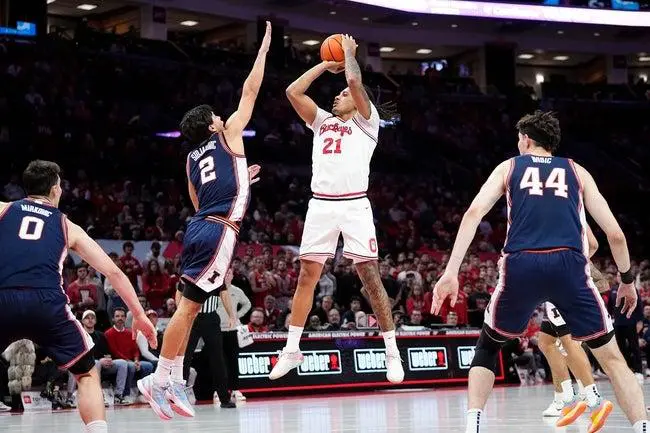
The Setup: Missouri at Illinois
Illinois is laying 8.5 points at home against Missouri in the Braggin’ Rights rivalry game, and I’m already seeing the takes: “It’s a rivalry game, take the points!” Look, I get it. These games are supposed to be tight, emotional battles. But here’s the thing – when you dig into the collegebasketballdata.com efficiency numbers, this isn’t just two teams meeting at a neutral emotional battleground. This is a top-5 national team hosting a squad that’s got some serious structural problems, and the line reflects exactly that reality.
Illinois checks in at #5 nationally in adjusted net efficiency with a +26.1 margin. Missouri? They’re sitting at #58 with a +12.0 mark. That’s not a small gap – that’s a chasm. The Illini boast the #3 adjusted offensive efficiency in the country at 126.0, paired with a #40 adjusted defense at 99.8. Missouri’s adjusted offense ranks #44 at 116.9, but here’s where it falls apart: their adjusted defense sits at #114 at 104.9. Let me walk you through why that 14-point efficiency gap on both ends of the floor makes this number very hittable.
Why This Number Makes Sense
The efficiency story here is crystal clear. Illinois operates at an offensive rating of 142.0 (#8 nationally) according to collegebasketballdata.com, while Missouri’s defensive rating sits at 99.0 (#77). That sounds decent until you realize Illinois has faced better competition and Missouri’s defense has already been exposed – they gave up 80 to Kansas and 76 to Notre Dame in their only real road tests.
Here’s where the pace matchup gets fascinating. Missouri wants to play at 70.9 possessions per game (#107), while Illinois prefers a methodical 62.3 pace (#330). Illinois is going to dictate tempo here at home, and that actually works in their favor. Do that math over 65 possessions, and Illinois’s efficiency advantage translates to roughly 17-18 points. Even accounting for home court being baked into these numbers, we’re looking at a double-digit natural margin.
The Four Factors tell an even clearer story. Illinois shoots 55.6% eFG (#71) while Missouri allows opponents to shoot 40.1% from the field but a concerning 33.9% from three (#240 nationally). That’s not just bad three-point defense – it’s a structural weakness against a team that will take their time and find quality looks. Missouri turns it over 13.3 times per game (#257) with a turnover ratio ranked #228 nationally. Illinois? They’re protecting the rock at 9.9 turnovers per game (#29). That’s a massive discipline gap.
Missouri’s Situation
The Tigers come in at 8-2, but let’s be honest about that record. Their wins are Bethune-Cookman, Alabama State, and Cleveland State – not exactly murderer’s row. They’re scoring 87.4 points per game (#42) with an impressive 52.4% field goal percentage (#10 nationally), and Mark Mitchell is having a nice season at 18.4 points per game. The offensive efficiency looks solid on paper at 123.3 (#54).
But here’s what concerns me: Missouri is a guard-heavy team with Mitchell, Jacob Crews (13.8 PPG), and Jayden Stone (13.3 PPG) carrying the load, and they have zero rim protection. They’re blocking just 3.0 shots per game (#240 nationally). Against Illinois’s size advantage with David Mirkovic (9.6 rebounds per game, #28 nationally) and Tomislav Ivisic (5.2 RPG) patrolling the paint, that’s a recipe for getting dominated inside.
The free throw shooting is another red flag – 68.1% (#275). In a game that could tighten up late, you need to convert from the stripe. Missouri has also shown they can’t handle quality road environments, losing by 20 at Kansas and dropping a game at Notre Dame. This is essentially a road game for them despite being a “neutral” rivalry.
Illinois’s Situation
The Fighting Illini sit at 7-2 with their only losses coming to Nebraska at home (80-83) and at UConn (61-74). That UConn loss actually tells me plenty – they went into a hostile environment against another elite team and competed. They bounced back immediately with a road win at Tennessee, 75-62. That’s the mark of a mature, well-coached team.
Kylan Boswell (17.0 PPG) and Andrej Stojakovic (14.9 PPG) provide perimeter scoring, but the real advantage is inside. Illinois grabs 43.1 rebounds per game (#15 nationally) compared to Missouri’s 39.8 (#68). Mirkovic is a matchup nightmare at 13.8 points and 9.6 boards per game. Illinois blocks 5.6 shots per game (#16) – nearly double Missouri’s output.
The Illini’s 77.0% free throw shooting (#32) is elite compared to Missouri’s struggles. They take care of the basketball, they defend the three-point line well (31.9% opponent three-point percentage, #147), and they control the glass. Those are winning fundamentals, especially at home where they can impose their slower pace.
The Matchup: Where This Gets Decided
This game lives and dies on Illinois’s ability to dominate the paint and control tempo. Missouri wants to run and gun, but Illinois will walk it up, work the shot clock, and pound the ball inside. The Tigers have no answer for Mirkovic and Ivisic’s size. That rebounding gap of 3.3 boards per game becomes massive over 65-70 possessions – that’s potentially 4-5 extra possessions for Illinois.
I keep coming back to those defensive efficiency numbers because they’re just too extreme to ignore. Missouri’s adjusted defense at #114 versus Illinois’s adjusted offense at #3 – that’s not a competitive matchup. Missouri’s guard-heavy lineup will struggle to defend Illinois’s size, and their lack of rim protection means Illinois will get quality looks at the basket all night.
The three-point defense matchup seals it for me. Missouri ranks #240 in opponent three-point percentage. While Illinois isn’t a volume three-point shooting team (33.2%, #196), they take smart shots in their half-court offense. When you give a patient, efficient offense open looks from deep, they’ll make you pay.
Here’s the thing about rivalry games – yes, they can be emotional and tight. But Missouri’s structural deficiencies don’t disappear because it’s the Braggin’ Rights game. Illinois is bigger, more efficient on both ends, better coached, and playing at home where they can control pace. The main risk here is if Missouri gets nuclear hot from three and Illinois goes cold, but the efficiency gap is just too massive.
My Play
I’m taking Illinois -8.5 for 2 units with confidence. This line should probably be closer to 10 or 11 based on the efficiency metrics, and I think we’re getting value here. Illinois wins this game by double digits, controlling the paint, dominating the glass, and forcing Missouri into a half-court grind they can’t win.
Give me Illinois 82, Missouri 69. The Illini impose their will, Mirkovic feasts inside, and Missouri’s defensive shortcomings get exposed against a top-5 caliber offense. I’ve considered the rivalry angle, the potential for Missouri to shoot lights out, and the possibility of a tight finish. The efficiency gap is still too massive to ignore. Illinois covers comfortably.