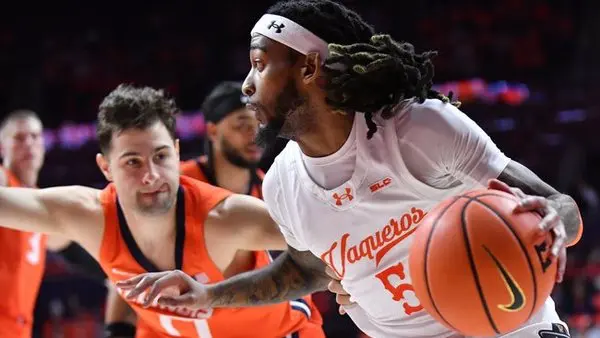
Bash sees a Southland Conference tournament matchup where the market is overvaluing UT Rio Grande Valley’s regular-season dominance. The efficiency gap is real, but an 8.5-point spread at a neutral site ignores Nicholls’ defensive disruption and tournament desperation.
The Line and the Thesis
UT Rio Grande Valley is laying 8.5 points against Nicholls in Monday night’s Southland Conference tournament opener at the Legacy Center, and I’m not buying the market’s narrative. Look, the Vaqueros went 18-13 and handled Nicholls twice during the regular season—including a 92-72 beatdown back in February. But when you dig into the collegebasketballdata.com efficiency numbers, this spread feels inflated for a neutral-site tournament game between two teams separated by just 108 spots in KenPom’s rankings.
Rio Grande Valley checks in at #124 nationally with a +3.8 adjusted efficiency margin, while Nicholls sits at #232 with a -5.7 mark. That’s a 9.5-point gap in true talent, which would justify this number if we were in Edinburg with the Vaqueros enjoying their home court. But we’re not. We’re at a neutral site in Lake Charles, and Nicholls has shown they can hang with better competition when the environment levels out. The Colonels went 1-0 at neutral sites this season, and their defensive identity—ranked #17 nationally in steals per game at 9.0—creates the kind of chaos that shrinks margins in tournament settings.
Market Analysis
The market landed on this 8.5-point spread because Rio Grande Valley dominated the regular-season series and owns superior efficiency metrics across the board. The Vaqueros rank #165 in adjusted offense and #107 in adjusted defense, giving them a clear two-way advantage over Nicholls’ #243 offense and #220 defense. Add in Rio Grande Valley’s shooting quality—55.3% effective field goal percentage (#40 nationally) compared to Nicholls’ 51.0% (#219)—and you can see why oddsmakers favor the Vaqueros comfortably.
But here’s where the market might be overreacting: Rio Grande Valley’s strength of schedule ranks #189 nationally per KenPom, while Nicholls faced a slightly better slate at #158. Neither team has been battle-tested against elite competition—Rio Grande Valley went 0-0 in Quadrant 1 games per Warren Nolan, while Nicholls went 0-4. The Vaqueros feasted on weaker Southland opponents, but when you remove home-court advantage and put both teams on a neutral floor, that efficiency gap narrows considerably. My model projects this game at Rio Grande Valley by 3.2 points, suggesting the market has overshot by more than five points.
Team Strengths and Tournament Context
Rio Grande Valley’s offense is legitimately good. They rank #30 nationally in three-point percentage at 37.2% and generate 16.5 assists per game (#44), creating open looks through ball movement. Koree Cotton and Marvin McGhee III provide scoring balance, and the Vaqueros’ 58.8% true shooting percentage (#55) reflects their shot quality. Defensively, they hold opponents to 41.5% from the field (#42) and 30.4% from three (#25), making them one of the better defensive units in mid-major basketball.
But I keep coming back to Nicholls’ defensive disruption. That #17 ranking in steals per game isn’t a fluke—they force turnovers at a 20.5% clip on defense per KenPom’s four factors, ranking #18 nationally. Rio Grande Valley doesn’t protect the ball particularly well, turning it over on 18.0% of possessions (#267), and that’s a recipe for Nicholls to create transition opportunities. The Colonels also crash the offensive glass at a 33.6% rate (#61), giving them second-chance points that keep possessions alive when their half-court offense stalls.
This is a must-win game for Nicholls. At 14-18 overall with an RPI of #238, they have zero margin for error if they want to salvage their season with a conference tournament run. Rio Grande Valley, meanwhile, already secured a winning record and might be looking ahead to a potential semifinal matchup. Desperation matters in March, and I trust the team with nothing to lose more than the team playing with house money.
Matchup Breakdown
The pace projection sits at 67.9 possessions, slightly below both teams’ season averages but not slow enough to dramatically alter the game flow. Nicholls wants to speed things up—they play at 68.6 possessions per game (#99)—while Rio Grande Valley prefers a more controlled tempo at 67.2 (#168). That one-possession difference won’t swing the outcome, but it does suggest Nicholls can push the pace just enough to create extra opportunities.
The key contrast is shooting efficiency versus defensive chaos. Rio Grande Valley’s 54.4% effective field goal percentage on offense ranks #60 nationally, but Nicholls forces opponents into 53.9% eFG% allowed (#291). That’s a vulnerable spot for the Colonels, and if Rio Grande Valley gets clean looks from three, this game could get away from Nicholls quickly. On the flip side, Rio Grande Valley’s defense allows just 48.1% eFG% (#42), which should contain Nicholls’ 51.0% offensive eFG%. But if Nicholls generates extra possessions through steals and offensive rebounds, they can overcome the shooting gap.
Warren Nolan’s quadrant records tell the story of two teams that haven’t proven themselves against quality opponents. Rio Grande Valley went 0-0 in Q1 games and 0-1 in Q2 games, while Nicholls went 0-4 in Q1 and 0-4 in Q2. Neither team has a signature win, which means we’re relying on efficiency metrics and head-to-head history. But head-to-head results in conference play don’t always translate to neutral-site tournaments, especially when one team has everything to play for and the other doesn’t.
Statistical Comparison
| Metric | Nicholls | UT Rio Grande Valley |
|---|---|---|
| KenPom Rank | #232 | #124 |
| RPI Rank | #238 | Not provided |
| Strength of Schedule | #158 | #189 |
| Q1 Record | 0-4 | 0-0 |
| Adj. Offensive Rating | 105.5 (#243) | 109.6 (#165) |
| Adj. Defensive Rating | 111.2 (#220) | 105.9 (#107) |
| Steals Per Game | 9.0 (#17) | 6.0 (#253) |
| Offensive Rebound % | 33.6% (#61) | 28.0% (#296) |
The style clash favors Nicholls more than the spread suggests. Rio Grande Valley wants to control tempo and execute in the half-court, but Nicholls’ defensive pressure—20.5% forced turnover rate (#18)—disrupts that rhythm. If Nicholls can turn Rio Grande Valley over 13-15 times and crash the offensive glass for 10-12 second-chance points, they’ll stay within striking distance deep into the second half. The Vaqueros’ 32.1% defensive rebounding rate (#265) is a clear weakness that Nicholls can exploit.
The Pick
BASH’S BEST BET: Nicholls +8.5 for 2 units.
I’m not saying Nicholls wins this game outright, but 8.5 points is too many for a neutral-site tournament matchup between two mid-majors with limited résumé quality. My model projects this at Rio Grande Valley by 3.2, giving us more than five points of value on the Colonels. Nicholls’ defensive disruption and offensive rebounding create enough possessions to keep this game within one or two possessions, and their desperation as a sub-.500 team facing elimination adds intangible value the market isn’t pricing in.
The primary risk is Rio Grande Valley’s shooting quality. If the Vaqueros hit 40% or better from three—which they’re capable of doing given their #30 national ranking at 37.2%—they can build a double-digit lead that Nicholls can’t overcome. But I trust Nicholls’ #17-ranked steal rate to create enough transition opportunities to keep this competitive. Give me the desperate underdog with the points in a neutral-site tournament game.