Our lead hoops handicapper, Bash, has identified a significant pace-related edge, making the Under his best bet for Sunday’s afternoon slate in the Big Ten.
The Setup: Purdue at Ohio State
Purdue’s laying 6.5 points at the Schottenstein Center on Sunday afternoon, and I’m already hearing the pushback. “Bash, it’s a trap game! It’s Ohio State at home! The Buckeyes always play tough!” Look, I get the sentiment. But when you dig into the collegebasketballdata.com efficiency numbers, this spread tells a very specific story about two teams heading in opposite directions as we approach March.
The Boilermakers check in at #8 in both polls with a 22-6 record, sporting the #2 adjusted offensive efficiency in the country at 129.4. That’s not a typo. Ohio State counters at 17-11 with respectable numbers but nothing close to elite—#26 adjusted offense, #73 adjusted defense. The gap in net rating is massive: Purdue +30.4, Ohio State +18.7. That’s an 11.7-point chasm in pure efficiency, yet the market is only asking you to lay 6.5. The question isn’t whether Purdue should be favored. It’s whether this number is actually too low.
Game Info & Betting Lines
Game: Purdue Boilermakers (22-6, #8 AP) at Ohio State Buckeyes (17-11)
When: Sunday, March 1, 2026, 1:30 PM ET
Where: Schottenstein Center, Columbus, OH
Conference: Big Ten
Spread: Purdue -6.5
Total: 150.5
Moneyline: Purdue -300, Ohio State +250
Why This Number Makes Sense (or Doesn’t)
Here’s where it gets interesting. The model projects Purdue by just 1.6 points after factoring in a standard 2.2-point home court advantage. That creates a 4.9-point edge on Ohio State +6.5. The market is essentially giving Ohio State nearly five extra points of cushion beyond what the efficiency metrics suggest they deserve.
Why? Two factors are at play. First, the betting trends scream caution: Purdue is 8-14-1 ATS in their last 23 games at the Schott, and Ohio State is 18-5 straight up at home against Purdue over a longer sample. The market remembers these matchups tend to stay tight in Columbus. Second, the pace. Both teams crawl—Purdue 64.9 possessions per game (#280 nationally), Ohio State 65.0 (#273). In a projected 65-possession game, every possession matters, and variance shrinks. That compresses outcomes and inflates the value of home court.
But here’s my counter: those historical trends include vastly different rosters. This Purdue team is fundamentally different from past iterations, and the efficiency gap is too wide to ignore. The model projects a total of 147.6 points, nearly three points under the 150.5 market number. That suggests a grind-it-out affair where Purdue’s superior execution should shine.
Purdue Breakdown: The Analytical Edge
Let’s talk about what makes this Purdue offense so lethal. The Boilermakers rank #3 nationally in assists per game at 19.8, led by point guard Braden Smith, who dishes 8.7 assists per game (#2 in the country). That ball movement creates elite shooting opportunities—57.9% effective field goal percentage (#13) and 38.4% from three (#15). This isn’t a one-dimensional attack.
Trey Kaufman-Renn anchors the interior with 13.9 points and 10.7 rebounds per game (#11 nationally), while Fletcher Loyer provides perimeter scoring at 14.4 points per game. The assist-to-turnover ratio of 2.18 is exceptional—they take care of the ball at just 9.1 turnovers per game (#9). When you combine elite shooting, ball security, and unselfish play, you get the nation’s second-best offense.
Defensively, Purdue is solid if unspectacular—#27 adjusted defensive efficiency at 99.0. They hold opponents to 43.7% shooting and 33.0% from three. Against Ohio State’s 122.3 adjusted offense, that matchup projects to 110.7 points per 100 possessions, or about 72 points in this pace environment.
Ohio State Breakdown: The Counterpoint
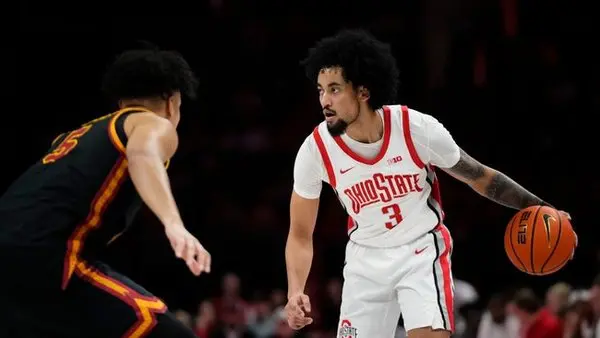
Ohio State’s offense runs through Bruce Thornton, who’s averaging 20.1 points per game (#32 nationally) with 4.0 assists. He’s the engine. But here’s the problem: the supporting cast is severely compromised. John Mobley Jr. (14.0 PPG) is out with a hand injury, and Brandon Noel (9.1 PPG, 5.4 RPG) remains sidelined with a foot injury. That’s two key rotation pieces missing against a team you need every weapon to compete with.
The Buckeyes’ assist-to-turnover ratio of 1.34 pales in comparison to Purdue’s 2.18. They’re turning it over 10.5 times per game compared to Purdue’s 9.1, and in a slow-paced game, those extra possessions are gold. Ohio State’s #73 adjusted defensive efficiency at 103.7 isn’t bad, but it’s not nearly good enough to slow down the nation’s second-best offense. The model projects Purdue scoring 116.5 points per 100 possessions, translating to roughly 76 points.
The home splits offer some hope: Ohio State is 13-5 straight up at home this season and scored 67.6 points per game in home conference games. But they’re just 5-9-1 ATS at home, and they’ve lost three of their last five overall, including getting throttled 74-57 at Iowa.
The Matchup: Where This Gets Decided
This game will be won or lost in the halfcourt. Neither team pushes pace, so transition opportunities will be minimal. Purdue’s offensive efficiency advantage is staggering—a 7.1-point edge in adjusted offense. But the real killer is the execution gap. Purdue’s 19.8 assists per game against Ohio State’s tendency to turn it over creates a possession-by-possession advantage that compounds over 65 possessions.
The rebounding battle slightly favors Purdue—36.1 boards per game versus Ohio State’s 33.6—but neither team is elite on the glass. The shooting efficiency gap is more telling: Purdue’s 50.1% field goal percentage versus Ohio State’s 48.6%, and a 2.5-point edge in effective field goal percentage. In a low-possession game, those percentage-point advantages become actual points on the scoreboard.
Ohio State’s best path to covering is simple: Thornton goes nuclear, they protect home court with energy, and Purdue’s road shooting (they’re 8-2 straight up but the efficiency can dip) regresses. The Buckeyes are 0-9 in Quadrant 1 games this season, but this is technically a home game against a top-10 opponent—desperation can be a motivator.
The injury situation cannot be ignored. Losing Mobley and Noel shrinks Ohio State’s rotation and puts even more pressure on Thornton and Christoph Tilly (14.1 PPG). Purdue has no significant injuries. That’s a massive edge in a physical Big Ten grind.
Bash’s Best Bet
I’m passing on the spread and going UNDER 150.5. The model projects 147.6 total points, and everything about this matchup screams low-scoring affair. Two teams ranked #280 and #273 in pace, both playing deliberate halfcourt basketball, with Purdue’s elite ball security limiting transition opportunities. The betting trends support it too: the total has gone UNDER in 8 of Purdue’s last 11 road games, and Ohio State has gone UNDER in four straight home games.
Purdue’s defense should hold Ohio State’s depleted offense in check, and while the Boilermakers can score, they’re not going to run away with this in a 65-possession game. I’m projecting something in the 75-71 range, right around that 146-point total. Lay the points if you want Purdue, but the cleaner play is betting on two methodical teams grinding this out below the number.
The Pick: UNDER 150.5