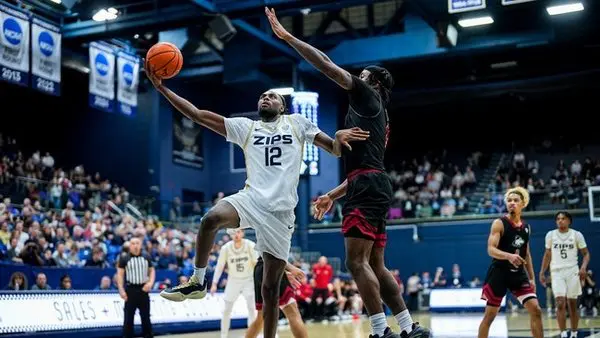
Bash is backing the favorite despite the market’s hesitation, trusting Akron’s offensive firepower and Toledo’s defensive vulnerabilities to cover a spread that looks light given the efficiency chasm between these MAC Tournament semifinal opponents.
The Line and the Thesis
Akron’s laying 7.5 points against Toledo in Saturday night’s MAC Tournament semifinal at Rocket Mortgage FieldHouse, and I’m already hearing the skeptics. These teams just played twice this season—Akron won both by 10 and 9 points—so why is the market only asking for a touchdown-plus? When you dig into the collegebasketballdata.com numbers, the answer becomes clear: this is a conference tournament situational spot where familiarity breeds respect, but the underlying metrics suggest that respect is misplaced. Akron ranks #44 in adjusted offensive efficiency while Toledo checks in at #92. More damning? Toledo’s adjusted defensive efficiency sits at #217 nationally, creating a mismatch that the 7.5-point spread doesn’t fully capture. This qualifies as a mid-major metric gap versus conference tournament perception spot—exactly the kind of edge I hunt.
Why the Market Landed Here
The 7.5-point number reflects two realities: Toledo’s 15-6 ATS record against Akron over their last 21 meetings, and the Rockets’ 9-3-1 ATS mark on the road this season. The market is giving Toledo credit for their cover ability and the neutral-site setting that theoretically levels the playing field. But here’s what the oddsmakers are weighing more heavily: Akron’s 28-5 overall record versus Toledo’s 19-14 mark, and the Zips’ #33 RPI compared to Toledo’s #87. The total sitting at 159.5 makes sense given both teams’ pace—Akron at 71.3 possessions per game (#17 nationally) and Toledo at 69.6 (#57)—projecting to roughly 70 possessions in a neutral setting. Warren Nolan’s strength of schedule data shows Akron at #155 and Toledo at #96, meaning the Rockets have faced marginally tougher competition, but that SOS gap doesn’t overcome the 11.1-point net rating chasm between these programs.
Akron’s Offensive Firepower Meets Toledo’s Defensive Weakness
Akron’s offense ranks #9 nationally in offensive rating at 124.2, averaging 88.6 points per game. Tavari Johnson leads the charge at 18.5 points and 5.2 assists per game, orchestrating an attack that shoots 50.4% from the field (#10) and 38.2% from three (#17). The Zips’ 59.0% effective field goal percentage ranks #8 nationally, and their 18.5 assists per game (#9) demonstrate elite ball movement. Now match that against Toledo’s defensive profile: the Rockets allow opponents to shoot 47.1% from the field, ranking #323 in opponent field goal percentage. Their 109.7 defensive rating (#217) creates a massive vulnerability. I’m projecting Akron to score efficiently in the mid-80s based on this matchup advantage, and Toledo simply doesn’t have the defensive personnel to slow down Johnson and Amani Lyles (15.4 PPG, 5.8 RPG).
Toledo’s Path Requires Offensive Perfection
Toledo’s counter-punch relies on offensive efficiency—they rank #68 in offensive rating at 116.7 and shoot 49.0% from the field (#23). Sonny Wilson (15.3 PPG) and Leroy Blyden Jr. (14.6 PPG, 4.3 APG) provide backcourt scoring, while Sean Craig (13.7 PPG, 8.1 RPG) controls the glass. The Rockets have won four of their last five, including a 98-78 demolition of Buffalo, showing they can score in bunches. But here’s the problem: Akron’s 103.0 defensive rating (#66) is significantly better than Toledo’s offensive rating suggests they can exploit. The Zips hold opponents to 41.9% shooting (#55) and force turnovers at a respectable rate. Toledo’s 33.8 rebounds per game (#267) also creates a rebounding disadvantage against Akron’s 38.1 boards per game (#53). The Rockets need near-perfect execution to keep pace, and their recent 74-72 loss at Miami (OH) showed what happens when the shots don’t fall.
Quadrant Records and Tournament Readiness
Warren Nolan’s quadrant data reveals a critical gap in tournament-caliber experience. Akron’s 1-3 in Quadrant 1 games and 2-2 in Quadrant 2, meaning they’ve faced and competed with quality opponents despite a mid-major schedule. Toledo’s 0-6 in Q1 games and 2-1 in Q2 shows they’ve been overmatched against elite competition. The Rockets’ 3-7 record in Q3 games is particularly concerning—those are games they should win, and the losses suggest fragility against mid-tier opponents. Akron’s 19-1 conference record versus Toledo’s 11-7 mark demonstrates dominance within the MAC. The tempo contrast favors Akron’s ability to control possessions—their 71.3 pace pushes the game into the low-70s possession range where their offensive efficiency advantage compounds. KenPom projects this game at 70 possessions with Akron winning 86-78, and that 8-point margin aligns with my read that 7.5 undersells the Zips’ edge.
The Numbers That Matter
| Metric | Toledo | Akron |
|---|---|---|
| KenPom Ranking | #133 | #64 |
| RPI (Warren Nolan) | #87 | #33 |
| Strength of Schedule | #96 | #155 |
| Q1 Record | 0-6 | 1-3 |
| Adj. Offensive Efficiency | 114.3 (#92) | 120.3 (#44) |
| Adj. Defensive Efficiency | 111.0 (#217) | 106.0 (#113) |
| Net Rating | +3.2 | +14.3 |
The 11.1-point net rating gap jumps off the page. Akron’s 6.0-point adjusted offensive edge and 5.0-point adjusted defensive edge create separation in a 70-possession game that projects to roughly 8-9 points of margin. Toledo’s true shooting percentage of 58.4% trails Akron’s 62.0% by 3.6 percentage points, meaning the Zips convert possessions into points more efficiently. The turnover rates are identical at 0.1%, neutralizing that variable. Akron’s rebounding edge isn’t massive, but their 38.1 boards per game versus Toledo’s 33.8 provides extra possessions that compound over 40 minutes. The style clash favors Akron’s ability to dictate tempo and execute in the halfcourt, where their superior shooting and assist rate create quality looks.
Bash’s Best Bet
BASH’S BEST BET: Akron -7.5 for 2 units.
I’m laying the points with the Zips because the efficiency gap is too wide to ignore. Akron’s offensive rating advantage against Toledo’s porous defense creates a mismatch that should produce consistent scoring in the 80s. Toledo’s recent cover success against Akron (15-6 ATS in the last 21 meetings) gives me pause, but those trends include games from years past with different rosters. The current numbers—#44 adjusted offense versus #217 adjusted defense—tell me Akron wins this game by double digits more often than not. The primary risk is Toledo’s three-point shooting variance; they hit 36.5% from deep (#37) and can get hot in bunches, as shown in their 12-for-whatever performance against Buffalo. If Wilson and Blyden catch fire and push the Rockets into the low 80s, this becomes a sweat. But I’m trusting Akron’s defensive rating (#66) to limit those explosive possessions and their offensive firepower to pull away late. This is a MAC Tournament semifinal where the better team should advance comfortably, and 7.5 points is the right price to pay for that quality gap.