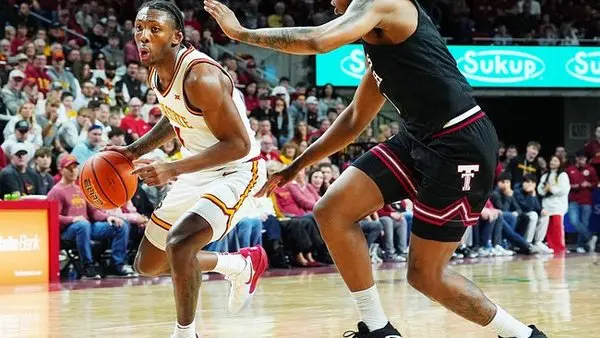
Lubbock hosts a Tuesday night clash with massive conference seeding on the line. The focus shifts to whether Christian Anderson can outpace the Frogs’ elite perimeter guards.
The Setup: TCU at Texas Tech
Texas Tech’s laying 10.5 at home against TCU on Tuesday night, and I can already hear the skeptics. A double-digit spread in a Big 12 matchup between two teams that have split their recent meetings? But when you dig into the collegebasketballdata.com efficiency numbers, this isn’t your typical conference rivalry toss-up. The Red Raiders are a legitimate top-15 team nationally with the #8 adjusted offensive efficiency in the country at 124.8, while TCU checks in at a respectable but not elite #84 at 114.4. That’s a 10.4-point offensive efficiency gap, and it shows up in the net rating differential—Texas Tech holds a +26.5 adjusted net rating (#14 nationally) compared to TCU’s +14.1 (#52). The market isn’t crazy here. The question is whether it’s gone too far.
Game Info & Betting Lines
Game: TCU Horned Frogs (19-10) at #10 Texas Tech Red Raiders (22-7)
Date: Tuesday, March 3, 2026
Time: 7:00 PM ET
Venue: United Supermarkets Arena, Lubbock, TX
Conference: Big 12
Spread: Texas Tech -10.5 (Bovada) / -9.5 (DraftKings)
Total: 148.5
Moneyline: Texas Tech -625 / TCU +430
Why This Number Makes Sense (or Doesn’t)
Let’s start with the fundamentals. Texas Tech’s offensive machine is built on elite shooting—they’re hitting 39.5% from three (#5 nationally) with an effective field goal percentage of 56.5% (#21). That’s the kind of efficiency that wins conference titles. Christian Anderson and JT Toppin form one of the Big 12’s most dangerous duos, and they’re operating within a system that generates 120.2 points per 100 possessions on the raw offensive rating.
TCU’s defense deserves credit—their #36 adjusted defensive efficiency at 100.4 is legitimately good. But here’s the problem: they’re facing an offense that’s built to exploit exactly what TCU struggles with. The Horned Frogs allow 50.9% effective field goal percentage (#156 nationally), and Texas Tech lives in that efficient shooting space. The pace factor matters too. Both teams play slower basketball—TCU at 64.9 possessions per game (#281) and Texas Tech at 67.5 (#161)—which projects to around 66 possessions in this matchup. That’s fewer opportunities for variance, which typically favors the better team.
The market settled on 10.5 because the efficiency gap is real. Texas Tech’s +12.4 net rating advantage translates to roughly 8-9 points in a neutral setting, and home court adds another 2-3. The question isn’t whether Texas Tech should be favored—it’s whether TCU’s recent form and defensive capabilities can keep this closer than the numbers suggest.
TCU Breakdown: The Analytical Edge
TCU’s 19-10 record is built on two things: turnover creation and offensive rebounding. They’re forcing turnovers at a 19.7% clip (#32 nationally) and grabbing 33.7% of available offensive rebounds (#59). That combination creates extra possessions, which matters in a slower-paced game. David Punch (13.4 PPG, 7.6 RPG) and Brock Harding (10.1 PPG, 6.1 APG – #20 nationally) give them legitimate weapons.
The Horned Frogs are also 8-3 ATS in their last 11 road games, and they’ve won four of their last five overall. Their recent road wins at Kansas State (77-68) and Oklahoma State (95-92) show they can compete in hostile Big 12 environments. The problem? They’re shooting just 33.1% from three (#237) and 44.7% overall from the field (#211). Against an elite offense, you can’t afford to leave points on the table.
Texas Tech Breakdown: The Counterpoint
Texas Tech is 17-3 at home and 10-1 SU in their last 11 games in Lubbock. United Supermarkets Arena is a fortress, and the Red Raiders have the personnel to exploit it. JT Toppin is a legitimate All-Big 12 candidate at 20.8 PPG (#21 nationally) and 11.5 RPG (#5), while Christian Anderson runs the show at 19.1 PPG and 7.0 APG (#5 nationally). That’s an elite one-two punch.
The shooting numbers are what separate Texas Tech from the rest of the Big 12. That 39.5% three-point percentage isn’t a fluke—they’re getting quality looks within the system and converting at an elite rate. Their 59.2% true shooting percentage (#42) confirms they’re not just chucking—they’re executing efficiently. The Red Raiders also defend the three-point line well, holding opponents to 31.5% (#57 nationally).
Here’s the concern: Texas Tech is 1-5-1 ATS in their last seven games against TCU, and they’re just 16-13 ATS overall this season. They win games, but they don’t always blow teams out. Their last five games have been solid—wins at Iowa State and Arizona, plus a home destruction of Kansas State—but they’ve also shown vulnerability, losing at Arizona State.
The Matchup: Where This Gets Decided
This game comes down to whether TCU can disrupt Texas Tech’s offensive rhythm. The Horned Frogs have the defensive profile to make it uncomfortable—that #36 adjusted defensive efficiency isn’t an accident. They block shots (4.7 per game, #29 nationally) and create steals (7.9 per game, #68). If they can force Texas Tech into contested threes and limit second-chance opportunities, they have a path to covering.
The problem is offensive execution. TCU’s 50.9% effective field goal percentage (#227) is mediocre, and their 55.2% true shooting (#225) shows they struggle to finish efficiently. Against Texas Tech’s #23 adjusted defensive efficiency at 98.3, the Horned Frogs will need to hit tough shots. Brock Harding’s playmaking will be critical—he’s the engine that makes everything work—but can TCU’s shooters convert against a defense that’s allowing just 49.0% effective field goal percentage (#71 nationally)?
The pace factor favors Texas Tech. In a 66-possession game, the better offensive team typically wins by a wider margin because there’s less randomness. TCU needs chaos—turnovers, offensive rebounds, transition opportunities. If this becomes a halfcourt grind, Texas Tech’s shooting efficiency will eventually break through.
Bash’s Best Bet
I’m taking TCU +10.5. Look, Texas Tech is the better team—no question. But this number feels inflated by the Red Raiders’ recent home dominance and TCU’s road struggles earlier in the season. The Horned Frogs are 8-3 ATS on the road in their last 11, and they’ve shown they can hang in tough Big 12 environments. Their defensive efficiency is legitimate, and in a slower-paced game, that #36 adjusted defensive rating will keep them competitive.
The head-to-head trends matter too. Texas Tech is 1-5-1 ATS in the last seven meetings, and TCU has won two of the last three straight-up. This rivalry has been closer than the market expects, and I don’t see why that changes dramatically here. Texas Tech wins, but TCU’s defense keeps it inside double digits. Give me the Horned Frogs getting two possessions worth of cushion in a game projected around 66 possessions.
The Pick: TCU +10.5