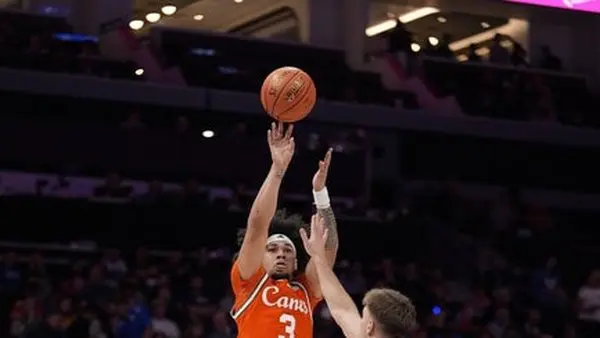
Bash is leaning into the efficiency gap and March stakes in this NCAA first-round neutral-court battle, where No. 7 seed Miami’s defensive edge meets No. 10 seed Missouri’s late-season slide.
The Line and the Lean
No. 7 seed Miami opens as a 2.5-point favorite over No. 10 seed Missouri in Friday’s NCAA Tournament first-round matchup at the Enterprise Center, with a total sitting at 146.5. Tip-off is set for 10:10 PM ET, and this number tells you everything about how the market views these teams: separated by talent, not by a chasm. Miami’s ranked No. 25 in the AP Poll and No. 23 in the Coaches Poll, but that’s not what drives my interest here. It’s the adjusted efficiency gap — a 6.5-point net rating edge per collegebasketballdata.com — that makes this spread feel about right, maybe even a touch light given the tournament stakes. This is a classic NCAA Tournament spot where resume quality and late-season form collide on neutral ground, and Missouri’s 0-2 neutral-court record this season versus Miami’s 2-1 mark matters more than most casual bettors realize.
Tournament Context and Injury Report
Let’s address the elephant in the room first: Missouri is down two key rotation pieces. Annor Boateng has been out since early February with a leg injury and won’t return, while Jevon Porter remains sidelined with no timetable. Both players were significant contributors before going down, and their absence has forced Dennis Gates to lean harder on a guard-heavy rotation led by Mark Mitchell (18.4 PPG) and Jacob Crews (13.8 PPG). Miami, meanwhile, enters this NCAA game fully healthy, with Malik Reneau (20.2 PPG, 6.6 RPG) and Tre Donaldson (14.7 PPG, 5.8 APG) leading a balanced attack. In a single-elimination tournament game where depth and versatility matter, Miami’s clean injury report gives them a tangible edge.
Why the Market Landed Here
The 2.5-point spread reflects two teams with nearly identical shooting profiles — Miami’s 55.6% eFG% ranks 31st nationally, Missouri’s 55.3% checks in at 37th — but divergent defensive identities. Miami’s adjusted defensive rating of 100.6 ranks 41st in the country, while Missouri’s 104.8 mark sits at 92nd. That’s a four-point gap in points allowed per 100 possessions, and in a projected 67.5-possession game, that’s the difference between a coin flip and a clear favorite. The total at 146.5 feels low given both teams’ offensive ratings (Miami 121.8, Missouri 119.4), but the pace blend of 67.5 possessions keeps this from turning into a track meet. Missouri’s tempo ranks 197th nationally at 66.5 possessions per game, and Miami’s not much faster at 68.6 (97th). The market is pricing in a half-court grind where Miami’s defensive edge becomes the separator, and the Warren Nolan data backs that up: Miami’s RPI of 31st versus Missouri’s 64th tells you which team has earned their way into better tournament positioning.
The Efficiency and Motivation Angle
Miami’s net rating advantage of 6.5 points isn’t just a number — it’s a reflection of how these teams have performed against quality competition. Miami’s 2-0 in Quadrant 1 games and 4-0 in Quadrant 2 contests, a spotless 6-0 record against the NCAA Tournament committee’s most scrutinized tiers. Missouri? They’re 4-6 in Q1 games and 2-4 in Q2, a combined 6-10 record that screams “bubble team that got hot at the right time.” The Tigers limped into the NCAA Tournament with three straight losses — falling to Kentucky, Arkansas, and Oklahoma to close the regular season — while Miami dropped just two of their last five, both competitive games against Louisville and Virginia. I’m not dismissing Missouri’s ability to shoot the ball (49.0 FG%, 22nd nationally), but their 68.6% free throw rate ranks 305th in the country, and that’s a glaring weakness in a close NCAA Tournament game where every possession magnifies. Miami shoots just 68.5% from the line (308th), so neither team will win this one at the stripe, but Miami’s offensive rebounding edge (32.8% vs. 32.6%) and superior assist rate (16.0 APG vs. 14.1 APG) give them more ways to generate second-chance points and quality looks.
Matchup Contrasts and Resume Quality
The style clash here isn’t dramatic, but the details matter. Missouri forces just 12.4 turnovers per game (272nd nationally) and allows opponents to shoot 36.5% from three (341st), two defensive metrics that scream “exploitable” against a Miami team that moves the ball well and doesn’t beat itself. Miami’s turnover rate of 11.2 per game (159th) versus Missouri’s 12.4 (272nd) might not look like a massive gap, but in a 67-possession game, that’s 1-2 extra possessions for the Hurricanes. Miami’s also better at defending without fouling — their opponents’ free throw rate of 29.0% ranks 47th nationally, compared to Missouri’s 35.0% (176th). That’s critical in March, where foul trouble can derail a rotation in minutes. The Quadrant 1 record disparity is the clincher for me: Miami’s 2-0 mark proves they can win the games that matter, while Missouri’s 4-6 record suggests they’ve been competitive but not dominant against elite competition. Missouri’s strength of schedule (76th per Warren Nolan) is stronger than Miami’s (229th), but the Hurricanes have taken care of business in a way Missouri hasn’t, and that matters when you’re laying points in a neutral-site NCAA Tournament game.
Advanced Metrics Breakdown
| Metric | No. 7 Miami | No. 10 Missouri |
|---|---|---|
| KenPom Rank | 31st | 52nd |
| RPI Rank | 31st | 64th |
| Strength of Schedule | 229th | 76th |
| Quadrant 1 Record | 2-0 | 4-6 |
| Adj. Offensive Rating | 121.8 (35th) | 119.4 (51st) |
| Adj. Defensive Rating | 100.6 (41st) | 104.8 (92nd) |
| Net Rating | +21.2 (33rd) | +14.7 (55th) |
The KenPom and RPI alignment here is striking — Miami ranks 31st in both, while Missouri sits 52nd and 64th respectively. That’s not a coincidence; it’s a reflection of Miami’s superior performance in meaningful games. The four-factor breakdown reveals why Miami’s offense should have the edge: their offensive rebounding rate of 36.9% ranks 17th nationally, compared to Missouri’s 35.5% (38th). That’s an extra possession or two per game, and in a projected 67.5-possession contest, those margins become the difference between covering and pushing. Missouri’s turnover rate on offense (17.9%, 267th) is also a concern against a Miami defense that forces 18.3% turnovers (82nd nationally). The style clash favors Miami’s ability to control tempo without sacrificing efficiency, and that’s exactly what you want in a neutral-court NCAA Tournament setting where neither team has a crowd advantage.
Bash’s Best Bet
BASH’S BEST BET: Miami -2.5 for 2 units.
I’m laying the points with the No. 7 seed in a spot where the efficiency gap, resume quality, and health all favor the Hurricanes. Missouri’s played a tougher schedule, but they’ve stumbled down the stretch with three straight losses, and their defensive metrics against the three-point line (341st in opponent 3P%) are a glaring weakness Miami can exploit. The primary risk here is Missouri’s shooting variance — they’re 22nd nationally in field goal percentage, and if Mark Mitchell and Jacob Crews get hot early, this game could tighten. But Miami’s 6.5-point net rating edge isn’t a fluke, and their 2-0 Quadrant 1 record tells me they know how to win the games that matter. In a neutral-court NCAA Tournament game where depth and defensive versatility matter, I’m trusting the team that’s healthier, more efficient, and battle-tested in the moments that count. Give me Miami to advance, and give me the Hurricanes to cover a short number that feels like a gift.