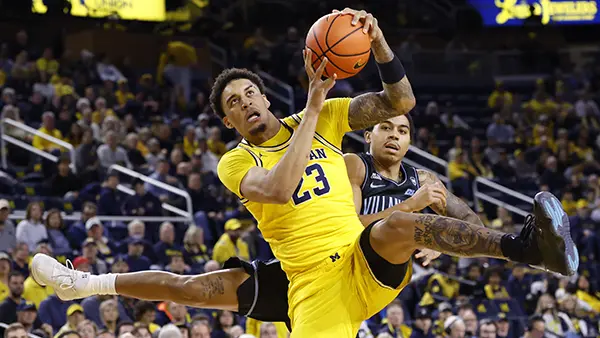
The undefeated Michigan Wolverines welcome USC to the Crisler Center for a high-stakes Big Ten clash this Friday. Our expert analysis breaks down whether Michigan’s top-ranked adjusted net efficiency justifies laying a 22-point point spread against the 8-1 Trojans.
The Setup: USC at Michigan
Michigan’s laying 21.5 to 22.5 points against USC at Crisler Center, and I can already hear the skeptics: That’s too many points in a Big Ten conference game between two solid teams. Look, I get it. USC comes in at 8-1 with a couple of legitimate scorers, and laying three touchdowns feels uncomfortable. But here’s the thing – when you dig into the collegebasketballdata.com efficiency numbers, this isn’t just Michigan being good. This is Michigan being historically elite on one end of the floor while USC has shown some glaring defensive vulnerabilities that get absolutely exploited in this matchup.
Michigan sits at #1 in adjusted defensive efficiency nationally at 88.0, while their adjusted offensive efficiency ranks #6 at 124.2. That’s an adjusted net efficiency of +36.2, which ranks #1 in the country. Meanwhile, USC checks in at a respectable #52 in adjusted net efficiency at +13.1, but that’s built on an offense ranked #28 and a defense that sits all the way down at #137 in adjusted defensive efficiency at 105.8. Let me walk you through why that 23-point gap in adjusted net efficiency isn’t just a number – it’s the entire story of this game.
Game Info & Betting Lines
Matchup: USC (8-1) @ Michigan (8-0)
Date: January 2, 2026
Time: 7:00 PM ET
Location: Crisler Center, Ann Arbor, MI
Spread: Michigan -21.5 to -22.5
Total: 170 to 170.5
Why This Number Makes Sense
Here’s why this line makes sense – Michigan is doing things defensively that we rarely see in college basketball. They’re holding opponents to 34.6% from the field, which ranks #2 nationally. That’s not just good defense, that’s suffocating. USC’s effective field goal percentage sits at 54.6%, which is solid at #94 nationally, but they haven’t faced anything close to this defensive intensity.
On the other end, Michigan is shooting 52.8% from the field (#5 nationally) with an effective field goal percentage of 61.0% (#7). They’re scoring 94.6 points per game (#8) while allowing just 66.6 (#55). Do that math over 72 possessions – which is roughly where this game will land given Michigan’s pace of 71.9 (#71) – and you’re looking at a natural margin in the low-to-mid 20s before you even factor in home court.
The efficiency gap according to collegebasketballdata.com tells us everything. Michigan’s defensive rating of 88.5 (#10) against USC’s offensive rating of 119.4 (#79) suggests USC will score somewhere in the low-to-mid 70s. Meanwhile, USC’s defensive rating of 105.2 (#171) against Michigan’s offensive rating of 125.7 (#37) projects Michigan comfortably into the mid-90s. That’s a 20-point game right there, and we haven’t even discussed the specific matchup advantages yet.
USC’s Situation
USC can score – there’s no question about that. They’re averaging 89.0 points per game (#26) with an adjusted offensive efficiency ranked #28 nationally at 118.9. Chad Baker-Mazara is putting up 20.9 points per game (#18 nationally), and Rodney Rice adds another 20.3 (#28) while dishing 6.0 assists per game (#24). That’s legitimate firepower, and their 37.8% three-point shooting (#36) gives them the ability to get hot from deep.
But here’s where it falls apart: USC is allowing 78.2 points per game, which ranks #278 nationally. That’s not a typo – they’re in the bottom quarter of Division I in points allowed. Their opponent field goal percentage of 41.6% ranks just #106, and while they block shots well at 6.6 per game (#5), they’re not generating turnovers with just 6.3 steals per game (#255). Against Washington in their only loss, they gave up 84 points. Michigan is a completely different animal offensively than Washington.
The Trojans are also getting outrebounded in this matchup on paper. They pull down 37.6 rebounds per game (#149) with an offensive rebounding percentage of 31.7% (#156). Michigan dominates the glass at 45.8 rebounds per game (#2 nationally). That’s an eight-rebound gap per game, which translates to extra possessions Michigan doesn’t need.
Michigan’s Situation
Michigan is rolling right now, and the numbers back up what the eye test shows. They’ve won their last five games by an average margin of 38 points, including a 112-71 destruction of McNeese and a 102-50 annihilation of La Salle. Even on the road at Maryland, they won by 18. This isn’t a team that takes its foot off the gas.
The Wolverines distribute the ball beautifully with 20.8 assists per game (#3 nationally), which speaks to their offensive cohesion. Yaxel Lendeborg leads at 15.8 points and 7.6 rebounds, but this is a balanced attack with five guys scoring between 9.2 and 15.8 points per game. Aday Mara controls the paint with 8.9 rebounds per game (#52) and provides rim protection alongside the team’s 6.4 blocks per game (#7).
That #1 adjusted defensive efficiency isn’t a fluke. Michigan forces teams into bad shots, contests everything, and doesn’t give up second chances despite their lower offensive rebounding percentage. They’re holding opponents to 30.0% from three (#78) and making life miserable in the half-court. At Crisler Center, where the crowd will be rocking for a Big Ten showdown, this defense becomes even more suffocating.
The Matchup: Where This Gets Decided
This game lives and dies on whether USC can score efficiently against elite defense, and I just don’t see it happening. Michigan’s 34.6% opponent field goal percentage against USC’s shooting profile suggests the Trojans will struggle to get clean looks. Baker-Mazara and Rice are talented scorers, but they’re going to see ball pressure and help defense they haven’t experienced yet this season.
Here’s the matchup that seals it for me: Michigan’s rebounding dominance. That eight-rebound per game advantage translates to roughly 5-6 extra possessions over the course of this game. At Michigan’s offensive efficiency, that’s 7-8 additional points just from controlling the glass. Add in USC’s defensive rating of 105.2 against Michigan’s offensive firepower, and you’re looking at the Wolverines scoring in the mid-to-high 90s.
On the other end, USC’s 119.4 offensive rating gets throttled by Michigan’s 88.5 defensive rating. I keep coming back to those adjusted efficiency numbers because they’re just too extreme to ignore. The collegebasketballdata.com projections suggest USC scores somewhere between 68-75 points in this environment. Michigan should hit 95-98. That’s a 23-27 point margin before you factor in any variance.
The three-point shooting matchup also favors Michigan. While both teams shoot around 37% from deep, Michigan’s defense holds opponents to 30.0% while USC allows better looks from three. If Michigan gets hot early – which they’ve done consistently – this could get ugly fast.
My Play
Michigan -21.5 for 2 units
I’m laying the points with Michigan, and I’m comfortable doing it. The efficiency gap is massive, the home court matters, and USC’s defensive issues are going to get exposed against the best offensive system they’ve faced. I’m projecting something in the neighborhood of Michigan 96, USC 72, which covers comfortably.
The main risk here is if USC gets nuclear from three-point range and Baker-Mazara or Rice goes for 30-plus. They have the offensive talent to score in bunches, and if Michigan has an uncharacteristic off-shooting night, this could stay closer than expected. I’ve considered all of that, and the defensive dominance is still too massive to ignore.
Michigan hasn’t just been winning – they’ve been destroying teams. That #1 adjusted net efficiency isn’t an accident, and USC’s #137 adjusted defensive efficiency is going to get picked apart. Take the Wolverines and don’t think twice about it.