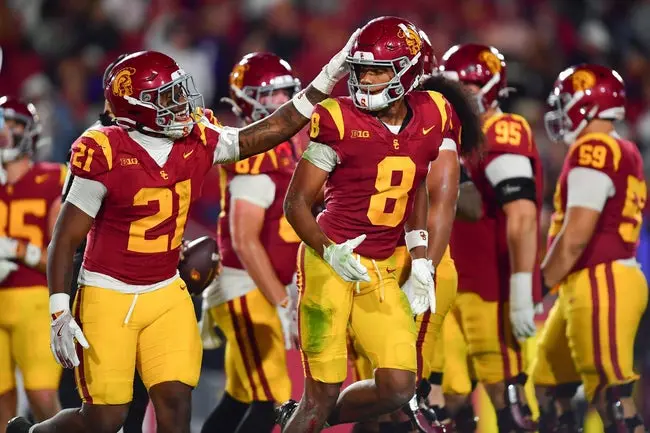
Iowa at USC Predictions: Elite Defense Meets Elite Offense
Rich Crew breaks down Iowa vs USC with his signature efficiency-based approach, weighing the Hawkeyes’ elite defense against the Trojans’ explosive offense for his Week 11 betting pick.
Market Read
On paper, this is the classic strength-on-strength showdown: Iowa’s defense against USC’s fireworks. The books have planted their flag at USC -6.5 and haven’t really blinked. You’re seeing small juice tweaks — BetOnline at -6.5 (-103/-117), Bodog -6.5 (-105/-115) — but no one is racing off the number.
The total opened 49.5 and hasn’t moved. That’s the market quietly saying, “Yeah, this feels right.” We’ve got a mid-range spread between the key numbers of 3 and 7, and a total right in the college football “sweet spot,” where one or two explosive plays can swing it either way.
Moneyline tells the story cleanly: USC -235 implies the Trojans should win more often than not, but not in blowout fashion. Iowa +205 is your “believe-the-defense” ticket — if you think the Hawkeyes can drag USC into their kind of game and keep it one-possession, that price has some teeth.
Cover math is simple enough: USC has to win this by at least a touchdown against a defense allowing 13.67 points per game. Iowa’s job is the same as always — don’t self-destruct on offense, trust a strong defense to shorten the field and squeeze the clock.
Game Dashboard
Matchup: Iowa Hawkeyes at USC Trojans
Date: Saturday, November 15, 2025 – 12:30 PM PT / 3:30 PM ET
Venue: Los Angeles Memorial Coliseum
Consensus Spread: USC -6.5
Consensus Total: 49.5
Best Moneyline: Iowa +205 / USC -235
Iowa Hawkeyes Profile
Iowa is exactly who you think they are: a team built on defensive strength with a functional, deliberate offensive approach. They’re scoring 29.56 PPG and allowing just 13.67 PPG (all opponents). That +15.89 point differential shows a team with legitimate two-sided quality.
Total offense averages 333.44 yards per game — a combination of 133.22 passing yards and 200.22 rushing yards. This represents solid balance and functional operation rather than the severe limitation sometimes attributed to Iowa’s system. They’re passing at 9.22 yards per attempt, which is respectable efficiency for a run-heavy offense. The ground game operates at 4.54 yards per carry on heavy volume with a 59.36% rush rate.
What sets Iowa apart is defensive execution. The Hawkeyes allow just 3.21 yards per rushing attempt, effectively shutting down ground-based attacks. Their run defense is elite. However, the secondary shows more vulnerability than sometimes portrayed — Iowa allows 9.92 yards per pass attempt, which represents average-to-above-average pass defense, not the elite-tier lockdown often claimed. Against competent passing attacks, Iowa can be vulnerable.
Iowa enters at 6-3 overall, 4-2 Big Ten with a strong ATS record of 6-2 ATS recently. They cover numbers consistently and travel reasonably well. Their road Under tendency (13 of 18 on the road) suggests pace control and lower-scoring affairs, though that may change against USC’s explosive offense.
USC Trojans Profile
USC is built in the opposite direction: scoreboard pressure first, everything else second. They’re hanging 39.56 PPG and leading the nation with offensive efficiency. Their passing attack operates at an elite 14.21 yards per attempt — a critical number that significantly exceeds Iowa’s defensive ability to contain vertical passing games. The defense allows 21.78 PPG, which is solid if not elite.
Efficiency-wise, this is as clean as it gets: 7.5 yards per play (nation’s best), 14.21 yards per pass, and a run game that’s more than window dressing at 5.81 yards per carry. USC converts 51.89% of third downs, score on 93.33% of red zone trips.
The Coliseum version of USC is a different animal. At home, they’re 5-0 SU with 4-1 ATS with four straight Overs, outscoring opponents by nearly three touchdowns per game. The offense feels more comfortable, the pace is cleaner, and the explosives come in waves.
The blemish is away from home — 1-3 ATS on the road with some defensive leakage when opponents can sustain drives. That remains relevant context, though playing at home eliminates this particular concern.
Head-to-Head Comparison Matrix
| Category | Iowa | USC | Edge |
|---|---|---|---|
| Run Game | 4.54 YPC | 5.81 YPC | USC |
| Run Defense | 3.21 YPC allowed | 4.29 YPC allowed | Iowa |
| Pass Game | 9.22 YPA | 14.21 YPA | USC (+4.99) |
| Pass Defense | 9.92 YPA allowed | 10.99 YPA allowed | Iowa (slight) |
| Points Per Game | 29.56 | 39.56 | USC (+10.0) |
| Points Allowed | 13.67 | 21.78 | Iowa (-8.11) |
| Turnover Margin | -0.44 | -0.34 | Slight Iowa |
Short version: Iowa has the sturdier defense against the run; USC has a pronounced passing advantage. The critical tug-of-war is Iowa’s strong run defense versus USC’s efficient ground attack, with the pass game representing USC’s primary edge.
Matchup Breakdown
In the trenches, it’s power on power. USC’s 5.81 yards per rush is a serious number, but now they’re running into an Iowa front that allows just 3.21 yards per carry. If the Hawkeyes win that lane and muddy the running game, everything else slows down dramatically.
Through the air, the Trojans have a pronounced advantage. Iowa’s pass defense allows 9.92 yards per pass attempt, while USC is operating at 14.21 yards per pass attempt. That’s a 4.29 YPA advantage for USC — more substantial than casual analysis suggests. This represents a significant differential that favors the Trojans.
For Iowa, drive sustainability is everything. Their approach requires long, controlled drives that keep USC’s offense on the sideline. Field position becomes critical. Iowa needs to establish the run game early, limit negative plays, and convert enough third downs to maintain drives. Even field goals can keep Iowa alive as a dog.
Here’s the lever: If USC hits explosives early and forces Iowa to chase, the Hawkeyes get dragged into a type of game they don’t want — obvious passing downs with offensive limitations. If Iowa keeps this controlled and turns it into a field-position war, suddenly +6.5 looks very playable.
Trends & Patterns
Iowa shows 6-1 ATS recently and has covered consistently. They travel reasonably well defensively. Their road Under tendency (13 of 18 on the road) speaks to pace control and defensive-driven games.
USC is 8-2 SU in last 10 with 11-2 ATS in last 13 home games. The home split is stark: dominant at the Coliseum, vulnerable on the road (1-3 ATS away). Home games lean Over (6 of 7), while road games trend Under. Playing at home eliminates USC’s road vulnerability.
Historically, USC leads the series 7-3, but the last meeting was all Hawkeyes — a 49-24 Iowa win in the 2019 Holiday Bowl. Different teams, different coordinators, but that score remains reference point for both programs. However, expect a more controlled affair this time given Iowa’s defensive priorities.
Advanced Betting Metrics & Projection
When you feed the efficiency metrics into a projection model and factor in pace, you get roughly 68-70 total plays and a landing spot around USC 24, Iowa 17.
Iowa’s defense can suppress USC from their season average, but the Hawkeyes’ own offensive limitations (despite being more functional than previously portrayed) keep them in the high-teens, low-20s range. That kind of game naturally leans dog + Under, though the Under thesis becomes less certain given USC’s home explosiveness.
Cover thresholds are pretty clear:
- If Iowa can establish the run game and avoid negative plays, forcing USC into manageable field position, +6.5 becomes absolutely live.
- USC probably needs one or two short fields or explosives to reach 31+, which is where they start to separate from this number.
The total projection lives near the posted number. The realistic band is 45-54 points, which means both the side and total offer reasonable value depending on your read.
Rich’s Recommendation
Primary Play: Iowa +6.5 (Playable to +6)
Iowa’s defensive strength in the run game combined with their recent ATS success (6-1 last 7) makes +6.5 appealing. While USC’s passing advantage is more pronounced than some analyses suggest (14.21 YPA vs Iowa’s 9.92 allowed), Iowa’s ability to control pace and focus on defensive field position provides legitimate paths to cover.
The matchup shows Iowa keeping this inside a touchdown if they execute their game plan — controlling line of scrimmage, limiting explosives, and moving methodically on offense.
Risk notes: The whole handicap is vulnerable to short fields. If USC forces early turnovers or gets special teams advantage, the Trojans can push this into blowout territory and bust both the spread and total. Iowa needs clean football and methodical execution to cash +6.5.
Bottom line: Iowa’s defense travels and their recent cover record is legitimate. Six and a half points give you breathing room in what profiles as a controlled, field-position game. If Iowa keeps USC’s efficiency in check and manages pace, the Hawkeyes are exactly where you want to be.