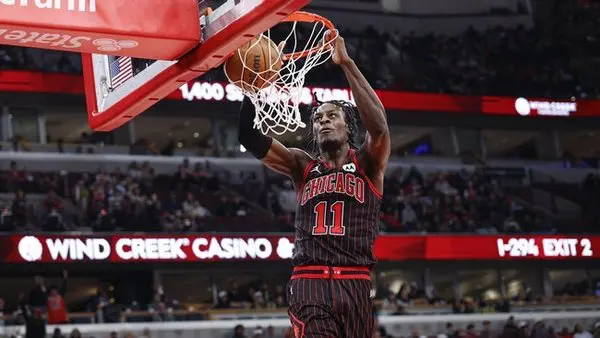
Bash sees a double-digit spread that looks inflated on paper but makes sense when you dig into the efficiency gaps and Chicago’s defensive struggles. The Cavs are rolling, and this number might not be big enough.
The Setup: Cleveland Cavaliers at Chicago Bulls
Cleveland rolls into the United Center on Thursday night laying 13 points against a Bulls team that just got boat-raced by Toronto. The projection has the Cavs winning by a much smaller margin, but before you rush to grab those 13 points with Chicago, let’s talk about what’s actually happening on the floor.
The Cavaliers are 42-27 and sitting fourth in the East, playing their best basketball at the right time. They just handled Milwaukee on the road without Jarrett Allen, getting 27 apiece from Evan Mobley and James Harden in a game that featured 16 lead changes before Cleveland pulled away late. That’s a team that knows how to close.
Chicago is 28-41 and going nowhere. They’re 11-22 on the road and just 17-19 at home, which tells you everything about their lack of home-court edge. Wednesday night, the Raptors hung 139 on them and led by 38 at one point. Josh Giddey, who’d been on an absolute heater with five triple-doubles in seven games, got held to nine points and zero rebounds. That’s not a misprint—zero boards for a guy averaging 8.4 on the season.
Game Info & Betting Lines
Game Time: March 19, 2026, 8:00 ET
Location: United Center
TV: Home: CHSN | Away: FanDuel SN OH, NBA League Pass
Current Betting Lines (< a href="https://www.predictem.com/betting-sites/bovada/">Bovada):
- Spread: Chicago Bulls +13.0 (-115) | Cleveland Cavaliers -13.0 (-105)
- Total: Over 240.5 (-110) | Under 240.5 (-110)
- Moneyline: Chicago Bulls +550 | Cleveland Cavaliers -850
Why This Line Exists
Thirteen points is a statement number, and the market is telling you that Cleveland’s efficiency advantage is real. The season-long numbers back it up—the Cavs are +4.3 in net rating while Chicago sits at -4.5. That’s an 8.8-point gap per 100 possessions, and it’s the foundation of why this spread exists.
Cleveland’s offensive rating of 117.8 ranks among the league’s best, and they’re doing it with balance. Donovan Mitchell is averaging 28 points, Harden is facilitating at 8.0 assists per game, and Mobley just showed you he can dominate without Allen on the floor. The Cavs shoot 47.8% from the field and 59.1% true shooting—those are elite numbers.
Chicago’s defensive rating of 116.9 is bottom-tier stuff, and when you match that against Cleveland’s offense, you get a mismatch that’s hard to ignore. The Bulls allow 115.9 points per game and just gave up 139 to a Raptors team that shot 57% from the field. That’s not a defense that’s going to slow down Mitchell, Harden, and Mobley.
The offensive rebounding gap is another factor—Cleveland holds a 3.8 percentage-point edge on the offensive glass, which means more second-chance opportunities in a game that should be played at a decent pace. At 101.6 projected possessions, there’s room for the Cavs to create separation.
Cleveland Cavaliers Breakdown
The Cavs are 20-14 on the road, and they just proved they can win without Allen by leaning on Mobley’s versatility. His 27 points and 15 rebounds against Milwaukee weren’t empty stats—he controlled the paint and made plays down the stretch when it mattered. That’s growth for a guy who’s always had the tools but is now putting it together consistently.
Harden continues to be the steadying force, and his 8.0 assists per game keep this offense humming. Mitchell is the closer, averaging 28 points on 47.9% shooting and 36.4% from three. When Cleveland needs a bucket, they know where to go.
The Cavs are missing Allen, Tyrese Proctor, and Craig Porter, but none of those absences change the core rotation. Mobley slides into the starting center role, and Thomas Bryant provides depth off the bench. This isn’t a team that’s compromised—they’re just redistributing minutes to guys who are more than capable.
Cleveland’s clutch record is 17-18, which is basically even, but they’re +0.4 in clutch plus-minus. They don’t blow leads, and they don’t panic when games tighten up. That matters against a Bulls team that’s been inconsistent in close situations.
Chicago Bulls Breakdown
Chicago is a team without an identity right now. Giddey’s recent surge was fun, but Wednesday’s dud against Toronto reminded everyone that consistency isn’t this roster’s strength. When your lead facilitator puts up nine points, three assists, and zero rebounds, you’re not beating anybody of consequence.
Matas Buzelis led the Bulls with 19 points in that loss, and Collin Sexton returned from a left leg injury to chip in 14. But those are empty calories in a 30-point blowout. Chicago’s offensive rating of 112.4 is mediocre, and their defensive rating of 116.9 is a problem they haven’t solved all season.
The Bulls are missing Zach Collins, Noa Essengue, Jaden Ivey, Anfernee Simons, and Isaac Okoro. That’s five rotation pieces, and while some of those guys are out for the season, the cumulative effect is a roster that’s thin and lacks depth. Simons and Ivey are both significant absences in the backcourt, which puts more pressure on Giddey, Sexton, and Tre Jones to carry the offensive load.
Chicago’s home record of 17-19 tells you they don’t have any real advantage at the United Center. They’re 28-41 overall and have lost three of four, including that embarrassing performance against Toronto. This is a team that’s playing out the string, and motivation is a legitimate question mark.
The Matchup
This game comes down to Cleveland’s ability to execute in the halfcourt and Chicago’s inability to get consistent stops. The Cavs rank 117.8 in offensive rating, and when you pit that against a Bulls defense that ranks 116.9, you’re looking at a scenario where Cleveland should score efficiently all night.
The pace projection of 101.6 possessions favors Cleveland because it gives them more opportunities to exploit their offensive advantages. Chicago likes to play fast at 102.5 pace, but they don’t have the defensive discipline to keep games close when the tempo picks up. Cleveland’s 100.7 pace is slightly slower, but they’re comfortable in transition and can push when they need to.
The offensive rebounding edge for Cleveland is significant—3.8 percentage points might not sound like much, but in a game with over 100 possessions, that’s multiple extra chances to score. Chicago ranks 23.2% in offensive rebounding, which is below average, and Cleveland’s 27.0% is well above the league norm. Mobley and the Cavs’ frontcourt should dominate the glass.
Chicago’s shooting percentages are basically in line with Cleveland’s—58.2% true shooting versus 59.1%, and 55.0% effective field goal percentage versus 55.8%. Those gaps are within noise, so this isn’t about one team shooting dramatically better than the other. It’s about Cleveland’s ability to create better looks and Chicago’s inability to defend without fouling or giving up second chances.
The clutch numbers are interesting—Chicago is 19-17 in clutch situations with a -0.3 plus-minus, while Cleveland is 17-18 with a +0.4 plus-minus. That’s basically even, which means if this game comes down to the final five minutes, neither team has a clear edge. But I don’t think this game gets that close. Cleveland’s efficiency advantage should allow them to build a lead and maintain it.
Bash’s Best Bet & The Play
The projection has Cleveland winning by 2.5 points, which makes that +13 look tempting for Chicago. But projections don’t account for motivation, roster depth, or the fact that the Bulls just quit against Toronto. My model projects a total of 234 points, which is 6.5 points below the posted total of 240.5, and that’s where I’m finding the value.
Cleveland’s defensive rating of 113.5 is solid, and while Chicago can score in spurts, they’re not going to light up the scoreboard against a Cavs team that’s locked in. The Bulls’ offensive rating of 112.4 is below average, and without Simons and Ivey, they lack the firepower to keep pace if Cleveland gets rolling.
I’m staying away from the spread because 13 is a big number, and Cleveland’s tendency to play close games in clutch situations makes me nervous about laying that many points. But the total feels soft. The projection points to 234, and even if both teams push the pace a bit, I don’t see how we get to 241 unless both defenses completely no-show.
The Play: Under 240.5 (-110). Cleveland’s defense should keep Chicago in check, and the Cavs don’t need to run up the score to win this game comfortably. The risk is that the pace gets out of hand and both teams start trading buckets in transition, but I trust Cleveland’s halfcourt execution to slow this game down when they need to. Lock in the under and expect a final score somewhere in the 120-112 range.