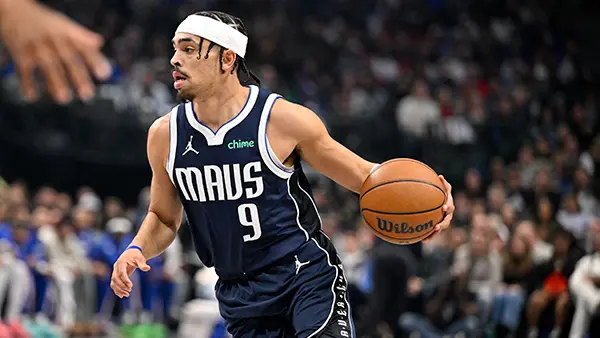
Dallas just put up 144 points on Utah, but they did it without Kyrie Irving and Anthony Davis, and now they’ll likely be without rookie star Cooper Flagg. Bash asks if Klay Thompson’s vintage shooting can ruin the best bet for a Jazz team that is also shorthanded and reeling from a 22-point loss.
The Setup: Utah Jazz at Dallas Mavericks
Dallas is laying 3.5 points at home against Utah on Saturday at American Airlines Center, and the total sits at 241.5. These teams just met Thursday night, with the Mavericks blowing out the Jazz 144-122 behind Klay Thompson’s season-high 26 points. But here’s what matters for this rematch: Dallas played that game without Cooper Flagg, who’s averaging 18.8 points and 4.2 assists per game. The rookie is questionable here, and that uncertainty is baked into a spread that feels lighter than it should given the context. Utah comes in at 14-27 and 5-15 on the road, while Dallas sits at 16-26 but a much more respectable 12-11 at home. The Mavericks are -150 on the moneyline, which tells you the market respects their home floor advantage but isn’t ready to hammer them without clarity on their rotation.
The thesis here is simple: Dallas should be bigger favorites if Flagg plays, and this number represents value on a Mavericks team that just found offensive rhythm against this exact opponent. Utah’s road struggles aren’t a small sample—they’re covering fundamental issues with pace management and defensive efficiency away from home.
Game Info & Betting Lines
Utah Jazz (14-27) at Dallas Mavericks (16-26)
Date: Saturday, January 17, 2026
Time: 5:00 ET
Venue: American Airlines Center
TV: Home: KFAA-TV, Mavs.com | Away: KJZZ-TV, Jazz+, NBA League Pass
Current Betting Lines (BetOnline:
- Spread: Dallas Mavericks -3.5 (-110)
- Moneyline: Dallas Mavericks -150 | Utah Jazz +130
- Total: 241.5 (Over/Under -110)
Why This Line Exists
The market landed on Dallas -3.5 because there’s legitimate uncertainty around Cooper Flagg’s availability after that ankle sprain. Without him Thursday, the Mavericks still put up 144 points—their offensive system clearly functions at a high level even when the rookie sits. But Flagg’s 18.8 points and secondary playmaking (4.2 assists per game) add a dimension that matters in tighter possessions. If he’s active, this number probably should’ve opened closer to 5 or 5.5 given the home/road split disparity between these teams.
Dallas is 12-11 at home. Utah is 5-15 on the road. That’s a 16-game swing in performance based purely on location, and it reflects real structural differences in how these teams execute away from their comfort zones. The Jazz struggle to maintain defensive intensity on the road, and when you’re already dealing with Walker Kessler being out for the season, your rim protection becomes a rotating door. Dallas exploited that Thursday with efficient interior scoring, and there’s no reason to believe Utah fixed that problem in 48 hours.
The total at 241.5 reflects Thursday’s 266-point explosion, but the market is accounting for potential regression. That game featured Dallas shooting the lights out and Utah unable to get stops in transition. A more typical version of this matchup probably lands in the 230-235 range, which means the number is slightly inflated by recency bias.
Utah Jazz Breakdown: What You Need to Know
Lauri Markkanen is having an excellent individual season at 27.9 points and 7.2 rebounds per game, and Keyonte George has emerged as a legitimate secondary creator with 23.7 points and 6.8 assists. But those numbers don’t translate to winning basketball when your defensive infrastructure is missing. Walker Kessler’s season-ending injury removed the one player who could anchor their interior defense, and the Jazz have no comparable replacement on the roster.
On the road, Utah’s issues compound. They’re 5-15 away from home because they can’t control pace in hostile environments. When Markkanen and George have to work harder for their shots, the offense stagnates, and their role players don’t step up consistently. Georges Niang remains out with a foot injury, which removes another veteran presence who could stabilize rotations in tight moments. The Jazz are essentially asking two high-usage scorers to carry the load every night, and that’s not sustainable against competent home teams.
Dallas Mavericks Breakdown: The Other Side
Anthony Davis is posting 20.4 points and 11.1 rebounds per game, and P.J. Washington adds 14.6 points and 7.4 boards as a versatile forward. The Mavericks’ home success (12-11) comes from their ability to control tempo and execute in half-court sets when the crowd is behind them. Thursday’s 144-point outburst showed what happens when their shooters get clean looks—Klay Thompson went 6-for-6 from deep and scored 26 points, his best output of the season.
The elephant in the room is Kyrie Irving, who remains out recovering from ACL surgery. There’s optimism around a pre-All-Star break return, but for this game, Dallas is operating without their primary playmaker. That’s where Cooper Flagg’s status becomes critical. If the rookie plays, he provides the secondary creation that keeps the offense flowing. If he sits again, Dallas leans harder on Davis and Washington to generate offense, which worked Thursday but might not be repeatable every night.
Dereck Lively II is also out for the season, which thins their frontcourt depth. But against a Utah team missing Walker Kessler, that becomes less of a disadvantage and more of a wash.
The Matchup: Where This Game Gets Decided
This game gets decided in the paint and in transition. Dallas scored efficiently inside Thursday because Utah had no rim protector capable of altering shots consistently. Anthony Davis took advantage, and the Mavericks’ role players got easy finishes off cuts and drives. If Utah can’t solve that problem—and they can’t, because Kessler isn’t walking through that door—Dallas will control the game through interior scoring and offensive rebounding.
The pace factor matters here. Thursday’s game hit 266 total points because both teams pushed tempo and neither could get consistent stops. Dallas prefers a slightly slower, more controlled pace at home, which actually works in their favor for covering a small spread. If they can grind possessions and force Utah into half-court sets, the Jazz don’t have the offensive creativity to score efficiently without transition opportunities.
Keyonte George’s 6.8 assists per game suggest he’s a capable facilitator, but he’s not breaking down set defenses consistently. When Dallas can load up on Markkanen and make George beat them as a scorer, Utah’s offense becomes predictable. The Mavericks don’t need to be perfect defensively—they just need to eliminate easy baskets and force contested jumpers. Over 90-95 possessions, that’s the difference between covering 3.5 points and falling short.
Bash’s Best Bet & The Play
I’m backing Dallas -3.5 for two units, and the logic is straightforward: Utah can’t defend the paint without Kessler, and Dallas just proved they can exploit that weakness even without their rookie star. If Cooper Flagg plays, this number is a gift. If he sits, the Mavericks still have enough offensive firepower at home to win by 5-7 points against a Jazz team that’s 5-15 on the road.
The main risk is Dallas coming out flat after Thursday’s blowout win. Emotional letdowns are real, especially for a team sitting at 16-26 with limited playoff hopes. But the home/road split tells me the Mavericks take care of business at American Airlines Center, and Utah doesn’t have the defensive personnel to keep this competitive late.
BASH’S BEST BET: Dallas Mavericks -3.5 for 2 units.
This is a spot where the line reflects uncertainty that shouldn’t exist. Dallas is the better team at home, and Utah’s road struggles are structural, not situational. Lay the points.