Bash sees value fading the Wolves in a matchup where Minnesota’s injury to Edwards and Utah’s decimated roster create a tighter contest than the double-digit spread suggests, while the projected pace and offensive firepower point to a total that climbs over the posted number.
The Setup: Utah Jazz at Minnesota Timberwolves
Minnesota is laying 12.5 points at home against a Jazz team that’s lost six of its last seven, and on the surface, this looks like a spot to hammer the home favorite. But here’s the thing—the Wolves are without Anthony Edwards for at least another week with knee inflammation, and Utah, despite being the second-worst team in the West at 20-48, has shown they can hang around offensively even with their roster gutted by injuries. The projection has Minnesota by 7.4 points, which creates a five-point gap against this spread. That’s not a small difference.
The total sits at 233.5, and with both teams capable of pushing pace and generating efficient looks—Utah at 113.2 offensive rating, Minnesota at 116.1—the math points to more scoring than the market is pricing. The projected total lands at 236.1, giving us a medium edge on the over. This is a game where the injuries matter, but not in the way the spread suggests. Minnesota is still the better team, but without their best player, asking them to cover nearly two possessions against a Jazz squad that can score is a tougher ask than this number implies.
Game Info & Betting Lines
Utah Jazz (20-48) at Minnesota Timberwolves (42-27)
When: March 18, 2026, 8:00 ET
Where: Target Center
Watch: FanDuel SN North (home), KJZZ-TV, Jazz+, NBA League Pass (away)
Current Betting Lines (MyBookie.ag):
- Spread: Minnesota Timberwolves -12.5 (-110)
- Total: 233.5 (Over/Under -110)
- Moneyline: Minnesota -769 | Utah +496
Why This Line Exists
The market is pricing this on season-long résumés and home-court advantage. Minnesota sits at 42-27 and sixth in the West, while Utah is 20-48 and playing out the string. The Wolves are 23-12 at Target Center, and the Jazz are a brutal 8-26 on the road. That’s a 22-win gap in the standings, and the books are assuming Minnesota handles business even without Edwards.
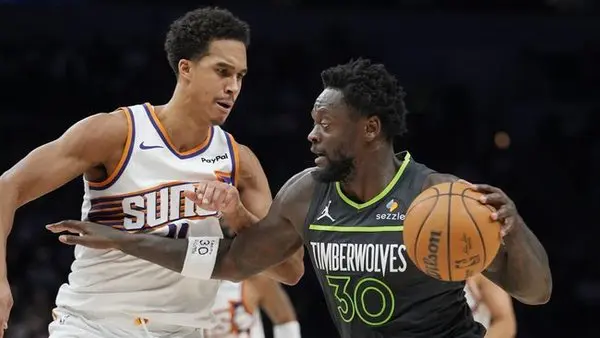
But here’s what the line doesn’t fully account for: Julius Randle just dropped 32 points in back-to-back games, and Bones Hyland added 22 off the bench in the win over Phoenix. That’s production, but it’s also a team adjusting to life without their 29.5 points-per-game engine. The Wolves are 7-4 without Edwards this season, which is solid, but those wins haven’t come by blowout margins. Meanwhile, Utah’s offensive rating of 113.2 isn’t elite, but it’s not dead either. Cody Williams just went for 34 points in Sacramento, Brice Sensabaugh added 22, and Isaiah Collier chipped in 21. This isn’t a team that rolls over offensively.
The net rating edge favors Minnesota by 10.6 points per 100 possessions, which is strong, but the projection accounts for that and still lands at 7.4 points. The market is giving you an extra five points of cushion on Utah, and that’s where the value sits. The effective field goal percentage gap is 2.8 percentage points in Minnesota’s favor, which matters, but it’s not a chasm. This line exists because the Jazz are bad and the Wolves are good. The question is whether that gap is actually 12.5 points without Edwards.
Utah Jazz Breakdown
The Jazz are a mess from a roster standpoint. Lauri Markkanen remains out and is being re-evaluated with no clear timetable. Keyonte George is sidelined with a hamstring injury for at least two more weeks. Walker Kessler, Jaren Jackson Jr., and Jusuf Nurkic are all done for the season. That’s five rotation pieces gone, including their best player and their entire frontcourt depth. Airious Bailey is questionable, and John Konchar is in danger of missing his fourth straight game with calf injury management.
What’s left is a team that can still score. Cody Williams, Brice Sensabaugh, and Isaiah Collier have stepped up in recent games, and Utah’s offensive rating of 113.2 shows they can generate decent looks even with a skeleton crew. The problem is defense—120.6 defensive rating is bottom-five in the league, and they don’t have the personnel to slow down Minnesota’s offensive weapons. The pace sits at 102.7, which is up-tempo, and that plays into their hands offensively. They want to run, they want to shoot, and they’ll give up points on the other end.
The clutch numbers are interesting—13-18 record in clutch situations, but a positive plus-minus of 0.5 in those spots. They’re not winning games, but they’re competitive late. That’s the profile of a team that hangs around and covers spreads even when they lose outright.
Minnesota Timberwolves Breakdown
Minnesota is 42-27 and sitting in sixth place in the West, but this isn’t the same team without Anthony Edwards. He’s the NBA’s third-leading scorer at 29.5 points per game, and while the Wolves have managed a 7-4 record without him, they’re leaning heavily on Randle and role players to fill the void. Randle has been excellent—32 points in back-to-back games—and Bones Hyland gave them 22 off the bench against Phoenix. Ayo Dosunmu added 19, and Rudy Gobert pulled down 19 rebounds. That’s a balanced effort, but it’s also a team working harder to generate offense without their primary creator.
The offensive rating of 116.1 is strong, and the defensive rating of 112.9 is top-10 in the league. The effective field goal percentage of 56.4% is elite, and they shoot 37.1% from three as a team. The pace is slower than Utah’s at 101.4, but the projected pace blend lands at 102.0 possessions, which is right in the middle. That’s enough possessions for both teams to get their offense going, and Minnesota’s efficiency advantage should show up in the final margin.
The clutch stats favor Minnesota—16-12 record and a 57.1% win rate in clutch situations compared to Utah’s 41.9%. That’s a 15.2% gap, and it matters in tight games. If this comes down to the final five minutes, the Wolves have the edge. But the question is whether they can build a big enough lead early to avoid that scenario, and without Edwards, that’s tougher.
The Matchup
The offensive matchup slightly favors Utah in a weird way—their offense against Minnesota’s defense creates a mismatch value of just 0.3 points per 100 possessions, which is basically within noise. Minnesota’s offense against Utah’s defense is a different story, with a -4.5 mismatch favoring the Wolves. That’s a medium edge, and it’s where Minnesota should do most of their damage. But here’s the thing: Utah’s pace and willingness to trade baskets keeps them in games. They’re not going to slow this down and grind it out. They’re going to run, shoot threes, and hope their offensive efficiency can keep pace with Minnesota’s defensive pressure.
The rebounding edge is minimal—1.0 percentage point in Minnesota’s favor—and the turnover gap is within noise at 0.3 percentage points. This isn’t a game where one team is going to dominate the margins. It’s going to come down to shot-making and whether Minnesota’s shooting quality advantage holds up over 102 possessions. My model projects Utah at 115.4 points and Minnesota at 120.8, which gives you a total of 236.1. That’s 2.6 points over the posted number of 233.5, and with both teams capable of pushing pace and generating efficient looks, the over has value.
The spread projection of 7.4 points is the key number here. Minnesota should win this game, but asking them to cover 12.5 without Edwards is a big ask. Randle and Hyland have been great, but they’re not Anthony Edwards. Utah’s offense is good enough to keep this within single digits, and the five-point gap between the projection and the spread is significant.
Bash’s Best Bet & The Play
The Play: Utah Jazz +12.5 (-110)
I’m taking the points with Utah. Minnesota is the better team, and they should win this game at home, but 12.5 points is too many to lay without Edwards. The projection has this at 7.4, and that five-point cushion is real value. Utah’s offense is functional even with their roster decimated, and they’ve shown they can hang around in games even when they lose. Cody Williams, Brice Sensabaugh, and Isaiah Collier have all stepped up recently, and the pace of this game favors their style. Minnesota will likely win, but I’m betting they win by single digits or Utah keeps it close enough to cover.
Secondary Look: Over 233.5 (-110)
The total also has value. The projected total is 236.1, and with both teams capable of scoring efficiently and the pace sitting at 102 possessions, this game should push over the number. Utah’s defensive rating is bottom-five in the league, and Minnesota’s offensive efficiency should take advantage. The over has a medium edge, and it’s a solid secondary play if you want to stack it with the spread.
Risk note: If Minnesota comes out hot and builds a big lead early, this could get ugly. But without Edwards, I’m betting they don’t have the firepower to blow the doors off a team that can score like Utah. Take the points.