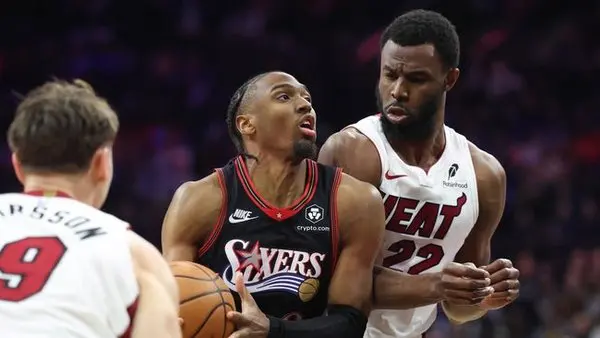
Houston hits the road with a legitimate +5.6 net rating, but Bryan Bash’s best bet focuses on a stylistic clash where Miami’s league-high home pace could pull the Rockets out of their defensive comfort zone.
The Setup: Rockets at Heat
The Rockets are laying 3.5 points on the road in Miami Saturday afternoon, and this line doesn’t add up once you run the efficiency math. Houston sits at 37-21 with a +5.6 net rating, while Miami limps in at 31-29 with a +2.4 net rating. On paper, that’s a 3.2-point gap per 100 possessions favoring the Rockets — but the projection has this game essentially dead even at Miami +0.4 once you factor in home court. That creates a 3.9-point edge against the spread in favor of the Heat.
Here’s the wrinkle: both teams are decimated. Houston’s without Jabari Smith Jr. (ankle), and Miami’s missing Norman Powell (hamstring) and Terry Rozier (suspended indefinitely). The Rockets just erased a 19-point deficit in Orlando behind Kevin Durant’s 40-piece, but they’re 17-14 on the road. Miami’s 17-11 at Kaseya Center, and while they just dropped a close one in Philly, Bam Adebayo put up 29 and 14. The market’s disrespecting Miami here — this number assumes Houston’s road form holds up against a Heat team that defends its home floor and runs at a pace that changes everything in this matchup.
Game Info & Betting Lines
Date & Time: February 28, 2026, 3:30 ET
Location: Kaseya Center
TV: Prime Video
Current Odds (MyBookie.ag):
- Spread: Rockets -3.5 (-110) | Heat +3.5 (-110)
- Total: 225.0 (Over/Under -110)
- Moneyline: Rockets -159 | Heat +129
Why This Line Exists
The market’s giving Houston 3.5 points on the strength of that +5.6 net rating versus Miami’s +2.4 mark — a 3.2-point efficiency gap that typically justifies this kind of spread. But the possessions math tells a different story once you blend these two teams’ pace. Houston plays at 96.6 possessions per game, one of the slowest tempos in the league. Miami runs at 104.9, pushing the ball and generating more scoring opportunities. The pace blend settles at 100.8 possessions — closer to Miami’s preferred tempo than Houston’s grind-it-out style.
That pace advantage matters because it amplifies Miami’s offensive rhythm while pulling Houston out of its comfort zone. The Rockets post a 117.2 offensive rating, elite stuff, but they do it by controlling tempo and limiting possessions. Miami’s 114.0 offensive rating isn’t as gaudy, but they compensate with volume — 119.9 points per game versus Houston’s 114.7. When you project this game over 100.8 possessions, the model sees Houston at 115.3 points and Miami at 113.7, essentially a pick’em with home court as the tiebreaker.
The injuries tilt this further. Smith Jr. gives Houston 15.5 points and 6.8 boards — losing him forces Reed Sheppard into the starting lineup, and while Sheppard lit up Orlando with 20 points off the bench, asking him to start on the road is a different ask. Miami’s without Powell (22.5 PPG) and Rozier, but Tyler Herro and Bam Adebayo just combined for 54 points in Philly. The writing’s on the wall with this matchup: Miami’s got enough firepower at home to stay within this number, even shorthanded.
Rockets Breakdown: What You Need to Know
Kevin Durant is carrying this team right now — 26.1 points per game on 50.8% shooting and 40.2% from three. He dropped 40 on Orlando Thursday, including 26 in the second half to erase that 19-point deficit. Alperen Sengun (20.4 PPG, 9.2 RPG, 6.4 APG) gives them a versatile hub in the paint, shooting 50% overall, and Amen Thompson (17.3 PPG, 7.6 RPG) adds athleticism and transition punch.
But Houston’s 17-14 on the road for a reason. They defend at 111.6 — solid, not elite — and they rely on controlling pace to limit opponent possessions. When teams push them into faster games, the Rockets struggle to maintain their efficiency edge. Their clutch record sits at 15-16, shooting just 42.8% in crunch time with a 31% mark from three. They’re not built to win track meets, and Miami’s going to force them into one.
The offensive rebounding gap is massive: Houston crashes at a 35.2% clip, one of the best marks in the league. That’s 9.8 percentage points better than Miami’s 25.5% rate. Second-chance points could be the difference if this game stays tight, but only if Houston can slow it down enough to set their offensive glass. If Miami gets out in transition, those boards don’t matter.
Heat Breakdown: The Other Side
Miami’s offense runs through Tyler Herro (21.2 PPG, 48.2% FG, 36.2% from three) and Bam Adebayo (18.5 PPG, 9.8 RPG). Herro just put up 25 in Philly, and Adebayo’s 29-and-14 performance showed he can dominate when the Heat need a bucket. Andrew Wiggins (16.1 PPG, 47.5% FG, 40.8% from three) gives them a third scoring option who’s shooting the lights out from distance, and Jaime Jaquez Jr. (15.0 PPG, 50.3% FG) provides versatile playmaking at 4.6 assists per game.
The Heat’s 17-11 at home because they defend their building — that 111.6 defensive rating matches Houston’s exactly. But where they separate is ball movement: 28.7 assists per game and a 66.1% assist rate, both significantly higher than Houston’s 24.8 and 58.2%. They share the rock, they generate open looks, and at home they execute. Their clutch record is 13-13 with a 50% win rate in close games — dead average, but they shoot 41.8% in those spots with a solid 79.2% from the stripe.
Losing Powell and Rozier hurts, no question. That’s 22.5 points per game gone from the starting lineup. But Herro’s been the primary initiator all season, and Adebayo’s usage will spike without Powell’s volume. The Heat turn it over at just 11.9% — 1.5 percentage points better than Houston’s 13.4% — which means they’ll protect possessions even when the game gets chaotic. At 104.9 pace, they’re built to run, and Kaseya Center gives them the environment to push tempo.
The Matchup: Where This Game Gets Decided
The efficiency gap is too wide to ignore here — but it’s not the gap you think. Houston’s offense versus Miami’s defense creates a +5.6 mismatch per 100 possessions in the Rockets’ favor. That’s the medium-level edge that justifies Houston as the favorite. But Miami’s offense versus Houston’s defense only generates a +2.4 advantage for the Heat, a smaller gap that suggests Houston should control the scoring battle.
Except pace changes everything. Over 100.8 possessions, that +5.6 offensive advantage for Houston translates to roughly 5.6 extra points. But Miami’s running 8.3 more possessions per game than Houston’s season average. Those extra possessions give Miami more chances to score, more transition opportunities, and more ways to exploit Houston’s road defense. The Rockets are elite at offensive rebounding, grabbing 35.2% of their misses, but Miami’s ball security (11.9% turnover rate) means fewer live-ball turnovers to crash. Houston has to earn their second chances in the halfcourt, and that’s harder when Miami’s pushing pace.
My model projects this total at 228.9 — nearly four points higher than the posted 225.0. That’s a strong edge toward the over, driven entirely by pace blend. Both teams shoot around 57% true shooting and 53-54% effective field goal percentage, so the shooting quality is basically priced correctly. The difference is volume. At 100.8 possessions, you’re looking at 115.3 for Houston and 113.7 for Miami, and both teams have the offensive firepower to hit those marks even with key absences.
Bash’s Best Bet & The Play
I’m taking the points all day long. Miami +3.5 gives you a 3.9-point cushion against a projection that has this game at Heat +0.4. That’s a strong edge, and it’s rooted in pace, home-court execution, and Houston’s road mediocrity. The Rockets are 17-14 away from home, and while Durant’s playing out of his mind, asking him to carry this team without Jabari Smith Jr. in a faster-paced environment is a tall order. Miami’s shorthanded too, but Herro and Adebayo just proved they can score in bunches, and Kaseya Center has been kind to this Heat team all season.
The risk is Houston’s offensive rebounding — that 9.8-percentage-point gap could generate enough second-chance points to swing a close game. But if Miami executes in transition and forces Houston into a track meet, those boards won’t matter. The clutch data shows both teams are roughly even in tight games, so if this comes down to the final possession, Miami’s got as good a shot as anyone to cover or win outright.
BASH’S BEST BET: Heat +3.5 for 2 units. This is exactly the spot where the market overvalues the road favorite’s net rating without accounting for pace and home-court execution. Miami’s got the tempo advantage, the home crowd, and enough offensive talent to keep this within a possession. I’ve seen this movie before — Houston grinds, Miami runs, and the game stays closer than the spread suggests. Give me the home dog with the points.