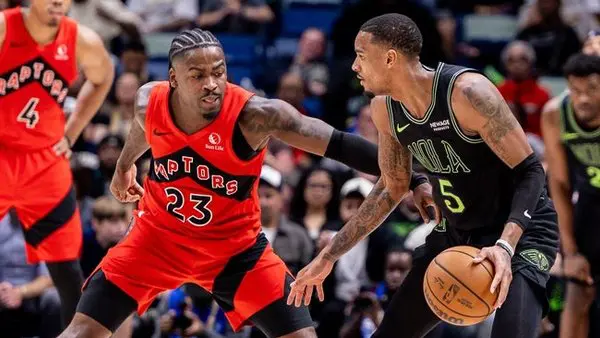
Bash sees a market overreaction to recent box scores and finds value on a shorthanded road team getting too many points in a pace-down matchup.
The Setup: Phoenix Suns at Toronto Raptors
Toronto’s getting chalked up as a 4.5-point home favorite Friday night against a Suns team riding four straight wins, and the projection says this number is inflated by at least two points. Phoenix just dropped 123 on Indiana with Devin Booker and Jalen Green combining for 79 points, while Toronto’s coming off a six-point loss in New Orleans where their three-point shooting fell apart. The market’s pricing in home court and recent form, but the underlying efficiency gap between these clubs is basically nonexistent—we’re talking a +0.1 net rating edge for Toronto that’s well within noise.
The Suns are without Dillon Brooks, Mark Williams, and potentially Grayson Allen, but they just proved Thursday night that Booker and Green can carry the offensive load when the rotation tightens. Toronto’s dealing with illness concerns around Scottie Barnes, and if he’s compromised or sits, this number becomes even more bloated. My model projects this game at Toronto by 2.1 points, which puts the Suns +4.5 in solid value territory against a spread that’s giving too much respect to home court and not enough credit to Phoenix’s current offensive rhythm.
Game Info & Betting Lines
Game Time: March 13, 2026, 7:30 PM ET
Location: Scotiabank Arena
TV: TSN (Home) | Arizona’s Family 3TV, Suns Live, NBA League Pass (Away)
Current Betting Lines (MyBookie.ag):
- Spread: Toronto Raptors -4.5 (-110) | Phoenix Suns +4.5 (-110)
- Total: Over 218.5 (-110) | Under 218.5 (-110)
- Moneyline: Toronto Raptors -200 | Phoenix Suns +142
Why This Line Exists
The market’s looking at a Raptors team at home against a Suns squad missing three rotation pieces and assuming the depth chart advantage tilts this decisively toward Toronto. That’s lazy handicapping. Phoenix just played Thursday night in Indianapolis—second game of a six-game road trip—and still managed to put up 123 points with Booker going for 43 and Green adding 36. Royce O’Neale stepped into expanded minutes and hit five threes on eight attempts. The offensive firepower is clearly there even with the absences.
Toronto’s sitting seventh in the East at 36-29, same conference position as Phoenix in the West at 39-27. The Raptors just lost six of eight and got torched by New Orleans, where they needed 44 three-point attempts to make 14 while the Pelicans hit the same number on 29 tries. That’s not a team playing clean, efficient basketball right now. The 4.5-point spread assumes Toronto’s going to execute at home against a motivated Suns team that’s won four straight and has two elite scorers playing at peak levels. The efficiency metrics don’t support that assumption—Toronto’s offensive rating is actually slightly worse than Phoenix’s, and their defensive rating edge is minimal.
The total at 218.5 is interesting because the pace blend projects around 98.7 possessions, which is deliberate basketball. Both teams play in the high 90s for pace, and with Phoenix potentially missing Allen and Toronto dealing with Barnes’ illness, this could grind even slower than expected. The projection sits at 223.2, which creates a strong lean toward the over, but that requires both offenses to execute efficiently in a game that might feature compromised rotations on both sides.
Phoenix Suns Breakdown
The Suns are 39-27 and seventh in the West, playing at a 98.2 pace with a 114.0 offensive rating and 112.6 defensive rating. That’s a +1.4 net rating that reflects a team capable of winning games without being dominant on either end. Booker’s averaging 25.3 points and 6.1 assists on the season, but he just went for 43 on 14-of-31 shooting with 11-of-11 from the free-throw line. When he’s in that mode, he’s generating offense in ways that don’t show up in the season averages.
Jalen Green’s emergence as a secondary scorer—16.5 points per game on the year, but 36 in Thursday’s win—gives Phoenix a two-man game that’s difficult to contain when both guys are rolling. Collin Gillespie’s shooting 42.3 percent from three and provides steady ball-handling, while O’Neale just proved he can step up when Allen sits. The absence of Brooks and Williams hurts defensively and on the glass, but Phoenix is still grabbing offensive rebounds at a 29.2 percent clip, which is nearly four percentage points better than Toronto’s 25.5 percent mark. That’s a strong edge in second-chance opportunities that could offset some of the depth concerns.
Phoenix’s clutch numbers are solid—17-13 in close games with a 42.8 percent field goal percentage in crunch time. They’re not elite closers, but they’re competent, and Booker’s the type of player who can manufacture a bucket when the game tightens up. The road record is 17-14, which isn’t spectacular, but this is a team that’s won four straight and just handled business against a Pacers squad that’s struggling.
Toronto Raptors Breakdown
Toronto’s 36-29 with a 17-16 home record, which tells you they’re not exactly a fortress at Scotiabank Arena. The Raptors play at a 99.2 pace with a 113.6 offensive rating and 112.0 defensive rating, producing a +1.5 net rating that’s essentially identical to Phoenix’s profile. Brandon Ingram’s leading the way at 21.5 points per game in his return to the city where he played six seasons, and he dropped 22 in Wednesday’s loss to New Orleans. Scottie Barnes and RJ Barrett are both contributing around 18-19 points nightly, while Immanuel Quickley runs the offense at 17.3 points and 6.1 assists.
The concern here is Barnes’ questionable status with an illness. If he’s compromised or sits entirely, Toronto loses a versatile defender and playmaker who’s averaging 7.9 rebounds and 5.3 assists. That would shift more responsibility to Ingram and Barrett, but it also thins out the rotation in a way that makes the 4.5-point spread look even more generous for Phoenix. The Raptors’ assist-to-turnover ratio is strong—they’re moving the ball at a 68.6 percent assist rate—but they’re also coming off a game where they shot 31.8 percent from three on 44 attempts. That’s not sustainable offense.
Toronto’s clutch record is 19-12, which is better than Phoenix’s, but their field goal percentage in close games is just 38.9 percent. They’re winning tight games more often, but they’re not doing it with clean execution. The defensive rating of 112.0 is respectable but not dominant, and Phoenix’s offensive rating advantage of 114.0 suggests the Suns can score efficiently even against a competent defense.
The Matchup
This game sets up as a pace-down grind between two teams with nearly identical efficiency profiles. The offensive rebounding gap favors Phoenix significantly—that 3.7 percentage point edge in offensive rebounding rate is one of the strongest splits in this matchup and could generate extra possessions for a Suns team that needs to maximize opportunities with a shortened rotation. Toronto’s better at protecting the ball with a turnover rate that’s 0.8 percentage points cleaner, but that’s within noise and unlikely to swing the outcome.
The mismatch edge actually tilts slightly toward Phoenix when you match offense against opposing defense. The Suns’ 114.0 offensive rating against Toronto’s 112.0 defensive rating creates a +2.0 advantage per 100 possessions, which is small but meaningful in a game projected for under 99 possessions. Toronto’s offensive rating of 113.6 against Phoenix’s defensive rating of 112.6 produces a +1.0 edge for the Raptors, so the Suns actually have the better matchup on paper when you isolate offense versus defense.
The shooting metrics are essentially identical—both teams are at 53.6 percent effective field goal percentage, and the true shooting gap is just 0.3 percentage points in Toronto’s favor. There’s no real separation in shooting quality, which means this game likely comes down to execution, pace control, and whether Phoenix can dominate the offensive glass the way their season numbers suggest they should. With Barnes potentially compromised and Phoenix’s two best scorers playing at an elite level right now, the Suns have a legitimate path to covering this number even on the road.
Bash’s Best Bet & The Play
The Play: Phoenix Suns +4.5 (-110)
I’m taking the Suns and the points in a spot where the market’s overvaluing home court and recent box scores without accounting for the underlying efficiency metrics. Phoenix and Toronto are essentially the same team when you strip away the narratives—both sitting at +1.4 to +1.5 net rating, both playing deliberate basketball in the high 90s for pace, both capable of scoring efficiently but not dominant defensively. The difference is Phoenix has two scorers who just combined for 79 points and are playing with confidence, while Toronto’s coming off a loss where their three-point shooting cratered and they’re potentially without Barnes or playing him at less than 100 percent.
The offensive rebounding edge for Phoenix is real and repeatable, and in a game projected for fewer than 99 possessions, those second-chance opportunities matter. The projection has this at Toronto by 2.1, which means we’re getting more than two points of value on the Suns at +4.5. That’s a medium edge against a spread that assumes Toronto’s going to execute cleanly at home, and I’m not seeing the evidence that supports that assumption given their recent shooting struggles and the minimal efficiency gap between these clubs.
The risk is Phoenix playing the second night of a back-to-back situation on the road with a thin rotation, but they just proved Thursday they can win in that exact spot. Booker and Green are carrying the offensive load, and if O’Neale or Gillespie can provide secondary scoring, the Suns have enough firepower to stay within this number even if they don’t win outright. I’ll take the better value and the team that’s actually playing better basketball right now, even if the market doesn’t want to acknowledge it.