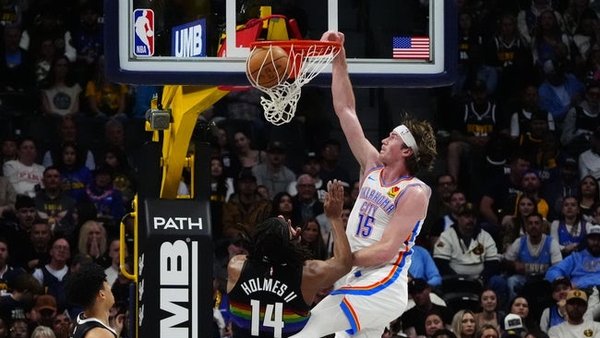
Bash examines a regular-season finale that’s turned into a G-League showcase on both sides, with the Thunder resting their entire rotation and the Suns missing six rotation pieces heading into the play-in tournament.
The Setup: Suns at Thunder
Oklahoma City sits at -5 hosting Phoenix in Sunday’s regular-season finale, and this number exists in a vacuum. The Thunder have already locked the West’s top seed at 64-17 and are sitting ten rotation players—Shai Gilgeous-Alexander, Chet Holmgren, Jalen Williams, Isaiah Hartenstein, Alex Caruso, Cason Wallace, Isaiah Joe, Ajay Mitchell, and Jaylin Williams all out for rest or minor maintenance. Phoenix isn’t much better. The Suns are missing Devin Booker, Grayson Allen, Dillon Brooks, and Royce O’Neale to rest, with Jalen Green, Collin Gillespie, Jordan Goodwin, and Mark Williams all questionable.
This is a glorified preseason game in April. The projection sees a seven-point Thunder edge even with both benches running the show, and the total sits at 212.5 in a game where neither side has any incentive to push pace or extend rotations. We’re looking at third-stringers playing controlled minutes with playoff rotations already set.
The market’s treating this like a real game. It’s not.
Game Info & Betting Lines
Phoenix Suns (44-37) at Oklahoma City Thunder (64-17)
Sunday, April 12, 2026 | 8:30 PM ET
Paycom Center
TV: FanDuel SN OK (Home), Arizona’s Family 3TV, Suns Live, NBA League Pass (Away)
Current Betting Lines (MyBookie.ag):
Spread: Thunder -5.0 (-110) | Suns +5.0 (-110)
Total: Over 212.5 (-110) | Under 212.5 (-110)
Moneyline: Thunder -244 | Suns +193
Why This Line Exists
The Thunder own an 11.6-point net rating edge on the season—117.7 offensive rating against 106.1 defensive rating compared to Phoenix’s 113.9 and 113.0 split. Even with skeleton crews, Oklahoma City’s home dominance (34-6) and overall season profile justify a short number. The Suns went 19-21 on the road and just got boat-raced by the Lakers 101-73 on Friday, a game where LeBron James had 28 points and LA clinched home court without Luka Doncic or Austin Reaves.
But here’s the tension: this line assumes some semblance of normal rotation structure. It doesn’t. The Thunder are running out Nikola Topic, Jared McCain, Branden Carlson, Aaron Wiggins, Brooks Barnhizer, and Payton Sandfort. Phoenix counters with whatever’s left after sitting their top six scorers. We’re talking about players who’ve combined for maybe 15% of their teams’ total minutes this season.
The total at 212.5 reflects the market pricing in deliberate pace and limited firepower, but the projection lands at 223.7 possessions based on a 99.3-possession pace blend. That’s an 11-point gap between what the market expects and what the math suggests, even in a rest-heavy spot.
Suns Breakdown
Phoenix limps into this one on a two-game slide and missing the bulk of its scoring punch. Booker (26.1 points per game) is out with right ankle management. Allen (16.5 points per game) exited Friday’s loss with a hamstring issue. Brooks (20.2 points per game) sits for rest. O’Neale, who started 67 games this season, is out for maintenance.
That leaves Dillon Brooks’ backup and deep bench guards to carry the load. If Green, Gillespie, and Goodwin all sit, we’re looking at Jamaree Bouyea, Amir Coffey, and Koby Brea handling backcourt minutes. The Suns’ 113.9 offensive rating ranked middle-of-the-pack this season, and their 36.0% three-point shooting won’t improve with fourth-stringers launching attempts.
Phoenix does rebound—28.9% offensive rebounding rate gives them second-chance opportunities—but without Brooks or Booker to finish possessions, those extra cracks don’t carry the same weight. The Suns went 19-19 in clutch games this season with a negative clutch plus-minus, and this roster construction won’t survive tight moments if this game somehow stays competitive late.
Thunder Breakdown
Oklahoma City’s regulars are done. Gilgeous-Alexander (31.1 points, 6.6 assists per game) won’t play. Holmgren (17.1 points, 8.9 rebounds, 1.9 blocks) is out with lower-back spasms. Jalen Williams (17.1 points, 5.5 assists) sits with hamstring management. The Thunder’s 117.7 offensive rating and 106.1 defensive rating—both elite marks—mean nothing when the rotation looks like a Summer League depth chart.
What remains is organizational depth that’s been tested all season. The Thunder went 64-17 because they could survive injury stretches and maintain defensive structure even when stars sat. Their 60.0% true shooting percentage as a team won’t translate with end-of-bench players, but the system and coaching infrastructure remain intact.
Oklahoma City’s 100.4 pace ranked in the league’s middle tier, and with no playoff seeding implications, there’s zero incentive to push tempo or extend possessions. David Adelman already said Friday night that rest decisions reflect what’s best for the team long-term. That philosophy extends to Sunday—get through 48 minutes, avoid injury, move on to the postseason.
The Matchup
The season-long numbers suggest Oklahoma City should win this by seven or eight points. The Thunder’s 10.6-point net rating edge over Phoenix provides the foundation, and even watered-down versions of these rosters should reflect some of that gap. My model projects a 7.3-point Thunder margin with a 223.7 total, both of which lean against the current market.
But here’s the problem: we have no idea who’s actually playing. If Phoenix sits all four questionable players, the Suns might dress nine guys, half of whom haven’t logged rotation minutes since January. If Oklahoma City runs a strict 20-minute cap on everyone, we’re looking at possessions that resemble scrimmage pace more than competitive basketball.
The total feels like the sharper angle. Both teams shot well this season—Phoenix at 56.7% true shooting, Oklahoma City at 60.0%—but those marks came with NBA-caliber spacing and decision-making. Third-stringers don’t execute at that level. The Thunder’s 22.4% offensive rebounding rate (well below Phoenix’s 28.9%) limits second-chance points, and without reliable shot creation on either side, we’re looking at longer possessions and more missed attempts.
The 99.3-possession pace blend suggests enough game flow to push scoring into the 220s, even with limited talent. Oklahoma City’s home court (34-6) typically plays to their tempo, and Phoenix has no defensive anchor with their rotation gutted. The under looks tempting given the rest situation, but the shooting efficiency gap and pace math point the other direction.
Bash’s Best Bet & The Play
I’m taking Over 212.5. The projection sits at 223.7, giving us an 11-point cushion even if this game turns into a sloppy rotation exercise. Both teams lack defensive anchors with their starters out, and while the talent level drops significantly, the pace and possession count should generate enough scoring opportunities to clear this number.
Phoenix’s offensive rebounding (28.9%) creates extra possessions, and Oklahoma City’s system—even with backups—should generate cleaner looks than the Suns’ makeshift lineup can defend. The Thunder went 24-10 in clutch situations this season with a positive clutch plus-minus, but we’re not banking on late-game execution here. We’re banking on 99 possessions and enough transition buckets to push this total into the 220s.
The risk is obvious: if both coaches pull the plug early and run strict minute limits, we could see a slower, more controlled game than the numbers suggest. But the math supports the over, and I’ll trust the possession count over the roster uncertainty.
The Play: Over 212.5 (-110)