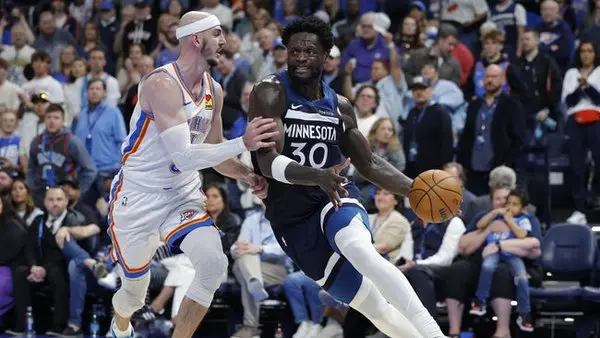
Bash sees an offensive showcase brewing at Target Center with both teams missing key defensive pieces. The total looks low given the pace and shooting matchup, and he’s backing the firepower to push this one over the market number.
The Setup: Phoenix Suns at Minnesota Timberwolves
Minnesota opens as a 4.5-point home favorite against Phoenix on Tuesday night, and the total sits at 221. That number feels conservative when you dig into what’s actually happening on both sides. The Timberwolves are without Anthony Edwards—their franchise centerpiece who’s been a constant presence all season—while the Suns are down both Dillon Brooks and Mark Williams. Brooks has been their defensive enforcer all year, and Williams anchors the paint. Strip away those defensive pieces, and you’ve got two teams that should be able to generate cleaner looks than usual.
The projection here lands around 228 points, which creates meaningful separation from the 221 market total. Minnesota runs at 101.5 possessions per game, Phoenix at 98.1, and we’re looking at a pace blend right around 100 possessions. That’s not a track meet, but it’s enough runway for two offenses shooting 57.0% and 59.7% true shooting to do damage. When the defensive anchors are missing and the shooting profiles are this strong, the math tilts toward points.
The Wolves are the better team on paper—116.1 offensive rating against 114.1, and their net rating advantage of 1.9 points per 100 possessions reflects that gap. But this isn’t about picking a side. This is about recognizing that both offenses should eat with diminished defensive resistance, and 221 doesn’t account for what’s missing on the other end of the floor.
Game Info & Betting Lines
Game Time: March 17, 2026, 8:00 ET
Location: Target Center
TV: FanDuel SN North (Home), Arizona’s Family 3TV, Suns Live, NBA League Pass (Away)
Current Betting Lines (MyBookie.ag):
- Spread: Minnesota Timberwolves -4.5 (-110) | Phoenix Suns +4.5 (-110)
- Total: Over 221.0 (-110) | Under 221.0 (-110)
- Moneyline: Minnesota Timberwolves -179 | Phoenix Suns +144
Why This Line Exists
The 4.5-point spread makes sense when you look at the season-long profiles. Minnesota is 41-27 with a 22-12 home record, while Phoenix sits at 39-29 and just 17-16 on the road. The Wolves have been the more efficient team all year—3.0 net rating compared to Phoenix’s 1.1—and they’re getting about two points of home-court advantage baked into this number. The market is pricing Minnesota’s overall quality edge and the venue, which is standard operating procedure.
The total at 221 reflects the deliberate pace these teams typically play. Neither squad pushes tempo aggressively, and the market is anchoring to season-long scoring averages: Phoenix at 112.5 points per game, Minnesota at 118.5. That’s a combined 231 points if both teams hit their averages, but totals pricing usually shaves a few points off raw averages to account for variance and defensive adjustments.
What the market isn’t fully accounting for is the defensive personnel that won’t be on the floor. Brooks has been Phoenix’s primary perimeter stopper all season, and Edwards is Minnesota’s most dynamic two-way player. When you pull those guys out, the defensive intensity drops, and the shooting quality on both sides should tick up. The 221 total feels like it’s pricing healthy rosters, not the shorthanded groups we’re actually getting.
Phoenix Suns Breakdown
The Suns just dropped back-to-back games after a four-game winning streak, most recently falling 120-112 in Boston. Devin Booker dropped 40 points in that one, and Jalen Green added 21, but they couldn’t slow down Jaylen Brown’s fourth-quarter takeover. That loss exposed what happens when Phoenix doesn’t have Brooks available to take on tough defensive assignments—Brown went for 41 with 18 in the fourth, and the Suns had no real answer.
Offensively, Phoenix is humming. Booker is averaging 25.7 points per game on 45.6% shooting, and the supporting cast—Green at 17.6, Grayson Allen at 17.2, Collin Gillespie at 13.1—provides enough scoring balance to keep defenses honest. The Suns shoot 36.3% from three and 57.0% true shooting, which is above-league-average efficiency. They’re not a great offensive rebounding team at 28.8%, but they take care of the ball reasonably well and move it with purpose (60.4% assist rate).
The problem is on the other end. Without Brooks and Williams, the Suns lose their two best defensive anchors. Brooks is out with a broken hand and won’t return until late March at the earliest, and Williams is out for the next few weeks with an undisclosed injury. That’s a huge blow to a defense that already ranks middle-of-the-pack at 113.0 defensive rating. Oso Ighodaro and Khaman Maluach will handle center minutes, but neither brings Williams’ rim protection or physicality.
Minnesota Timberwolves Breakdown
Minnesota is riding an eight-game losing streak after falling 116-103 in Oklahoma City on Sunday. Julius Randle carried the offense with 32 points, and Edwards added 19 before exiting, but the Thunder’s depth and efficiency were too much. That loss dropped the Wolves to 41-27, and now they’re facing Phoenix without their best player. Edwards is out Tuesday after missing just one game since late January, and Ayo Dosunmu is expected to slide into the starting lineup at shooting guard.
When healthy, Minnesota has one of the league’s most potent offenses. Edwards leads the way at 29.5 points per game on 49.2% shooting and 40.2% from three, while Randle provides 21.1 points and 6.9 rebounds. Jaden McDaniels (14.5 points, 51.9% shooting) and Dosunmu (14.2 points, 51.9% shooting) give the Wolves reliable secondary scoring, and Naz Reid anchors the second unit with 13.7 points and 6.2 boards. The team shoots 59.7% true shooting and 56.4% effective field goal percentage, both elite marks.
The concern is how much Edwards’ absence affects the defensive intensity. He’s Minnesota’s best perimeter defender and sets the tone on that end. Without him, the Wolves lose a key piece of their 113.1 defensive rating, which is already just average. Naz Reid is also questionable with a right shoulder injury he picked up Sunday, though he played through it and seems likely to go. If Reid sits, that’s another defensive body missing, and the Suns’ guards should have cleaner driving lanes.
The Matchup
This game sets up as a shooting and efficiency battle between two teams missing their best defensive players. Minnesota’s offense grades out at 116.1 against Phoenix’s 113.0 defensive rating, which creates a 3.1-point mismatch in the Wolves’ favor. Going the other way, Phoenix’s 114.1 offense against Minnesota’s 113.1 defense is a 1.0-point edge for the Suns. Both offenses should be able to score, and the defensive resistance on both sides is compromised.
The shooting gap favors Minnesota. The Wolves hold a 2.7-point edge in both true shooting and effective field goal percentage, which reflects their superior shot quality and conversion rates. Edwards’ absence hurts that profile, but Randle, McDaniels, and Dosunmu are all shooting above 50% from the floor, and the Wolves still have enough firepower to generate efficient looks. Phoenix counters with Booker’s shot-creation and a balanced supporting cast that can space the floor and knock down open threes.
Rebounding slightly favors Minnesota, but the 0.7-point edge is marginal. The Suns actually hold a 3.0-point advantage in offensive rebounding rate, which could create extra possessions and second-chance points. That’s meaningful in a game where both teams should be able to score. Turnovers are basically even—within noise—so there’s no real edge there for either side.
The pace blend projects around 100 possessions, which is deliberate but not slow. That’s enough runway for two efficient offenses to push well past 110 points each, especially with diminished defensive personnel. My model projects Phoenix around 113 and Minnesota around 114, which lands the total near 228. That’s a seven-point gap from the 221 market number, and it’s driven by the shooting quality and personnel losses on defense.
Bash’s Best Bet & The Play
The Play: Over 221.0 (-110)
I’m backing the firepower here. Both teams are missing their best defensive players, and both offenses shoot the ball well enough to exploit that. Phoenix without Brooks and Williams loses its perimeter stopper and rim protector. Minnesota without Edwards loses its best two-way player and defensive tone-setter. When you strip away those defensive anchors and leave two offenses shooting 57.0% and 59.7% true shooting, the math tilts toward points.
The projection lands around 228, which creates meaningful separation from the 221 total. That’s not a small gap—it’s seven points of value, and it’s rooted in the shooting profiles and personnel context. Minnesota’s 116.1 offensive rating against Phoenix’s compromised defense should produce efficient looks, and Phoenix’s 114.1 offense should be able to score on a Wolves defense missing its best perimeter defender.
The pace isn’t explosive, but 100 possessions is enough. Both teams move the ball well, shoot it efficiently, and have enough scoring balance to keep the offense flowing. The Suns just put up 112 in Boston with Booker going for 40, and the Wolves scored 103 in Oklahoma City even in a loss. Neither team is struggling to generate offense, and the defensive resistance is lighter than usual.
The risk is if one team goes cold from three or if the pace slows further than expected. But the shooting percentages and efficiency metrics suggest both offenses are capable of hitting their projections, and the defensive personnel losses tilt the environment toward scoring. I’ll take the over at 221 and trust the firepower to push this one past the market number.