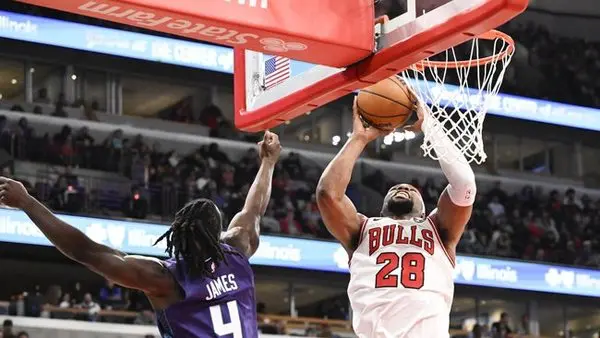
Laying four points with a road team missing its primary initiators is a risky proposition, which is why our latest prediction leans on the Bulls’ league-leading assist rate to keep this contest within a single possession.
The Setup: Portland Trail Blazers at Chicago Bulls
The Bulls are catching +4.0 at home Thursday night against a Portland squad that’s missing its top two offensive weapons. the projection has this game as essentially a toss-up — Bulls by less than a point — which means Chicago’s getting 4.9 points of value against the spread. This line doesn’t add up once you run the efficiency math. Portland sits at 28-31 with a -2.6 net rating, while Chicago checks in at 24-35 with a -4.8 mark. That 2.2-point gap in season-long efficiency favors the Blazers, but it’s nowhere near wide enough to justify laying four points on the road when both teams are operating with depleted rotations and Chicago holds meaningful advantages in shooting efficiency and ball security.
The Blazers are without Deni Avdija and Shaedon Sharpe, erasing 45.8 combined points per game from their rotation. Chicago’s missing Anfernee Simons, Jaden Ivey, and Patrick Williams is likely out as well. But here’s the difference: the Bulls’ shooting metrics and turnover discipline create a legitimate path to covering at home, especially when you factor in that Portland’s offensive rebounding edge — normally a massive weapon at 31.3% — gets neutralized by Chicago’s defensive glass work. I’m taking the points all day long.
Game Info & Betting Lines
Game Time: February 26, 2026, 8:00 ET
Location: United Center
TV: Home: CHSN+ | Away: KUNP 16, BlazerVision, NBA League Pass
Current Betting Lines (MyBookie.ag):
- Spread: Chicago Bulls +4.0 (-110) | Portland Trail Blazers -4.0 (-110)
- Total: Over 235.5 (-110) | Under 235.5 (-110)
- Moneyline: Chicago Bulls +141 | Portland Trail Blazers -175
Why This Line Exists
The market’s giving Portland respect for their net rating edge and road competency — the Blazers are 12-16 away from home, which isn’t pretty but beats Chicago’s 9-19 road mark. But this number points to overreaction to season-long context without accounting for current roster reality. The projection has Chicago losing by 0.9 points at home, which includes the standard two-point home-court bump. Strip that out and you’re looking at a dead-even matchup on a neutral floor.
The pace blend sits at 102.2 possessions, right in line with both teams’ season averages. Portland runs at 102.0, Chicago at 102.3, so we’re not dealing with a style clash that creates hidden variance. Over those 102 possessions, the efficiency gap becomes the story. Portland’s offensive rating of 113.0 faces Chicago’s defensive rating of 117.4, creating a -4.4 mismatch that favors the Blazers’ offense. Flip it around: Chicago’s 112.6 offensive rating against Portland’s 115.6 defensive rating produces a -3.0 mismatch.
Neither offense has a significant edge, which is why the projected total lands at 234.3 — just under the posted 235.5. But here’s what the market’s missing: Chicago’s shooting quality metrics are legitimately better. The Bulls post a 58.2% true shooting percentage compared to Portland’s 57.0%, and their effective field goal percentage sits at 54.9% versus Portland’s 53.1%. That 1.8-percentage point eFG advantage might sound small, but over 102 possessions it compounds into real scoring separation.
Portland Trail Blazers Breakdown: What You Need to Know
The Blazers just dropped a 124-121 decision to Minnesota at home Tuesday, with Jrue Holiday leading the way at 22 points and Jerami Grant adding 18. Scoot Henderson came off the bench for 19 points, six rebounds, and five assists, which tells you everything about Portland’s current rotation chaos. Without Avdija (24.4 PPG, 6.6 APG) and Sharpe (21.4 PPG), the offensive creation burden falls entirely on Holiday, Grant, and Henderson — none of whom are natural primary initiators at this stage.
Portland’s offensive rating of 113.0 ranks middle-of-the-pack, but their defensive rating of 115.6 explains the -2.6 net rating. They’re not stopping anyone consistently. The one area where Portland should dominate is offensive rebounding — their 31.3% OREB rate is elite and creates second-chance opportunities that mask inefficient half-court execution. Donovan Clingan grabbed 15 boards in Tuesday’s loss, and Robert Williams III is questionable for Thursday but has been solid on the glass when healthy.
The clutch numbers are interesting: Portland’s 16-17 in close games with a 48.1% field goal percentage in clutch situations. They’re competitive late, but they’re not winning those moments. The turnover rate of 14.6% is manageable but not exceptional, and against a Chicago team that protects the ball better (13.0% TOV rate), those extra possessions add up.
Chicago Bulls Breakdown: The Other Side
Chicago’s riding a 10-game losing streak after getting boat-raced by Charlotte 131-99 on Tuesday. Matas Buzelis dropped a career-high 32 points in the loss, but the Bulls coughed up 19 turnovers and got torched from three. That’s the nightmare version of this team. The competitive version — the one that shows up in close games where they’re 17-16 in clutch situations — is a different animal.
Josh Giddey remains the engine at 17.8 points, 8.1 rebounds, and 8.4 assists per game. Buzelis is emerging as a legitimate scoring threat at 15.3 PPG on 47.4% shooting and 36.7% from three. Collin Sexton (13.9 PPG, 47.8% FG) and Tre Jones (11.9 PPG, 5.7 APG) provide backcourt stability with Simons and Ivey sidelined. The Bulls’ assist-to-turnover profile is excellent — they lead the league in assist rate at 68.3% while posting the lowest turnover rate at 13.0%.
Defensively, Chicago’s 117.4 rating is bottom-tier, which explains the 10-game skid. But the offensive efficiency of 112.6 paired with superior shooting splits keeps them in games. The 58.2% true shooting percentage is legit, and the ball movement creates quality looks even without elite individual creators. Patrick Williams is doubtful, and Jalen Smith is likely out, which thins the frontcourt rotation. But against a Portland team missing its top two scorers, the Bulls’ shooting edge becomes the critical factor.
The Matchup: Where This Game Gets Decided
This game gets decided in the margins — specifically, shooting efficiency and ball security over 102 possessions. The efficiency gap is too wide to ignore here when you isolate the shooting metrics. Chicago’s 1.8-percentage point effective field goal advantage and 1.6-percentage point turnover edge create a cumulative swing that the model captures in the tight projected margin.
Portland’s offensive rebounding rate of 31.3% compared to Chicago’s 23.0% represents an 8.3-percentage point gap — the single largest mismatch in this game. That’s where the Blazers can steal extra possessions and compensate for their shooting inefficiency. Over 102 possessions, if Portland converts that OREB edge into even five extra scoring chances, they’re looking at 8-10 additional points. But here’s the counter: Chicago’s defensive rebounding at 34.3 per game suggests they’re disciplined on the glass, and without Avdija’s 7.0 boards and Sharpe’s 4.4, Portland’s crashing numbers take a hit.
The pace blend of 102.2 possessions means both teams get roughly 51 offensive trips. If Chicago executes at their 58.2% true shooting mark while limiting turnovers to their season average of 13.0%, they’re generating 1.16 points per possession. Portland, running at 57.0% TS with more turnovers, hovers closer to 1.13 points per trip. That three-point gap per 100 possessions — compounded over 102 actual possessions — explains why the model sees this as a virtual coin flip instead of a four-point spread.
The writing’s on the wall with this matchup: Chicago’s at home, desperate to snap a 10-game slide, catching four points against a road team missing 46 points per game from the lineup. The Bulls’ shooting and ball security advantages are real, measurable, and undervalued by this number.
Bash’s Best Bet & The Play
I’m backing Chicago +4.0 with confidence. the projection projects a 0.9-point Bulls loss, which means we’re getting 4.9 points of cushion against the actual spread. That’s a strong edge built on Chicago’s superior shooting efficiency, better turnover discipline, and home-court desperation against a shorthanded Portland squad.
The risk is obvious: Portland’s offensive rebounding can create chaos, and if Clingan and Williams dominate the glass, the Blazers generate enough extra possessions to cover the shooting gap. But I’ve seen this movie before — home dogs with better shooting metrics and ball security tend to keep games closer than the market expects, especially when the favorite is dealing with rotation upheaval.
The possessions math tells a different story than the season-long records suggest. Chicago’s 58.2% true shooting and 13.0% turnover rate create a real path to an outright win, and at worst, they’re competitive enough to stay within a single possession. This is exactly the spot where Portland burns you — laying points on the road without their top scorers against a team that executes efficiently in the half-court.
BASH’S BEST BET: Chicago Bulls +4.0 for 2 units.