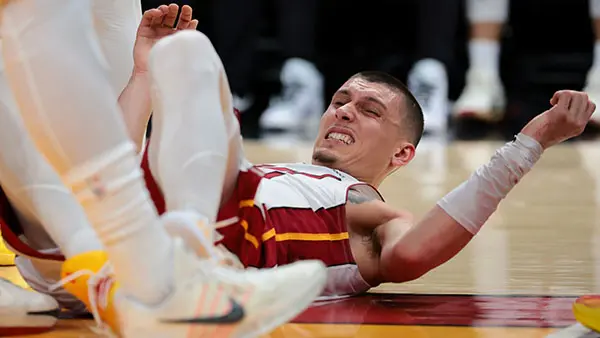
Bryan Bash examines a late-season matchup where the market may be pricing in too much separation between a playoff-hopeful Heat squad and a depleted Wizards team playing out the string.
The Setup: Washington Wizards at Miami Heat
Miami lays 17.5 points at home against Washington on Saturday afternoon, and that’s a big number even when you’re facing the league’s worst road team. The Heat sit at 40-37, clinging to the tenth seed in the East and desperately needing wins down the stretch. The Wizards are 17-59, completely gutted by injuries, and have nothing to play for except lottery positioning. On paper, this looks like a mismatch the Heat should dominate.
But here’s the thing about late-season NBA spots: motivation matters, but execution matters more. Washington’s been getting obliterated on the road all season—6-32 away from home—and Miami’s been solid at the Kaseya Center at 24-15. The efficiency gap is real: Miami posts a +1.9 net rating while Washington sits at -11.4. That 13.3-point per-100-possession edge is substantial. But 17.5 points? That’s asking Miami to not just win, but to bury a team that’s actually been competitive in clutch situations despite their awful record.
The projection sees this closer to a 9-point game when you account for home court. That’s an 8.6-point gap between what the model expects and what the market is asking you to lay. That’s not nothing.
Game Info & Betting Lines
When: Saturday, April 4, 2026, 3:00 ET
Where: Kaseya Center
Watch: MNMT, NBA League Pass
Spread: Miami Heat -17.5 (-115) | Washington Wizards +17.5 (-105)
Total: 247.5 (O/U -110)
Moneyline: Heat -2000 | Wizards +950
Why This Line Exists
The market’s looking at Washington’s injury report and seeing a team that’s completely hollowed out. Anthony Davis hasn’t played since January with ligament damage in his hand. Trae Young has missed ten straight games and likely won’t suit up again this season. KyShawn George is done for the year with an elbow injury. Alexandre Sarr, Bilal Coulibaly, Tre Johnson, Tristan Vukcevic, and Justin Champagnie are all questionable for Saturday.
That’s a roster that’s been reduced to spare parts and developmental pieces. When the books see that kind of decimation against a playoff-desperate team, they push the number high to protect themselves from getting middled on a blowout. The -2000 moneyline tells you everything about how lopsided the talent is here.
But here’s what the market might be missing: Washington’s actually been okay in clutch situations. They’re 12-13 in games decided by five points or fewer in the final five minutes, with a clutch field goal percentage of 42.1%. That’s not great, but it’s not the profile of a team that consistently gets run out of the gym. Even undermanned, they’ve found ways to stay in games longer than you’d expect.
Miami’s also dealing with some rotation issues. Norman Powell missed Friday’s media availability and remains out with an illness that’s kept him sidelined for four games. Tyler Herro is probable but dealing with a minor setback. This isn’t a fully loaded Heat squad, and they’ve been inconsistent enough at home to raise questions about whether they can cover this kind of inflated number.
Washington Wizards Breakdown
What’s left of the Wizards offense runs through whoever’s healthy enough to suit up. With Davis and Young out, you’re looking at a rotation built around role players trying to get through 48 minutes without embarrassing themselves. The team posts 112.7 points per game on 46.2% shooting, but those numbers are inflated by earlier-season performances when they actually had NBA-caliber talent on the floor.
The defensive rating of 121.0 is bottom-tier, and that’s not changing with this depleted roster. Washington allows 109.6 points per 100 possessions on offense, which creates a -11.4 net rating that accurately reflects how overmatched they are on most nights. They play at a 102.4 pace, which is slower than Miami’s preferred tempo, and that could actually work in their favor if they can grind possessions and keep the game ugly.
The turnover edge favors Miami by 2.0 percentage points, and Washington’s offensive rebounding sits at 24.0% compared to Miami’s 25.5%. Those are small edges, but they add up in a game where Miami needs to create separation. If Washington can limit live-ball turnovers and keep Miami off the offensive glass, they can at least control the possession count.
Miami Heat Breakdown
Miami’s offense hums at 115.1 points per 100 possessions, led by Norman Powell’s 22.1 points per game and Tyler Herro’s 21.4. Bam Adebayo anchors everything at 20.3 and 10.0 rebounds, while Andrew Wiggins and Jaime Jaquez Jr. provide secondary scoring. This is a balanced attack that can score in multiple ways, and they shoot 46.4% from the field with a 57.6% true shooting percentage.
The defensive rating of 113.2 is solid, and that’s where Miami should theoretically dominate this matchup. Washington’s offense runs at 109.6 per 100 possessions, which creates a -5.9 mismatch when you pit Miami’s defense against Washington’s attack. That’s the foundation for why this spread got pushed so high—Miami should be able to get stops and push tempo in transition.
But here’s the catch: Miami plays at 104.4 pace, and the blended pace for this game projects to 103.4 possessions. That’s not a track meet. That’s a grind-it-out game where every possession matters, and 17.5 points requires Miami to win those possessions at a rate they haven’t consistently shown all season. Their clutch record is 17-16, which tells you they’ve been in plenty of tight games even against inferior competition.
The Matchup
The efficiency gap is real, but the game environment doesn’t support a blowout. Washington’s slower pace forces Miami to execute in the halfcourt, and while the Heat have the talent advantage, they’ve struggled with focus against bottom-feeders all season. Boston just hung 147 on them Wednesday, and while Miami hit 24 threes in that game, they still lost by 18. That’s not the profile of a team that’s locked in defensively.
My model projects Miami by 8.9 points, which includes the standard 2-point home court advantage. That’s a comfortable win for the Heat, but it’s nowhere near 17.5. The projected total sits at 237.2, which is a full 10.3 points below the posted number of 247.5. The market’s expecting a shootout, but the pace and efficiency metrics suggest something slower and tighter.
Washington’s going to keep this game in the 110-120 range if they can control tempo and avoid live-ball turnovers. Miami should win, but asking them to cover nearly three possessions against a team that’s shown clutch competitiveness all season feels like an overreaction to the injury report.
Bash’s Best Bet & The Play
The Play: Washington Wizards +17.5 (-105)
I’m grabbing the points with Washington in a spot where the market’s overpricing Miami’s ability to blow out a depleted roster. The Wizards are bad, no question, but they’ve been competitive enough in clutch situations to suggest they won’t fold completely. The projected margin sits at 8.9 points, which gives us nearly nine points of cushion even if Miami controls this game start to finish.
The pace projects to just over 103 possessions, which limits Miami’s ability to run away with this. Washington’s going to grind possessions, take the air out of the ball, and force Miami to execute in the halfcourt. That’s not an environment where you see 20-point blowouts unless the favorite shoots lights out or forces a bunch of live-ball turnovers.
Miami’s also dealing with Powell’s absence and Herro’s minor issue, which takes some firepower off the table. This feels like a 12-14 point win for the Heat if everything breaks right, and that’s not enough to cover. Take the points and let Washington’s pace control keep this closer than the market expects.
Risk Note: If Washington’s questionable players all sit and they’re running out a G-League roster, this could get ugly fast. Monitor the injury report before tip, and if Sarr and multiple rotation pieces are ruled out, the value evaporates. But assuming they have enough bodies to field a competitive lineup, this number’s too high.