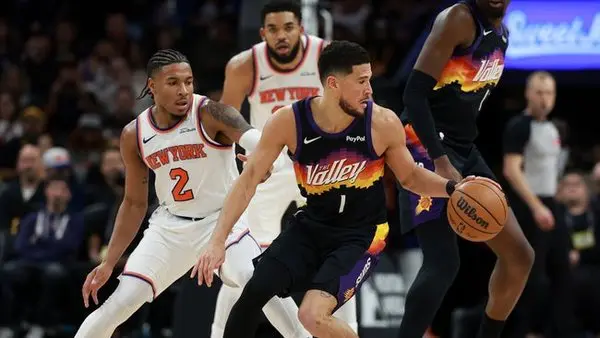
Phoenix returns home as heavy favorites against a Washington squad currently navigating life without Trae Young and several rotation regulars. Our analytical preview explains why the Suns’ top-tier defense makes them a volatile ATS pick for the Sunday night schedule.
The Setup: Wizards at Suns
Phoenix is laying 14 points at home against Washington on Sunday night, and on the surface, this number makes sense. The Suns are 23-15 and riding momentum after beating the Knicks on Friday. The Wizards are 10-27, just got blown out by New Orleans, and are missing their best player. This looks like a mismatch on paper, and the market is treating it exactly that way.
Here’s the thing — when you’re dealing with a spread this large, you’re not just betting on who wins. You’re betting on margin, and margin requires consistent execution over 96 possessions against a team that has nothing to lose. Phoenix should win this game. The question I’m focused on is whether they can sustain the defensive intensity and offensive efficiency needed to cover a two-possession spread against a Washington team that’s playing loose and has shown they can score in spurts.
Let me walk you through why this line exists, what the matchup data tells us, and where I’m landing on a spread that feels simultaneously justified and dangerously high.
Game Info & Betting Lines
Game: Washington Wizards at Phoenix Suns
Date: January 11, 2026
Time: 8:00 ET
Venue: Mortgage Matchup Center
Current Betting Lines (MyBookie.ag):
- Spread: Phoenix Suns -14.0 (-110)
- Moneyline: Suns -909 / Wizards +566
- Total: 229.0 (Over/Under -110)
Why This Line Exists
The market is pricing in a 13-game gap in the standings between these two teams, and it’s doing so for good reason. Phoenix sits at 23-15 with a 13-5 home record, while Washington limps in at 10-27 with a brutal 4-14 road mark. That home/road split alone accounts for a significant portion of this spread.
But the real driver here is personnel. Trae Young is out for Washington with a right quadriceps contusion, and he’s the engine that makes this offense functional. Young averages 19.3 points and 8.9 assists per game — that’s not just production, that’s usage and decision-making that now falls on guys like Bub Carrington, Malaki Branham, and AJ Johnson. Those are rotation players being asked to run an NBA offense on the road against a team that just held the Knicks to 107 points.
Phoenix also lost Cam Whitmore to a shoulder issue, but his 15.0 points per game are being absorbed by a deeper rotation that includes Corey Kispert, Justin Champagnie, and Will Riley. The Suns have Devin Booker averaging 25.5 points and 6.4 assists, Dillon Brooks putting up 21.3 per night, and enough secondary scoring to keep defenses honest. Washington doesn’t have that luxury right now.
The total sitting at 229 suggests the market expects Phoenix to push pace and score efficiently, while Washington keeps it competitive enough offensively to push the number over. That’s a reasonable assumption given the Wizards just allowed 128 to New Orleans, but it also assumes Washington can generate offense without their primary creator.
Wizards Breakdown: What You Need to Know
Washington is in full evaluation mode at 10-27, and without Trae Young, they’re missing the one player who could consistently create advantages in the half-court. Alexandre Sarr has been solid at 17.3 points and 7.5 rebounds per game, and KyShawn George has shown flashes with 15.0 points, 5.6 rebounds, and 5.0 assists. But neither of those guys is a primary ball-handler who can run pick-and-roll or collapse defenses consistently.
The Wizards are 4-14 on the road, and that’s not just bad luck — it’s a reflection of a team that struggles to generate efficient offense away from home and doesn’t have the defensive personnel to get stops when they need them. They just gave up 128 to a Pelicans team that had lost nine straight. That’s not just a stat — it’s how this team tilts when the matchup isn’t in their favor.
The main risk here is that Washington plays loose, pushes pace, and keeps this game in the 110-115 range where variance can keep them within the number. They have enough young talent to score in bunsts, and if Phoenix takes their foot off the gas in the third quarter, this spread could tighten quickly.
Suns Breakdown: The Other Side
Phoenix is 23-15 and playing like a team that’s figured out its identity. Devin Booker is scoring 25.5 per game with 6.4 assists, and Dillon Brooks has emerged as a legitimate second option at 21.3 points per night. That’s a two-man core that can carry offensive possessions, and when you add in Royce O’Neale hitting 4-of-6 from three against New York and Mark Williams providing interior presence, this roster has balance.
The Suns are 13-5 at home, and that’s not just home-court advantage — it’s a reflection of a team that controls pace, defends consistently, and has the depth to maintain intensity over 48 minutes. They held the Knicks to 107 on Friday, and New York is a significantly better offensive team than this version of Washington.
The concern with Phoenix is whether they can sustain focus against an inferior opponent. This is a classic look-ahead spot — the Suns have bigger games on the horizon, and it’s easy to see them building a 20-point lead in the second quarter and then coasting through the second half. When you do that math over 96 possessions, that’s how 20-point leads shrink to 12-point final margins.
The Matchup: Where This Game Gets Decided
This matchup comes down to half-court execution and defensive discipline. Washington doesn’t have the personnel to generate efficient offense without Trae Young, and Phoenix has the defensive versatility to switch across multiple positions and force contested shots. The Wizards are going to have to rely on Sarr and George to create in isolation, and that’s not a sustainable offensive model against a team that just held the Knicks under 110.
Once you dig into the matchup data, the efficiency gap becomes clear. Phoenix has Booker and Brooks who can score at all three levels, while Washington is relying on role players to carry primary usage. That’s a recipe for long offensive droughts, and when those droughts happen on the road, the margin expands quickly.
The total at 229 feels about right if Phoenix pushes pace and Washington keeps it competitive into the fourth quarter. But if the Suns lock in defensively the way they did against New York, this game could stay under and the margin could balloon. I keep coming back to this efficiency gap — Phoenix has the personnel to score in the half-court, and Washington doesn’t have the defensive personnel to get consistent stops.
The main variable here is effort. If Phoenix comes out focused and treats this like a statement game, they can win by 20. If they play down to the competition and let Washington hang around, this spread could be a sweat.
Bash’s Best Bet & The Play
I’ve accounted for the home court — and it still doesn’t get there. Phoenix should win this game comfortably, but 14 points is a lot to lay against any NBA team, even one as depleted as Washington. The Wizards are bad, but they’re not incapable of scoring 105-110 points, and if Phoenix takes their foot off the gas in the second half, that’s how double-digit leads shrink.
The play I like here is Wizards +14 for 1 unit. This isn’t a fade of Phoenix — it’s a bet on margin and variance. The Suns should win, but I need to see them sustain defensive intensity for 48 minutes against a team that has nothing to lose, and I’m not confident they do that in a Sunday night spot after beating the Knicks on Friday.
The main risk here is that Phoenix comes out locked in and builds a 25-point lead by halftime, but I’ll take that risk at this number. Washington has enough offensive talent to keep this game in the 12-point range, and that’s all we need.
The Pick: Wizards +14 (-110) for 1 unit