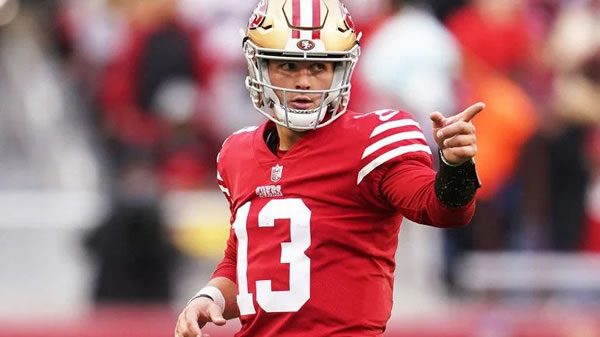
San Francisco visits Philadelphia as a 5-point underdog after a dismal 3-point performance against Seattle; our expert ATS pick evaluates if Brock Purdy can overcome the Eagles’ top-ranked red-zone defense.
Market Analysis: Sharp Money Backing Eagles Amid Total Uncertainty
The betting market opened this matchup with Philadelphia laying 4.5 points before quickly settling at 5, a move that suggests early respected action on the home favorite despite the 49ers’ stronger regular-season record. That type of line shift against what appears to be fairly balanced public interest usually indicates professional money recognizing the Eagles’ playoff experience and defensive improvements since mid-season.
The total sitting at 45 tells the story of two teams built around defense and methodical offensive approaches. Philadelphia’s under trend — hitting in 7 of their last 9 games — combined with San Francisco’s road under pattern creates a compelling narrative for sharps who’ve been hammering lower-scoring playoff scenarios. The 49ers’ offensive struggles in their Week 18 loss to Seattle, managing just 3 points, has the public questioning their ability to move the ball effectively against another elite defense.
What’s driving the line movement is the injury uncertainty surrounding key 49ers personnel, particularly Trent Williams and Ricky Pearsall, both questionable and both critical to San Francisco’s offensive functionality. The market has adjusted to reflect Philadelphia’s home-field advantage in January, where they’ve historically been dominant, while also accounting for the 49ers’ road warrior mentality that saw them cover in 4 of their last 5 away games.
This NFC Wild Card rematch carries significant playoff implications, with both teams still harboring Super Bowl aspirations. The Eagles are defending champions looking to validate their title, while the 49ers seek redemption after falling short in recent playoff runs. Weather conditions in Philadelphia could play a factor, though current forecasts suggest manageable conditions for both passing attacks.
Game Information
San Francisco 49ers at Philadelphia Eagles
When: 4:30 PM ET, Sunday, January 11, 2026
Where: Lincoln Financial Field
TV: FOX
Point Spread: San Francisco 49ers +5 (-110) / Philadelphia Eagles -5 (-110)
Money Line: San Francisco 49ers (+195) / Philadelphia Eagles (-235)
Total: 45 Over (-110) / Under (-110)
Sharp Money Breakdown: Professional Bettors Targeting Philadelphia Defense
The most telling indicator in this market lies in how the spread has behaved since opening. Despite the 49ers posting a better regular-season record and showing resilience on the road, the line moved from Eagles -4.5 to -5, suggesting that the bigger wagers are supporting the home favorite. This type of movement typically signals respected money recognizing something the general public might be missing.
The total presents an even more compelling sharp angle. With both teams trending under recently — Philadelphia hitting under in 7 of 9 games and San Francisco’s road games frequently staying below market expectations — professional bettors appear to be targeting a defensive slugfest. The 45-point total reflects not just recent trends but also the playoff environment where defenses traditionally tighten and offensive execution becomes more challenging.
Sharp indicators point toward the Eagles’ defensive improvements since Week 10, where they’ve ranked 3rd in opponent success rate and 4th in opponent EPA. This dramatic uptick in defensive efficiency, combined with their playoff experience from last year’s Super Bowl run, creates value that sophisticated bettors are recognizing before the general public catches on.
The injury uncertainty surrounding Trent Williams adds another layer of sharp interest. Professional handicappers understand that Williams’ absence fundamentally changes San Francisco’s offensive line protection schemes, particularly against Philadelphia’s improved pass rush. When elite left tackles are questionable, the ripple effects impact not just pass protection but also run-game execution and overall offensive rhythm.
Coaching Matchup & Strategic Analysis
Kyle Shanahan brings his innovative offensive schemes against Nick Sirianni’s more conservative but increasingly effective approach. Shanahan’s ability to manufacture explosive plays through motion, misdirection, and creative personnel groupings gives San Francisco multiple ways to attack, but his game plans require precise execution that can be disrupted by Philadelphia’s disciplined defensive front.
Sirianni has simplified his approach since mid-season, focusing on establishing Saquon Barkley in the ground game while allowing Jalen Hurts to manage the passing attack efficiently. This methodical style has served Philadelphia well in tighter games, and their red-zone touchdown efficiency of 70.45% (#1 ranking) shows they capitalize when opportunities arise.
The coordinator battle features Philadelphia defensive coordinator Vic Fangio against Shanahan’s offensive creativity. Fangio’s defense has shown marked improvement in getting off the field on third downs, while San Francisco’s 49.77% third-down conversion rate (#1) sets up an intriguing chess match. The team that wins third-down situations will likely control field position and clock management.
Both coaching staffs understand playoff football requires different approaches than regular-season games. Expect more conservative play-calling in crucial situations, with field position battles becoming paramount. Philadelphia’s home experience and Sirianni’s championship pedigree provide subtle but meaningful advantages in late-game decision-making scenarios.
Advanced Team Performance Analysis
The efficiency metrics reveal why sharp money is gravitating toward Philadelphia. The Eagles’ yards per point on offense (13.96) compares favorably to San Francisco’s defensive yards per point allowed (15.59), suggesting Philadelphia should find reasonable scoring opportunities. More importantly, Philadelphia’s defensive yards per point (16.43) creates significant resistance against San Francisco’s yards per point offense (13.67).
Third-down execution becomes critical in this matchup. San Francisco’s league-leading 49.77% conversion rate meets Philadelphia’s 40.53% defensive third-down percentage — a significant gap that could determine possession control. However, Philadelphia’s defensive improvements since Week 10 suggest their third-down numbers may not reflect their current capabilities.
Red-zone efficiency heavily favors Philadelphia, who converts 70.45% of red-zone opportunities into touchdowns compared to San Francisco’s defensive red-zone touchdown percentage of 53.85%. In lower-scoring games, the ability to finish drives with touchdowns rather than field goals often determines outcomes.
Turnover margins present an interesting dynamic. Philadelphia maintains a +0.4 turnover margin per game (#7) while San Francisco sits at -0.4 (#26). The Eagles’ ball security with only 0.9 giveaways per game (#4) compared to San Francisco’s 1.3 giveaways per game (#20) could prove decisive in a playoff environment where possessions are precious.
Penalty discipline significantly favors San Francisco, averaging just 4.9 penalties per game (#2) compared to Philadelphia’s 6.9 penalties per game (#23). In playoff games where every snap matters, San Francisco’s cleaner play could help offset other disadvantages.
Key Player Impact & Injury Analysis
Trent Williams’ status as questionable with a hamstring injury looms largest over this game. Williams anchors San Francisco’s offensive line and his absence would force significant protection adjustments against Philadelphia’s improving pass rush. Spencer Burford’s struggles at left guard became more apparent without Williams’ presence in their Week 18 loss.
Ricky Pearsall’s knee injury creates another crucial variable. Pearsall provided explosive plays in San Francisco’s earlier season victory over Seattle, but his absence in the Week 18 rematch was noticeable as the 49ers managed only 3 points. Without Pearsall’s downfield threat, Philadelphia’s defense can focus more attention on Christian McCaffrey and George Kittle.
For Philadelphia, Lane Johnson’s questionable status at right tackle and Dallas Goedert’s knee injury impact their offensive balance. Johnson’s pass protection is crucial against San Francisco’s defensive front, while Goedert’s red-zone presence has been important to Philadelphia’s league-leading red-zone touchdown efficiency.
Saquon Barkley’s health appears solid, giving Philadelphia their most reliable offensive weapon. Barkley’s ability to control clock and field position becomes even more valuable in playoff settings where defensive stops are expected to be more frequent.
Venue Factor & Environmental Analysis
Lincoln Financial Field in January provides Philadelphia with meaningful advantages. The Eagles’ home crowd becomes more of a factor in playoff atmospheres, particularly on third downs where communication becomes critical for visiting offenses. San Francisco’s road experience helps, but playoff environments intensify crowd noise effects.
The playing surface at Lincoln Financial Field is synthetic turf, which generally provides consistent footing and could benefit both teams’ cutting and acceleration. Weather conditions appear manageable for the current forecast, though January in Philadelphia can change quickly and impact passing games more than ground attacks.
Philadelphia’s familiarity with their home locker room, practice facilities, and routine provides subtle benefits that accumulate in high-pressure situations. The Eagles’ players sleep in their own beds and maintain normal routines while San Francisco adjusts to road logistics and hotel accommodations.
The 4:30 PM ET kickoff gives both teams adequate preparation time without early-game sluggishness. This time slot often produces cleaner offensive execution as teams are fully warmed up and mentally prepared for playoff intensity.
Bryan Bash’s Multi-Angle Strategy
Primary Investment: Philadelphia Eagles -5 (-110) — 2 Units
The sharp money indicators align with Philadelphia’s defensive improvements and home-field advantage in a playoff environment. San Francisco’s offensive line concerns without Trent Williams, combined with their defensive struggles ranking 27th in DVOA, create too many variables working against them. Philadelphia’s championship experience, superior red-zone efficiency at 70.45%, and better turnover management provide the foundation for covering a 5-point spread.
The market movement from -4.5 to -5 suggests respected action recognizes Philadelphia’s value before public perception catches up. San Francisco’s 3-point performance against Seattle exposed offensive vulnerabilities that Philadelphia’s improved defense can exploit. Expecting Philadelphia to win by 6-10 points in a methodical, defensive-oriented contest.
High-Value Alternative: Under 45 (-110) — 1.5 Units
Both teams’ under trends reflect their current identity and playoff realities. Philadelphia’s defense has allowed opponents to convert just 40.53% of third downs, while their own 37.14% offensive conversion rate suggests longer possessions and fewer total plays. San Francisco’s road games have frequently stayed under, particularly when their offensive line faces quality pass rushes.
The playoff environment naturally reduces scoring through tighter defensive play and more conservative offensive approaches. Both coaches will prioritize field position over aggressive downfield attacks, leading to more punts and field goal attempts rather than explosive touchdown drives.
Player Props Portfolio:
Christian McCaffrey Under rushing yards — McCaffrey’s effectiveness diminishes without proper offensive line protection and facing Philadelphia’s improving run defense. His 23-yard performance against Seattle shows how elite defenses can neutralize him when the blocking breaks down.
Jalen Hurts Under passing yards — Philadelphia’s game plan will likely emphasize Saquon Barkley and clock control rather than aggressive passing. Hurts’ efficiency matters more than volume in this matchup, and his rushing ability provides additional value without requiring high passing numbers.
Live Betting Strategy:
Monitor first-quarter execution to gauge both teams’ offensive rhythm. If Philadelphia establishes early leads through defensive stops and short fields, second-half unders become attractive as San Francisco may abandon their ground game. Conversely, if San Francisco keeps pace early, their historical road resilience could provide spread value as the game progresses.
Key indicators include third-down conversion rates, time of possession, and red-zone opportunities. Philadelphia’s ability to finish drives with touchdowns rather than field goals should signal their control of the game flow and support live bets on their spread and under totals.