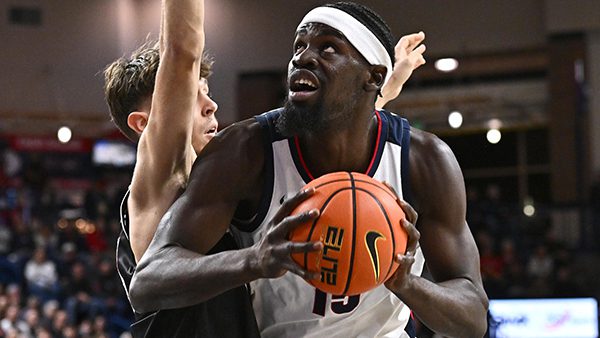
Our latest handicapping preview examines a WCC clash with massive efficiency splits. Bash explains why the free pick isn’t as scary as the high number suggests, especially with the Cougars ranking 329th in defensive rating.
The Setup: Gonzaga at Washington State
Gonzaga’s laying 18.5 points on the road at Washington State, and I can already hear the pushback: That’s a lot of points in a conference rivalry game, especially in Pullman where Beasley Coliseum can get loud. Look, I get it. These teams just joined the WCC together, there’s geographical proximity, and home dogs always feel appealing. But when you dig into the collegebasketballdata.com efficiency numbers, this isn’t your typical toss-up rivalry situation – this is a massive talent and execution gap that shows up in every meaningful metric. The Zags are 9-1 with the #2 adjusted defensive efficiency in the country, while Washington State sits at 3-7 with defensive numbers that rank #329 nationally. Here’s the thing – sometimes a big number is big for a reason, and this is one of those spots where the line actually undersells the gap between these programs.
Game Info & Betting Lines
Matchup: Gonzaga (9-1) @ Washington State (3-7)
Date: January 15, 2026
Time: 10:00 PM ET
Venue: Beasley Coliseum, Pullman, WA
Spread: Gonzaga -18 to -18.5
Total: 154.5
Moneyline: Gonzaga -4000 / Washington State +1200
Why This Number Makes Sense
Let me walk you through the efficiency gap that justifies this spread. According to collegebasketballdata.com, Gonzaga’s adjusted net efficiency sits at +33.9, ranking #2 nationally. Washington State? They’re at -4.0, ranking #222. That’s a 37.9-point swing in adjusted efficiency – and that’s not just a number on a spreadsheet, it’s a quantifiable measure of how much better Gonzaga executes on both ends of the floor when you normalize for opponent strength.
Break it down further: The Zags rank #13 in adjusted offensive efficiency at 122.4 and #2 in adjusted defensive efficiency at 88.5. Washington State ranks #105 offensively at 111.6 and a brutal #329 defensively at 115.6. Here’s why this matters for the game and the bet – Gonzaga’s defense is elite at limiting opponent field goal percentage (37.1%, #10 nationally) and three-point shooting (26.8%, #17), while Washington State allows opponents to shoot 48.9% from the field (#347) and 37.8% from three (#342). That’s not just bad defense – it’s why Washington State has allowed 79.6 points per game despite playing at a slower pace (68.5 possessions per game, #179).
Do that math over 70-72 possessions in this game, and you’re looking at Gonzaga generating high-efficiency looks all night while Washington State struggles to score against one of the nation’s best defenses. The 18.5-point spread isn’t some inflated number based on name recognition – it’s what happens when an elite team plays a severely flawed one.
Gonzaga’s Situation
The Zags are rolling, winners of five straight with their only loss coming back in early season play. They’re scoring 92.9 points per game (#11) while allowing just 65.3 (#30) – that’s a massive 27.6-point differential that reflects genuine dominance. Braden Huff leads the way at 17.0 points per game, but the real story is the depth and balance. Graham Ike adds 16.4 points and 8.1 rebounds (#75 nationally), giving them an interior presence that Washington State simply can’t match.
What makes Gonzaga dangerous is their offensive efficiency despite not being a lights-out three-point shooting team (35.6%, #107). They rank #13 in field goal percentage at 52.2% and #5 in rebounds per game at 44.8, meaning they get quality looks inside and clean up misses. Mario Saint-Supry runs the show with 5.0 assists per game (#79), and the Zags rank #6 nationally in assists at 20.4 per game. That’s ball movement that creates open shots, and against Washington State’s porous defense, those shots will fall.
The one concern? Gonzaga’s free throw shooting sits at just 72.1% (#158), so if this game gets chippy and turns into a foul fest, they could leave points at the line. But I keep coming back to those defensive numbers because they’re just too extreme to ignore – holding opponents to 37.1% shooting means Washington State will need a miracle shooting night just to stay within shouting distance.
Washington State’s Situation
Washington State is exactly what their 3-7 record suggests – a team trying to find its identity in a new conference against better competition. Ace Glass leads them at 16.6 points per game, but look at the supporting cast: nobody else averages more than 10.4 points. That’s a massive drop-off, and it shows in their offensive rating of 112.0 (#169) – serviceable but nothing special.
The real problem is defense. Washington State allows 79.6 points per game (#306) despite playing at a slower pace. Their opponents shoot 48.9% from the field (#347) and 37.8% from three (#342) – those are bottom-tier numbers that get exposed against quality opponents. They rank #290 in steals per game at just 5.8, meaning they don’t generate turnovers to create transition opportunities. Against Gonzaga’s disciplined offense (10.6 turnovers per game, #64), Washington State won’t get many easy baskets in transition.
Recent form tells the story: they’ve lost quality games against Saint Mary’s (82-88) and Seattle U (55-69), with their wins coming against Oregon State and lower-tier WCC opponents. The home court at Beasley Coliseum provides some energy, but energy doesn’t overcome a 37.9-point efficiency gap.
The Matchup: Where This Gets Decided
This game lives and dies on Gonzaga’s ability to impose their defensive will while exploiting Washington State’s defensive weaknesses. Here’s the matchup that seals it for me: Gonzaga’s interior duo of Huff and Ike against Washington State’s frontcourt. The Cougars’ best rebounders are ND Okafor (5.8 per game, #380) and Eemeli Yalaho (5.2, #576) – those are solid numbers, but they’re facing a Gonzaga team that ranks #5 nationally in rebounding at 44.8 per game. That’s an 11-rebound per game advantage, which translates to extra possessions and second-chance points.
The three-point battle favors Gonzaga defensively. Washington State shoots 35.0% from three (#133) but faces a Gonzaga defense that limits opponents to 26.8% from deep (#17). Meanwhile, Gonzaga shoots 35.6% from three against a Washington State defense that allows 37.8% (#342). That’s a massive swing in expected three-point production – probably worth 6-9 points by itself.
Pace is another factor. Gonzaga wants to play at 74.6 possessions per game (#19) while Washington State prefers 68.5 (#179). The faster pace benefits Gonzaga because it creates more possessions for their superior offense to exploit Washington State’s defense. Over a 72-possession game, Gonzaga’s offensive efficiency advantage (122.4 vs 111.6) and defensive edge (88.5 vs 115.6) projects to a comfortable 20+ point margin.
The last time these teams met in Pullman (February 2025), Gonzaga won 84-63 – a 21-point margin that’s right in line with what the numbers suggest this year. Washington State hasn’t improved enough to close that gap.
My Play
The Pick: Gonzaga -18.5 for 2 units
I’ve considered the home court factor, the rivalry angle, and the fact that 18.5 is a big number. But the efficiency gap is too massive to ignore. Gonzaga ranks #2 in adjusted net efficiency while Washington State sits at #222 – that’s not a close matchup that requires a big spread to separate them, it’s a talent and execution chasm that the spread actually undersells.
Gonzaga wins this game by controlling the glass, limiting Washington State’s three-point shooting, and executing their efficient half-court offense. The main risk here is if Gonzaga gets complacent with a big lead and coasts in the final five minutes, or if their 72.1% free throw shooting becomes an issue late. But Washington State doesn’t have the offensive firepower to make this a game – they’re scoring 76.7 points per game against mediocre competition, and Gonzaga’s defense is far from mediocre.
I’m projecting Gonzaga 88, Washington State 67. That’s a 21-point margin that covers comfortably and aligns with both the efficiency numbers and the recent head-to-head history. Lay the points with confidence.