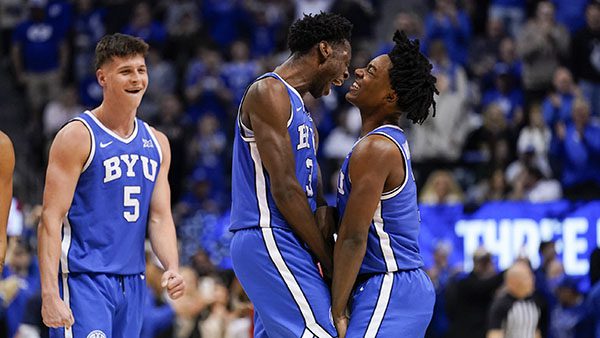
The #1 Arizona Wildcats put their perfect 20-0 record on the line tonight against AJ Dybantsa and the #13 BYU Cougars. Our betting preview dives into the efficiency gap between Arizona’s top-5 defense and BYU’s explosive offense to find the best bet for this Big 12 showdown.
The Setup: Arizona at BYU
Arizona’s laying 1.5 to 2.5 points at BYU on Monday night, and if you’re surprised this spread is so tight between two undefeated Big 12 teams, you haven’t been paying attention. The Wildcats roll into Provo at 8-0 with the fifth-ranked adjusted defense in the country, while BYU sits 7-1 with the 21st-ranked adjusted offense according to collegebasketballdata.com. This isn’t some conference bottom-feeder getting steamrolled—this is a legitimate top-15 matchup where the market is basically screaming “coin flip.” But here’s the thing: when you dig into the efficiency numbers and the tempo disparity, this line tells a very specific story about how Vegas expects this game to unfold.
Arizona’s adjusted net efficiency of 25.9 ranks sixth nationally. BYU’s 21.6 ranks 14th. On paper, that’s a four-point swing favoring the Wildcats, which tracks almost perfectly with this spread. The market isn’t disrespecting anyone here—it’s pricing in a hostile environment at the Marriott Center against a BYU squad that’s been surgical offensively.
Game Info & Betting Lines
Date: January 26, 2026
Time: 9:00 PM ET
Location: Marriott Center, Provo, UT
Bovada:
Spread: Arizona -2.5
Total: 165
Moneyline: BYU +120, Arizona -140
DraftKings:
Spread: Arizona -1.5
Total: 165.5
Why This Number Makes Sense (or Doesn’t)
Let’s talk about the total first, because that 165 number is doing some heavy lifting. Arizona plays at a pace ranked 53rd nationally at 72.4 possessions per game. BYU? They’re ranked 340th at 60.9 possessions. That’s a massive gap—nearly 12 possessions per game. When these two styles collide, something’s gotta give, and the market is betting BYU dictates tempo at home.
If we assume roughly 66 possessions—splitting the difference but leaning toward BYU’s crawl—that 165 total implies both teams scoring around 1.25 points per possession. Arizona’s offensive rating sits at 122.3, which translates to 1.22 PPP. BYU’s at 139.8—a ridiculous 1.40 PPP that ranks ninth nationally. But here’s the catch: BYU’s defensive rating of 111.7 ranks 268th. They give up 1.12 PPP, which is borderline atrocious against elite competition.
Arizona’s defensive rating of 92.6 ranks 24th nationally, and their adjusted defensive efficiency of 93.9 ranks fifth. That’s lockdown territory. The market is essentially saying BYU’s offense is good enough to hit their number even against Arizona’s defense, but the Wildcats won’t run wild in transition because BYU controls pace. I’m not sure I buy that Arizona just accepts a 60-possession slog, but the spread reflects uncertainty about who wins the tempo battle.
Arizona Breakdown: The Analytical Edge
Arizona’s shooting 53% from the field, ranked third nationally. Their effective field goal percentage of 57.9% ranks 29th. They don’t beat you with volume threes—they’re 55th in three-point percentage at 37.2%—they beat you by getting high-quality looks and converting at an elite rate. Koa Peat’s averaging 15.9 points, Jaden Bradley’s at 14.5, and this is a balanced attack that ranks 13th in assists per game at 19.4.
Defensively, this is where Arizona separates. Opponent field goal percentage of 39.5% ranks 46th. Opponent three-point percentage of 31.4% ranks 129th. The adjusted defensive efficiency ranking of fifth tells you everything—they’re elite when you account for strength of schedule and tempo. Motiejus Krivas anchors the paint with 7.9 rebounds per game, ranked 93rd nationally, and 4.4 blocks per game as a team ranks 74th.
The concern? Turnovers. Arizona’s averaging 12.8 turnovers per game, ranked 228th. That’s sloppy for a team with national championship aspirations, and BYU’s averaging 8.2 steals per game. If the Cougars force chaos, this game tilts.
BYU Breakdown: The Counterpoint
BYU’s offensive efficiency is absurd. A 139.8 offensive rating ranking ninth nationally isn’t a fluke—it’s AJ Dybantsa dropping 19.4 points per game, Richie Saunders adding 19.1, and Robert Wright III orchestrating at 6.1 assists per game, ranked 19th nationally. This is a three-headed monster that can score in the halfcourt, which matters against Arizona’s defense that won’t give up transition buckets easily.
The Cougars shoot 49.5% from the field and 37.4% from three, ranked 46th nationally. Their true shooting percentage of 60.5% ranks 50th. They’re efficient, they take care of the ball—9.6 turnovers per game ranks 22nd—and they execute in the halfcourt. That 60.9 pace isn’t a bug, it’s a feature. BYU wants to grind you down and execute in the half-court.
But that defense is a problem. A 111.7 defensive rating is exploitable, and Arizona’s adjusted offensive efficiency of 119.8 ranking 23rd suggests they’ll get theirs. BYU’s allowing 40.5% from the field, ranked just 72nd, and their rebounding is mediocre—offensive rebound percentage of 26.7% ranks 324th. Arizona can control the glass and get second chances.
The Matchup: Where This Gets Decided
This game comes down to two battles: pace and turnovers. If BYU slows this to 62 possessions and forces Arizona into their methodical halfcourt attack, the Cougars have a real shot. The Marriott Center is legitimately one of the toughest venues in college basketball, and BYU’s 7-1 with their only loss coming at Texas Tech. At home, they’re comfortable grinding.
But if Arizona pushes tempo even slightly—say, 68-70 possessions—the Wildcats’ superior defense becomes overwhelming. BYU’s defense ranking 268th in defensive rating means they’re vulnerable to teams that can execute, and Arizona’s 53% field goal percentage ranking third nationally is exactly the kind of efficiency that exploits that weakness.
The other X-factor is Arizona’s turnover issues. BYU doesn’t force a ton of steals relative to elite defensive teams, but 8.2 per game against a team averaging 12.8 turnovers? That’s 10-12 extra possessions for the Cougars if they capitalize. In a low-possession game, that’s the difference between covering and getting blown out.
I keep coming back to the efficiency gap. Arizona’s adjusted net efficiency of 25.9 ranking sixth is significantly better than BYU’s 21.6 ranking 14th. That’s a real talent gap, even accounting for home court.
Bash’s Best Bet
I’m laying the points with Arizona -1.5 at DraftKings. Yeah, the Marriott Center is tough. Yeah, BYU’s offense is explosive. But Arizona’s defense is the best unit on the floor, and I don’t trust BYU’s 268th-ranked defensive rating to slow down a Wildcats team shooting 53% from the field.
The pace battle matters, but even in a slower game, Arizona’s efficiency edge is too significant. They’re sixth in adjusted net efficiency for a reason—they beat good teams by executing on both ends. BYU’s one loss came against Texas Tech, another top-tier defensive team, and I see the same blueprint here.
Give me the Wildcats to win by 3-5 in a game that finishes around 80-77. Arizona -1.5 is the play.