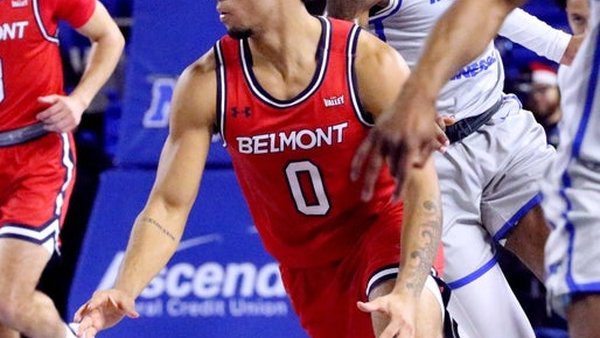
Belmont hosts Drake as 10.5-point favorites, but the efficiency metrics suggest a much tighter battle. Bash analyzes the Bruins’ poor home ATS record and Jalen Quinn’s scoring surge to find the sharpest prediction for Tuesday night.
The Setup: Drake at Belmont
Belmont’s sitting at 9-1 and laying somewhere between 9.5 and 10.5 points against a Drake squad that’s been one of the stingiest defensive teams in the country. The Bruins are riding a five-game winning streak at Curb Event Center, and the market’s telling us this one shouldn’t be close. But here’s where it gets interesting: Drake ranks 43rd nationally in defensive efficiency at 95.9, and they protect the basketball better than almost anyone in America with a turnover ratio that ranks 3rd in the country. When you dig into the collegebasketballdata.com efficiency numbers, this spread feels like it’s banking on Belmont’s offensive firepower overwhelming Drake’s methodical approach. The question isn’t whether Belmont can score—they’re shooting 51.5% from the field and rank 12th in effective field goal percentage. The question is whether Drake’s elite ball security and defensive discipline can keep this game ugly enough to stay within double digits.
Game Info & Betting Lines
Matchup: Drake (6-4) @ Belmont (9-1)
Date: February 3, 2026
Time: 9:00 PM ET
Venue: Curb Event Center Arena, Nashville, TN
Conference: MVC
Point Spread: Belmont -9.5 to -10.5
Over/Under: 152.5
Moneyline: Belmont -625, Drake +430
Why This Number Makes Sense (or Doesn’t)
The spread sits around double digits because Belmont’s adjusted net efficiency of 14.7 ranks 44th nationally, while Drake checks in at 111th with a 5.6 adjusted net rating. That’s a nine-point gap in the efficiency margin, which typically translates to somewhere between 8-11 points on a neutral court. Add in home court advantage—worth roughly 3-4 points in college basketball—and you can see why the market landed here.
But here’s the wrinkle: tempo matters, and these teams play at drastically different speeds. Drake operates at a glacial 65.7 possessions per game, ranking 275th nationally in pace. Belmont pushes it to 73.1 possessions, ranking 40th. When the slower team controls tempo, spreads compress. Drake’s not trying to run with anyone—they’re averaging just 8.8 turnovers per game, which ranks 6th in the country. That’s elite ball security, and it means fewer transition opportunities for Belmont’s attack.
The other factor? Drake’s defensive rating of 95.9 ranks 43rd nationally, while their adjusted defensive efficiency sits at 105.2. They’ve held opponents to 39.6% shooting from the field and 30.5% from three. Belmont’s offensive rating of 117.4 is strong, but their adjusted offensive efficiency of 113.2 ranks 88th—solid but not dominant. This isn’t a mismatch on paper. It’s a stylistic clash where Drake will try to suffocate possessions and Belmont will try to create enough separation through shooting efficiency.
Drake Breakdown: The Analytical Edge
Drake does two things at an elite level: they protect the basketball and they defend without fouling. That turnover ratio of 0.1 ranks 3rd nationally, and when you’re only coughing it up 8.8 times per game, you’re dictating pace and limiting opponent transition opportunities. Jalen Quinn leads the way at 18.3 points per game, but the real story is how balanced this offense operates. Five players averaging between 9-18 points, and they’re shooting 36.8% from three as a team.
Defensively, Drake ranks 48th in opponent field goal percentage at 39.6% and 92nd in opponent three-point percentage at 30.5%. They’re not generating a ton of steals—just 6.2 per game ranks 266th—but they’re forcing tough shots in the halfcourt. Okku Federiko provides interior presence with 6.7 rebounds per game, and the Bulldogs block 4.4 shots per contest, ranking 73rd nationally.
The concern? Offensive rebounding. Drake ranks 340th in offensive rebound percentage at 25.9%, which means they’re not getting second chances. Against a Belmont team that defends the three-point line well, Drake needs to capitalize on first-shot opportunities.
Belmont Breakdown: The Counterpoint
Belmont’s offensive efficiency is the headliner here. They’re shooting 51.5% from the field—18th nationally—and their 60.1% effective field goal percentage ranks 12th in the country. Tyler Lundblade and Sam Orme provide scoring punch, but Nic McClain is the engine, averaging 6.5 assists per game, which ranks 11th nationally. That’s elite playmaking, and it shows up in Belmont’s 18.9 assists per game, ranking 21st.
The defense has been stout too. Belmont’s defensive rating of 91.0 ranks 15th nationally, and they’re holding opponents to just 35.8% shooting from the field—5th in the country. They’ve allowed just 27.8% from three, ranking 29th. This isn’t just an offensive juggernaut; Belmont can get stops when they need them.
The vulnerability? Turnovers. Belmont’s averaging 13.5 turnovers per game, ranking 277th nationally, and their turnover ratio of 0.2 ranks 228th. Against a Drake team that protects the ball religiously, those extra possessions could be the difference between covering and not covering a double-digit spread. Free throw shooting is another concern—64.3% from the line ranks 337th. In a tight game, that’s a problem.
The Matchup: Where This Gets Decided
This game comes down to possession control and shooting efficiency. Drake wants to slow this thing to a crawl, milk the shot clock, and force Belmont into contested halfcourt jumpers. Belmont wants to push tempo off makes and misses, create transition opportunities, and exploit Drake’s 340th-ranked offensive rebounding with defensive boards that turn into fast breaks.
The key battle is Belmont’s turnover issues against Drake’s defensive discipline. If Belmont coughs it up 13-15 times like they’ve been doing, Drake gets extra possessions in a game where possessions are already limited. That’s how the Bulldogs stay within striking distance. But if Belmont takes care of the ball and shoots anywhere near their 51.5% field goal percentage, Drake doesn’t have the offensive firepower to keep pace.
Watch the three-point battle closely. Drake shoots 36.8% from deep but doesn’t generate many open looks. Belmont shoots 37.4% and creates better looks through ball movement. If Belmont gets hot from three early, this could get out of hand. If Drake forces Belmont into a halfcourt grind, the spread becomes vulnerable.
Bash’s Best Bet
I’m taking Drake +10.5 if you can still find it, and I’d play it down to +9. This feels like a 7-9 point game to me. Drake’s elite ball security and defensive efficiency will keep possessions limited, and Belmont’s turnover issues give Drake enough extra chances to hang around. The Bruins should win this game straight up, but laying double digits against a team that ranks 43rd in defensive efficiency and 3rd in turnover ratio? That’s asking Belmont to be near-perfect.
The total of 152.5 feels about right given the pace differential, so I’m staying away. But give me the Bulldogs with the points. Drake’s built to keep games close, and Belmont’s flaws—free throw shooting and turnovers—are exactly the kind of issues that keep spreads from covering in conference play.