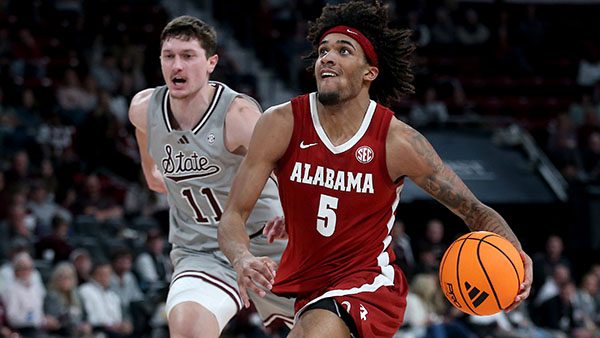
Alabama is laying 7.5 points at home against an Aggies squad currently leading the SEC standings. Handicapper Bash breaks down the 14-point efficiency gap and why Nate Oats’ 4th-ranked offense is the primary prediction for this Wednesday night battle in Tuscaloosa.
The Setup: Texas A&M at Alabama
Alabama’s laying 7.5 at home against Texas A&M on Wednesday night, and this number tells you everything about how the market views these two SEC offenses. Both teams can absolutely fill it up—the Aggies rank 17th nationally at 91.0 points per game, while Bama checks in at 7th with 95.1—but when you dig into the collegebasketballdata.com efficiency numbers, this spread makes perfect sense. Alabama’s adjusted offensive efficiency sits at 125.4, good for 4th in the country, while their adjusted defensive efficiency of 102.1 ranks 65th. Texas A&M? They’re at 114.2 and 105.2 respectively, landing them 71st and 119th. That’s a 23.2 adjusted net rating for the Crimson Tide compared to just 9.0 for the Aggies. The talent gap is real, and Coleman Coliseum is about to expose it.
Here’s what matters: Alabama plays at the 10th-fastest pace in college basketball at 75.6 possessions per game. Texas A&M trudges along at 65.4, ranking 284th. When you force a slow-tempo team to play at your speed AND you’ve got the superior efficiency on both ends, you’re looking at a legitimate mismatch. This isn’t about one team getting hot from three. This is about systemic advantages that compound over 40 minutes.
Game Info & Betting Lines
Matchup: Texas A&M (7-3) @ Alabama (7-2)
Date: February 4, 2026
Time: 7:00 PM ET
Venue: Coleman Coliseum, Tuscaloosa, AL
Conference: SEC
Betting Lines:
Point Spread: Alabama -7.5
Over/Under: 179/179.5
Moneyline: Alabama -350, Texas A&M +275
Why This Number Makes Sense (or Doesn’t)
The spread opened at 7.5 and it hasn’t budged, which tells you the market has confidence in this number. Let’s do the math on why. Alabama’s adjusted net rating of 23.2 ranks 12th nationally. Texas A&M’s 9.0 sits at 86th. That’s a 14.2-point gap in adjusted efficiency, and when you factor in home court advantage—typically worth 3-4 points in college basketball—you’re looking at a theoretical spread somewhere between 17 and 18 points.
Wait, what? So why is Alabama only giving 7.5?
Two reasons. First, the raw efficiency numbers don’t account for Texas A&M’s recent form—they’ve won four straight SEC games, including a road win at Georgia. Second, and more importantly, the pace differential creates uncertainty. Alabama wants to push tempo and create 75+ possessions. Texas A&M wants to grind this into the mid-60s. If the Aggies can control pace, they can keep this closer than the efficiency gap suggests. The market is essentially splitting the difference between Alabama’s clear talent advantage and Texas A&M’s ability to slow the game down.
The total of 179 is fascinating. With Alabama’s pace, you’d expect something north of 185. But oddsmakers are accounting for Texas A&M’s methodical approach and the fact that Alabama’s defense, while not elite, ranks 65th in adjusted efficiency. This total is begging the question: whose pace wins out?
Texas A&M Breakdown: The Analytical Edge
The Aggies have one elite trait: they can absolutely score when they get into their sets. That 133.6 offensive rating ranks 15th nationally, and their 20.7 assists per game sits 4th in the country. This is a team that shares the ball beautifully, led by Rubén Dominguez at 14.5 points per game and Rylan Griffen, who’s dishing 3.5 assists per contest while ranking 256th nationally in scoring at 10.6 points.
The shooting numbers back up the offensive efficiency. Texas A&M hits 36.5% from three (78th nationally) and posts a 60.1% true shooting percentage that ranks 63rd. When they get clean looks in the halfcourt, they convert. Rashaun Agee gives them a legitimate presence on the glass at 8.2 rebounds per game (70th nationally), and Samet Yigitoglu adds 8.0 boards from the center spot.
But here’s the problem: this defense is atrocious. They rank 297th in defensive rating at 113.6, and they’re allowing opponents to shoot 45.7% from the field (286th) and 35.9% from three (302nd). When you can’t get stops and you want to play slow, you’re asking for trouble against an elite offensive team.
Alabama Breakdown: The Counterpoint
Labaron Philon Jr. is a legitimate star, ranking 8th nationally at 21.4 points per game while also dishing 5.4 assists (46th nationally). Pair him with Aden Holloway at 18.2 points and 4.3 assists, and you’ve got one of the most dynamic backcourts in college basketball. This isn’t just about scoring volume—it’s about efficiency. Alabama’s 57.2% effective field goal percentage ranks 39th nationally, and their 60.9% true shooting percentage sits 41st.
The Crimson Tide’s rebounding advantage is substantial. They pull down 42.7 boards per game (20th nationally) compared to Texas A&M’s 37.8 (146th). Amari Allen at 7.7 rebounds per game (112th nationally) gives them a legitimate presence alongside Taylor Bol Bowen’s 4.8 boards. When you combine that rebounding edge with the 10th-fastest pace in the country, you’re creating extra possessions that compound Alabama’s efficiency advantage.
The defense isn’t lockdown, but it’s competent enough. That 102.1 adjusted defensive efficiency ranks 65th, and they block 6.2 shots per game (8th nationally). They force opponents into 42.1% shooting from the field (125th) and just 30.6% from three (96th). Against a Texas A&M team that wants to work the ball and find clean looks, Alabama’s length and shot-blocking could disrupt offensive flow.
The Matchup: Where This Gets Decided
This game comes down to one question: Can Texas A&M slow Alabama down enough to stay within striking distance? The Aggies rank 284th in pace. Alabama ranks 10th. That’s not just a stylistic difference—it’s a fundamental clash of philosophies.
If Alabama dictates tempo, this game could get ugly fast. The Crimson Tide score 95.1 points per game, and when they’re running in transition—152 fast break points through nine games—they’re virtually unstoppable. Texas A&M’s defensive rating of 113.6 suggests they simply cannot get stops consistently enough to prevent Alabama from pushing pace.
The turnover battle matters enormously here. Alabama commits just 9.9 turnovers per game (29th nationally) with a turnover ratio of 0.1 (3rd nationally). Texas A&M gives it away 12.1 times per contest (165th). When the team that wants to play fast also takes care of the ball better, you’re looking at a pace advantage that becomes insurmountable.
The three-point shooting matchup favors Alabama as well. The Aggies shoot 36.5% from deep, but they allow opponents to hit 35.9% (302nd nationally). Alabama shoots 34.7% while holding opponents to 30.6% (96th). That’s a six-possession swing over the course of a game if both teams attempt 20 threes.
Here’s the reality: Texas A&M’s only path to covering is if they turn this into a rock fight in the 60s and force Alabama into uncomfortable halfcourt possessions. But with Philon and Holloway creating off the dribble and Alabama’s 18.2 assists per game (34th nationally) showing they can execute in the halfcourt when needed, even a slower pace might not save the Aggies.
Bash’s Best Bet
I’m laying the points with Alabama -7.5. The efficiency gap is too wide, the pace advantage is too significant, and Texas A&M’s defense is too porous to hang with an Alabama team that ranks 4th in adjusted offensive efficiency. The Aggies have won four straight, but those wins came against Georgia, South Carolina, and Mississippi State—none of whom possess Alabama’s combination of elite offense and pace.
Coleman Coliseum is going to be rocking, and Alabama’s going to push tempo from the opening tip. Texas A&M will try to slow it down, but when you’re allowing 113.6 points per 100 possessions and facing the 4th-best adjusted offense in the country, your defensive limitations get exposed. I’m projecting Alabama wins this one by double digits. Give me the Crimson Tide to cover at home, and I’m not sweating this number in the final four minutes.