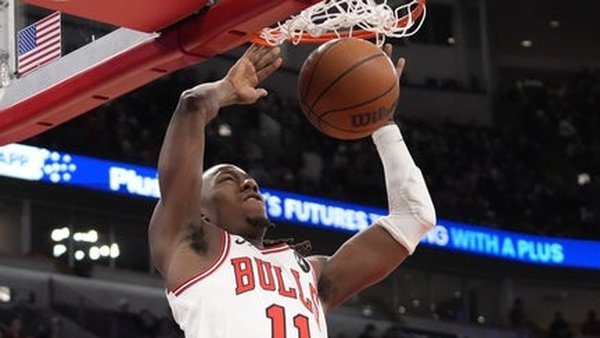
Chicago is laying 3.5 points on the road against a Brooklyn team missing its leading scorer and primary wing threat. Before you head to the window, check out who Bash thinks would be a strong ATS pick in this Eastern Conference showdown.
The Setup: Bulls at Nets
The Bulls are laying 3.5 at Barclays Center on Monday night, and this number reflects a simple truth: Chicago does almost everything better than Brooklyn, but they’re doing it on the road where they’ve been a disaster. The Bulls are averaging 9.7 more points per game, shooting better from everywhere, and turning it over less. They’re also 9-17 away from home, which means this spread has to account for a team that hasn’t figured out how to travel. Brooklyn sits at 7-18 at Barclays, but they’re catching the Bulls without Josh Giddey and facing a Nets squad missing both Michael Porter Jr. and Egor Demin. The line is asking whether Chicago’s statistical advantages can overcome their road struggles and a rotation that just lost its primary playmaker for a seventh straight game.
The total sits at 223.5, which feels aggressive for a Nets team averaging 107.3 points per game. But Chicago pushes that number up—they’re at 117.0 PPG on the season, and the Bulls’ shooting percentages (47.2% from the field, 36.9% from three) suggest they can get there even without Giddey running the offense. Brooklyn’s defensive metrics don’t inspire confidence, and their minus-7.6 plus/minus tells you they’re getting outscored consistently. The question isn’t whether Chicago can score—it’s whether Brooklyn can keep pace without their top two offensive weapons.
Game Info & Betting Lines
Game Time: February 9, 2026, 7:30 ET
Venue: Barclays Center
TV Network: Home: YES | Away: CHSN, NBA League Pass
Current Betting Lines (MyBookie.ag):
- Spread: Chicago Bulls -3.5 (-110) | Brooklyn Nets +3.5 (-110)
- Moneyline: Chicago Bulls -173 | Brooklyn Nets +141
- Total: Over 223.5 (-110) | Under 223.5 (-110)
Why This Line Exists
The market is giving Chicago 3.5 points because the statistical gap between these teams is real, but the context narrows it. The Bulls are minus-3.5 in plus/minus on the season, while Brooklyn sits at minus-7.6. That four-point difference aligns almost perfectly with this spread, which tells you the oddsmakers are pricing in Chicago’s overall superiority without giving them much credit for being on the road. And they shouldn’t—the Bulls are 9-17 away from home, which means they’ve lost nearly two-thirds of their road games. Brooklyn’s 7-18 home record isn’t much better, but it keeps this number from ballooning to five or six.
The injury situations create competing narratives. Chicago loses Giddey, who’s averaging 18.6 points, 8.6 rebounds, and 8.8 assists—those are lead playmaker numbers, and his absence for a seventh straight game means more ball-handling responsibility falls on Tre Jones and Collin Sexton. Brooklyn counters by missing Porter Jr., who’s putting up 25.0 points and 7.2 rebounds per game, and Demin, who handles 3.3 assists per contest. Porter’s scoring volume is the biggest loss on either side, which keeps the Nets competitive in this spot despite their brutal overall numbers.
The total at 223.5 reflects Chicago’s offensive firepower more than Brooklyn’s ability to score. The Bulls average 117.0 PPG and shoot 47.2% from the field, which gives them the foundation to hit 115-120 even in a road environment. Brooklyn needs to get to 105-110 to push this over, and that’s where the math gets tricky. The Nets are averaging 107.3 PPG, but without Porter’s 25 points per game, they’re asking Cam Thomas and Noah Clowney to carry more offensive load. Thomas is at 15.6 PPG on 39.9% shooting, which isn’t efficient enough to replace Porter’s volume.
Chicago Bulls Breakdown: What You Need to Know
The Bulls’ offensive identity runs through balance and efficiency. They’re averaging 29.4 assists per game, which ranks them among the better ball-movement teams in the league, and they’re converting at 47.2% from the field. Matas Buzelis is shooting 47.8% and contributing 15.1 points with 5.4 rebounds, while Anfernee Simons and Collin Sexton are both hitting 14.3 PPG. That depth matters when Giddey is out, because Chicago doesn’t have to rely on one guy to create everything. Tre Jones steps into more playmaking responsibility with his 5.8 assists per game, and his 55.0% field goal percentage means he’s not forcing bad shots.
The problem is what happens when Chicago leaves home. That 9-17 road record isn’t just bad luck—it’s a pattern. The Bulls commit 14.5 turnovers per game, which is solid, but their minus-3.5 plus/minus suggests they’re getting outscored in extended stretches. Their defensive activity numbers are decent (7.3 steals, 5.0 blocks), but they’re not generating enough stops to win consistently on the road. Brooklyn is averaging 15.5 turnovers per game, which gives Chicago opportunities to score in transition, but the Bulls haven’t proven they can capitalize on those chances away from home.
Chicago’s rebounding edge is real—they’re pulling down 45.0 boards per game compared to Brooklyn’s 40.5. That 4.5 rebound advantage should translate into extra possessions, and the Bulls are grabbing 10.2 offensive rebounds per contest. But Brooklyn actually leads in offensive boards at 11.1, which means the Nets are crashing the glass hard despite getting outrebounded overall. That offensive rebounding rate could keep possessions alive for Brooklyn and narrow Chicago’s efficiency advantage.
Brooklyn Nets Breakdown: The Other Side
The Nets are 14-37 for a reason—they can’t score consistently, and their defensive metrics don’t compensate. They’re averaging 107.3 points per game on 44.4% shooting, and their 34.1% mark from three-point range means they’re not stretching defenses effectively. Without Porter Jr., who accounts for 25.0 of those 107.3 points, Brooklyn is asking Thomas to be the primary scorer. Thomas is capable—15.6 PPG shows he can put the ball in the basket—but his 39.9% shooting percentage means he’s doing it inefficiently. That’s a problem when you’re already averaging fewer than 108 points per game as a team.
Nicolas Claxton provides some interior presence with 12.2 points, 7.2 rebounds, and 4.0 assists, and his 58.2% field goal percentage is elite. But he’s not a volume scorer, and his 1.3 blocks per game aren’t enough to anchor a defense that’s getting torched nightly. Noah Clowney is averaging 12.8 points, but he’s shooting just 38.6% from the field and 31.5% from three. That inefficiency compounds when Porter’s volume disappears from the lineup. Demin’s absence removes another 3.3 assists per game, which means Brooklyn’s already struggling ball movement (25.4 assists per game) takes another hit.
Brooklyn’s 7-18 home record tells you they’re not defending Barclays Center effectively, and their minus-7.6 plus/minus is one of the worst marks in the league. They’re committing 15.5 turnovers per game, which gives opponents easy transition opportunities, and their 7.5 steals and 4.2 blocks suggest they’re not creating enough defensive chaos to offset their offensive struggles. The Nets do lead in offensive rebounding at 11.1 per game, which could generate second-chance points against Chicago’s defense, but they’re not converting those extra possessions into enough scoring to stay competitive.
The Matchup: Where This Game Gets Decided
This game comes down to whether Chicago’s shooting efficiency can overcome their road struggles and Brooklyn’s ability to crash the offensive glass. The Bulls are shooting 47.2% from the field and 36.9% from three, which gives them a significant edge over Brooklyn’s 44.4% and 34.1% marks. That 2.8% difference in field goal percentage doesn’t sound massive, but over 90 possessions—roughly what you’d expect in a game with these rosters—it translates to an extra four or five made field goals. That’s eight to ten points, which is the difference between covering 3.5 and failing to do so.
Brooklyn’s offensive rebounding rate (11.1 per game) creates a counter-narrative. The Nets are grabbing more offensive boards than Chicago despite getting outrebounded overall, which means they’re generating second-chance opportunities. If Brooklyn can convert those extra possessions at a decent rate, they can stay within striking distance even if their half-court offense struggles. Chicago’s 10.2 offensive rebounds per game suggest they’ll get some second chances too, but the Bulls’ road efficiency issues mean they might not capitalize as effectively as they do at home.
The assist differential matters here. Chicago averages 29.4 assists per game compared to Brooklyn’s 25.4, and that four-assist gap reflects better ball movement and more open looks. Without Giddey orchestrating the offense, the Bulls lose some of that playmaking, but Tre Jones and Sexton can still facilitate. Brooklyn’s missing Demin’s 3.3 assists, which compounds their already limited passing game. The turnover edge favors Chicago (14.5 per game vs. 15.5), which means the Bulls should generate a few extra possessions. Whether they convert those into points on the road is the question.
The total at 223.5 requires Chicago to get to 115-120 and Brooklyn to hit 105-110. The Bulls have the offensive firepower to reach that range even without Giddey, but Brooklyn’s path to 105 without Porter’s 25 points is murky. Thomas and Clowney need to combine for 35-40 points to make up the gap, and their shooting percentages (39.9% and 38.6%) suggest that’s a tall order. If Brooklyn stalls out around 100 points, this game stays under even if Chicago scores 120.
Bash’s Best Bet & The Play
I’m backing the Under 223.5 here, and the logic is straightforward: Brooklyn can’t score enough without Porter Jr. to push this total over. The Nets are averaging 107.3 points per game with Porter in the lineup, and he’s accounting for 25.0 of those points. Even if Thomas and Clowney pick up some of that slack, Brooklyn is looking at 95-100 points in a best-case scenario. Chicago should get to 115-120 based on their shooting percentages and offensive balance, but that still leaves us short of 223.5. The Bulls’ road struggles add another layer—they’re 9-17 away from home, which means they’re not consistently hitting their offensive ceiling in hostile environments.
The risk is Chicago’s shooting efficiency translating better than expected on the road, or Brooklyn’s offensive rebounding creating enough second-chance points to inflate their total. But the Nets’ minus-7.6 plus/minus and their 44.4% field goal percentage suggest they’re not built to score in bunches, especially without their leading scorer. Chicago’s defense isn’t elite, but they don’t need to be—they just need to keep Brooklyn below 105, and the Nets’ offensive limitations make that achievable.
BASH’S BEST BET: Under 223.5 for 2 units. Brooklyn’s missing too much offensive firepower to keep pace, and Chicago’s road inconsistency means they’re not guaranteed to blow past 120. This total feels inflated by the Bulls’ season averages, but the context tells a different story. Take the under and let Brooklyn’s offensive struggles do the work.