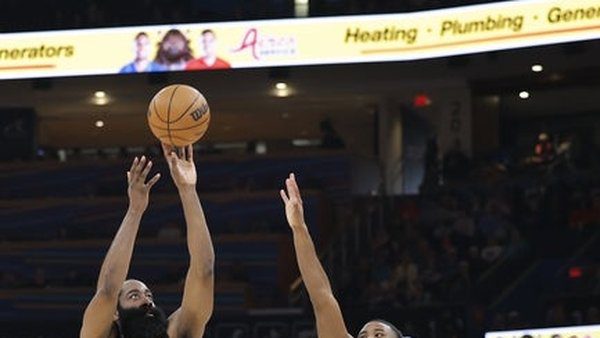
The bookies are asking you to lay more than a field goal with a Cavaliers team that just got torched by OKC, but catching 4 points with a New York team that just rallied from 18 down is the smarter ATS pick. Cleveland might have the shiny new Harden-Mitchell backcourt, but the Knicks have been a cash cow as underdogs this season, sporting a composure that travels well.
The Setup: New York Knicks at Cleveland Cavaliers
Cleveland is laying 4 points at home against a Knicks team that just clawed back from 18 down to beat Houston, then handled Chicago for their second straight win. The Cavaliers are coming off a loss to Oklahoma City where the Thunder hit 51% from three and exposed some defensive cracks. The projection here tells a different story than the spread suggests — this is essentially a coin-flip game with minimal separation, yet the market is asking you to lay more than a field goal with the home side.
The efficiency gap is too narrow to ignore here. Cleveland’s net rating advantage over New York sits at just 1.3 points per 100 possessions in the wrong direction — the Knicks actually hold the edge. When you account for home court and run the possessions math through an expected 100.1 possessions, the projected margin lands at Cleveland by just 1.3 points. That’s a 2.7-point gap between what the market is charging and what the numbers support. I’m taking the points all day long with New York at +4.
Game Info & Betting Lines
Game Time: Tuesday, February 24, 2026, 7:30 ET
Location: Rocket Arena
Watch: Peacock
Current Betting Lines (MyBookie.ag):
- Spread: Cleveland Cavaliers -4.0 (-110) | New York Knicks +4.0 (-110)
- Total: Over 232.5 (-110) | Under 232.5 (-110)
- Moneyline: Cleveland Cavaliers -175 | New York Knicks +143
Why This Line Exists
The market is giving Cleveland respect for home court and their backcourt firepower with Donovan Mitchell and James Harden. On paper, that makes sense — 19-11 at home, two elite shot creators, and Evan Mobley anchoring the defense. But when you dig into the season-long efficiency numbers, this line doesn’t add up once you run the efficiency math.
New York posts a 118.5 offensive rating against Cleveland’s 112.7 defensive rating — that’s a +5.3 mismatch advantage per 100 possessions for the Knicks’ offense. Cleveland’s offense against New York’s defense? That’s +4.9 for the Cavaliers. The offensive/defensive matchup essentially neutralizes, with New York holding a slight edge in exploiting Cleveland’s defensive vulnerabilities.
The pace blend projects 100.1 possessions, which sits right between New York’s deliberate 98.6 tempo and Cleveland’s more aggressive 101.5 pace. That’s enough possessions to expect scoring opportunities in the 115-116 range for both sides, which is exactly what the projection shows: Knicks 115.9, Cavaliers 115.2. Add in the standard 2-point home court advantage, and you land at Cleveland by 1.3 points — nowhere near the 4 the market is asking you to lay.
Cleveland’s net rating of +4.4 trails New York’s +5.7, and that gap has held consistent over 58 games of data. The shooting metrics are basically priced correctly — true shooting and effective field goal percentages are within noise levels, separated by just 0.4 percentage points. The market seems to be overvaluing Cleveland’s home court and recent narrative while undervaluing the Knicks’ superior season-long efficiency profile.
New York Knicks Breakdown: What You Need to Know
The Knicks are rolling right now, and Karl-Anthony Towns is the primary reason. His 28 points and 11 rebounds against Chicago marked his NBA-leading 39th double-double of the season, and he’s been the steadying force when Jalen Brunson’s shot isn’t falling. Towns is averaging 20.1 points and 11.8 boards while shooting 47.4% from the floor and 36.5% from three — that versatility creates matchup problems for Cleveland’s frontcourt.
Brunson orchestrates everything with 26.8 points and 6.2 assists per game, and his 47.1% shooting gives New York a reliable closer. Mikal Bridges (15.6 PPG, 50.1 FG%) and OG Anunoby (16.3 PPG, 1.8 steals) provide two-way balance that Cleveland can’t match across the wing positions. The loss of Miles McBride to a sports hernia hurts their backcourt depth, but Tyler Kolek and Jordan Clarkson have picked up the slack in recent games.
New York’s 118.5 offensive rating ranks elite, and their 58.7% true shooting percentage reflects quality shot selection and execution. They turn the ball over on just 11.9% of possessions — among the best marks in the league — which matters in a pace-up environment where extra possessions amplify mistakes. In clutch situations, the Knicks are 14-10 with a 47.0% field goal percentage when it matters most, and they’ve shown the composure to close tight games on the road.
Cleveland Cavaliers Breakdown: The Other Side
Cleveland’s offense runs through Mitchell and Harden, and that’s both a strength and a limitation. Mitchell’s 28.6 points per game on 48.6% shooting makes him one of the league’s most dangerous scorers, while Harden’s 24.6 points and 8.2 assists give them a secondary creator who can run pick-and-roll with Jarrett Allen and Evan Mobley. The problem is what happens when those two aren’t efficient — and against Oklahoma City, they combined for 40 points on 14-of-37 shooting while the Thunder torched them from deep.
Mobley (17.7 PPG, 8.6 RPG, 1.9 blocks) and Allen (14.8 PPG, 62.8 FG%) provide interior presence, but the Cavaliers rank just 27.4% in offensive rebounding rate — 1.8 percentage points worse than New York. That means fewer second-chance opportunities in a game where possessions will be at a premium. Jaylon Tyson has been a revelation at 13.5 points per game on 46.7% three-point shooting, but he’s still a role player being asked to fill Max Strus’s absence.
Cleveland’s 117.6 offensive rating is solid, but their 113.2 defensive rating exposes vulnerability — they’re allowing 119.7 points per game, and teams are shooting 55.7% effective field goal percentage against them. In clutch situations, they’re just 14-15 with a 40.7% field goal percentage and 31.3% from three when the game is tight. That’s a concerning pattern for a team being asked to cover 4 points in a projected one-possession game.
The Matchup: Where This Game Gets Decided
This game gets decided in the margins — offensive rebounding, turnovers, and which team executes better in transition. New York holds a 1.8 percentage point edge in offensive rebounding rate, which over 100.1 possessions translates to roughly 1-2 additional second-chance opportunities. That might not sound like much, but in a game projected to be decided by 1.3 points, those extra possessions matter.
The possessions math tells a different story than the spread. With 100.1 expected possessions and both teams projecting in the 115-116 point range, you’re looking at a game where 3-4 key plays determine the outcome. New York’s superior ball security — turning it over on 11.9% of possessions compared to Cleveland’s 12.4% — means fewer empty trips and more opportunities to exploit Cleveland’s defensive weaknesses.
The writing’s on the wall with this matchup when you examine the offensive/defensive crossover. New York’s offense against Cleveland’s defense produces a +5.3 mismatch advantage per 100 possessions — the Knicks can score on this Cleveland defense. Meanwhile, Cleveland’s offense against New York’s defense sits at +4.9. Over 100 possessions, that’s a net wash with a slight lean toward the Knicks’ ability to exploit defensive gaps.
My model projects this total at 231.2 points, which sits 1.3 points below the market’s 232.5 number. The pace blend of 100.1 possessions supports scoring, but both defenses have enough length and switchability to force contested looks. Cleveland’s 35.9% three-point shooting at home and New York’s 37.5% mark on the road suggest quality shot-making, but not the explosive shooting performance needed to push this over the total.
Bash’s Best Bet & The Play
BASH’S BEST BET: New York Knicks +4.0 for 2 units.
The market’s disrespecting New York here. A 2.7-point edge against the spread is significant — you’re getting a team with superior net rating, better offensive efficiency, and tighter ball security as a 4-point underdog. The Knicks are 14-13 on the road, which isn’t dominant, but they’ve shown the ability to win tight games with a 14-10 clutch record and composure down the stretch. Cleveland’s 14-15 clutch record and 40.7% field goal percentage in close games suggests they’re more vulnerable than this spread indicates.
The risk here is Cleveland’s home-court advantage and the Mitchell-Harden duo going nuclear. If both guards get hot and Cleveland hits 40% from three like they’re capable of, this could get away from New York quickly. But over 58 games of data, the efficiency gap favors the Knicks, and the projected margin of 1.3 points gives you plenty of cushion with 4 points in your pocket.
This is exactly the spot where the numbers and the narrative diverge — and I trust the numbers. Take New York plus the points and let Cleveland prove they’re worth laying a field goal at home against a better team.