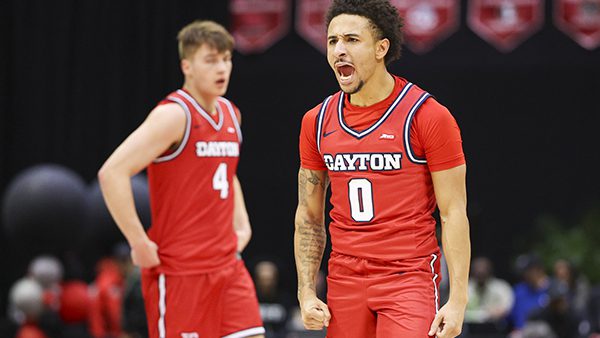
George Washington brings a top-25 offensive rating into Friday’s clash, but Bryan Bash’s best bet focuses on Dayton’s top-40 defensive unit, which excels at limiting possessions and forcing teams into half-court grinds.
The Setup: Dayton at George Washington
George Washington is laying 3.5 points at home against Dayton on Friday night, and the market’s telling you something clear: this is a toss-up dressed up as a home favorite situation. Look, when you’re getting a 3.5-point spread in a conference game between two teams separated by just 2.4 points in adjusted net rating, you’re not looking at a mismatch—you’re looking at a coin flip with home court baked in.
The efficiency numbers from collegebasketballdata.com paint the picture perfectly. George Washington checks in at #63 nationally in adjusted net rating (+12.5), while Dayton sits at #79 (+10.1). That’s razor-thin separation. But here’s where it gets interesting: GW’s offensive rating (#53 nationally at 118.7) significantly outpaces Dayton’s (#136 at 111.0), while the Flyers counter with a top-40 defense (#40 nationally at 101.0 adjusted defensive rating) against GW’s middle-of-the-pack #112 defensive unit. This sets up a classic offense-versus-defense A-10 battle, and the 152-point total suggests the market expects GW’s tempo and scoring punch to win out.
Game Info & Betting Lines
Game Time: February 27, 2026, 7:00 PM ET
Venue: Charles E. Smith Center, Washington, DC
Conference: Atlantic 10
Records:
Dayton: 19-9 (10-5 A-10)
George Washington: 16-12 (7-8 A-10)
Betting Lines:
Spread: George Washington -3.5
Total: 152/152.5
Moneyline: George Washington -170, Dayton +145
Why This Number Makes Sense (or Doesn’t)
The 3.5-point spread essentially breaks down to home court advantage plus a field goal, which aligns perfectly with the underlying efficiency metrics. When you blend the pace (67.5 projected possessions) with the offensive and defensive ratings, you’re looking at a projected margin right around three points. The market nailed this one.
But that 152-point total? That’s where I’m raising an eyebrow. Both teams play in the mid-to-high 60s in pace—Dayton at 66.9 (#186 nationally) and GW at 68.0 (#139). Neither squad is pushing tempo aggressively. The model projects 147.3 total points, which puts us nearly five points under the market number. George Washington’s 83.6 PPG (#33 nationally) is impressive, but that’s inflated by some cupcake matchups. In A-10 play, they’re scoring 80.2 PPG, and over their last 10 games, that drops to 77.5. Dayton’s defense (101.8 defensive rating, #55 nationally) is legitimately stout, allowing just 70.7 PPG overall.
The efficiency matchup supports a lower-scoring affair. Dayton’s adjusted defensive rating of 101.0 (#40) against GW’s adjusted offensive rating of 118.7 creates a 17.7-point gap favoring the offense, but flip it around—GW’s 106.2 defensive rating (#112) against Dayton’s 111.0 offensive rating is just a 4.8-point gap. The Flyers aren’t built to run teams off the court. They’re grinding out wins with defense and limiting possessions.
Dayton Breakdown: The Analytical Edge
The Flyers are 19-9 overall but just 4-6 on the road, and that road split matters. They’re 1-4 ATS in their last five away games, and more importantly, they’re 1-4 straight up. This isn’t a team that travels well. However, the head-to-head history is fascinating—Dayton is 8-2 straight up in the last 10 meetings and 14-4 ATS in the last 18 against George Washington. They own this matchup historically, even if the venue flips the script.
Defensively, Dayton is elite. That #40 adjusted defensive rating isn’t a fluke—they’re holding opponents to 43.6% from the field (#140 nationally) and generating 8.7 steals per game (#29). The issue is their offensive limitations. They rank #220 nationally in offensive rating (109.3) and struggle with efficiency metrics across the board: #189 in field goal percentage (45.1%), #186 in three-point percentage (33.9%), and dead last in offensive rebounding (#308 at 27.5%). They can’t create second-chance points, and against a GW team that ranks #75 in offensive rebounding percentage (33.1%), that’s a problem.
Javon Bennett (16.2 PPG) and De’Shayne Montgomery (15.4 PPG) carry the scoring load, but Dayton’s 14.4 assists per game (#140) suggests limited ball movement. They’re not generating easy looks.
George Washington Breakdown: The Counterpoint
George Washington’s offense is legit. They’re scoring 83.6 PPG (#33 nationally) with a 122.9 offensive rating (#23) and elite shooting efficiency: 47.5% from the field (#51), 55.9% effective field goal percentage (#33), and 59.6% true shooting (#39). Rafael Castro (16.1 PPG, 7.6 RPG) anchors the frontcourt, and when this team is clicking, they can score in bunches. They dropped 104 on La Salle in their last outing.
But the defense is suspect. A 106.2 adjusted defensive rating (#112) and 108.6 raw defensive rating (#192) means they’re giving up 73.8 PPG (#184 nationally). They’re allowing 44.3% shooting (#180) and struggling to get stops when it matters. That’s why they’re just 7-8 in A-10 play despite the offensive firepower.
The injury report adds intrigue: Garrett Johnson (14.9 PPG) is questionable with an undisclosed injury. Johnson is GW’s second-leading scorer, and if he’s limited or out, that’s a massive blow to their offensive depth. On the Dayton side, Bryce Heard is questionable with a lower body injury, though he’s not listed among the key statistical contributors.
Home court has been critical for GW—they’re 13-4 at the Smith Center and 16-6 SU in their last 22 home games against Dayton. But they’re also 4-14 ATS in their last 18 overall against the Flyers, which tells you the market consistently overvalues them in this matchup.
The Matchup: Where This Gets Decided
This game comes down to two factors: Can Dayton’s defense slow down George Washington’s elite offense, and can GW overcome their defensive limitations against a Dayton team that struggles to score?
The rebounding edge favors George Washington significantly—they’re pulling down 37.7 boards per game (#72) compared to Dayton’s 32.9 (#303), and that 5.6-point offensive rebounding edge could be the difference. GW averages 12.46 offensive rebounds per game compared to Dayton’s 9.04, and second-chance points will matter in a game projected for 67 possessions.
But Dayton’s defensive discipline is the counter. They’re forcing 11.9 turnovers per game and converting those into 476 points off turnovers this season. George Washington is coughing it up 12.6 times per game (#286 nationally), and their 1.27 assist-to-turnover ratio suggests they’re careless with the ball. If Dayton can turn GW over and limit possessions, they can keep this game in the 140s.
The pace projection of 67.5 possessions favors Dayton’s style. They want a rock fight, and GW’s home court advantage might not be enough to speed things up. The betting trends scream caution on the total: the under is 4-1 in GW’s last five home games, and Dayton’s road games have gone under in four of their last five conference matchups.
Bash’s Best Bet
I’m passing on the side and hammering the UNDER 152. The model projects 147.3 total points, and everything about this matchup screams lower scoring than the market expects. Dayton’s elite defense (#40 adjusted) will force George Washington into contested shots, and the Flyers’ offensive limitations (109.3 offensive rating, #220 nationally) mean they’re not built to push the pace or create easy buckets.
The pace blend of 67.5 possessions supports a grind-it-out affair, and GW’s recent home unders (4-1 in their last five) align with Dayton’s road profile. Add in the potential absence of Garrett Johnson, and GW’s scoring punch takes a hit. Dayton wins these games in the 70s, and even if GW gets to 75-78, you’re looking at a total in the mid-140s.
The Pick: UNDER 152 (-110)
This is a classic A-10 defensive battle disguised as a shootout. Take the under and watch Dayton’s defense grind this one into the 140s.