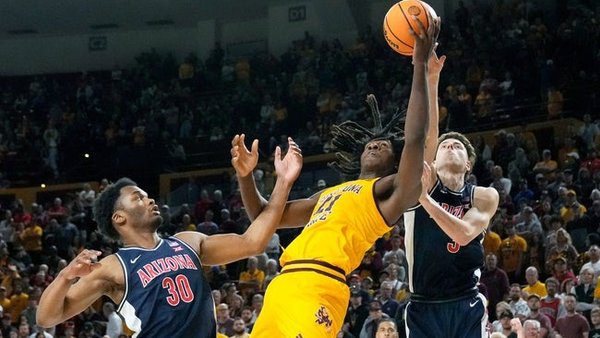
Bash is backing Baylor to settle the score in Kansas City, where the Bears’ elite offensive rebounding and adjusted efficiency edge make this neutral-site number look too generous.
The Line That Caught My Eye
Baylor’s getting 3.5 points against Arizona State in Tuesday’s Big 12 Tournament first-round matchup at T-Mobile Center, and I’m immediately drawn to the Bears. These teams just played 17 days ago in Waco, where Baylor won 73-68 despite failing to cover as 8-point favorites. Now we’re getting essentially a pick’em on a neutral floor between a team ranked #48 in KenPom and one sitting at #63.
When you dig into the collegebasketballdata.com efficiency numbers, this isn’t just about recent familiarity. Baylor posts a 123.1 adjusted offensive rating (#20 nationally) against Arizona State’s 114.8 (#82). That’s an 8.3-point gap in offensive firepower, and it shows up everywhere in the advanced metrics. The Bears’ 15.6 net rating (#48) holds a clear 4.8-point advantage over the Sun Devils’ 10.8 mark (#74).
The market is essentially saying these teams are equals on a neutral floor. The numbers say otherwise.
Why the Market Landed Here
Arizona State’s 19-12 ATS record is doing heavy lifting in this line construction. The Sun Devils have been profitable all season, particularly at home where they’re 12-6 ATS. Baylor’s 14-16 ATS mark tells a different story—this is a team that’s underperformed expectations despite superior underlying metrics.
But here’s the context that matters: Arizona State is 0-7 straight up against Baylor historically, including 0-5 in their last five meetings. The Sun Devils are 2-9 on the road this season and just 1-8 away from home in Big 12 play. Strip away the home-court advantage they’ve enjoyed all year, and you’re left with a team that’s struggled mightily in hostile or neutral environments.
Warren Nolan’s RPI data reinforces this split. Arizona State sits at #70 overall with a 2-9 road record. Their 3-9 Q1 record shows they’ve been tested against elite competition and come up short more often than not. Baylor’s #84 RPI is dragged down by a 3-12 Q1 mark, but that’s a function of facing the nation’s 19th-toughest schedule. Both teams are battling in the Big 12 gauntlet, but Baylor’s played the slightly harder slate.
The total sitting at 154.5 reflects a pace blend around 70 possessions with two teams that defend reasonably well. KenPom projects 69 possessions with an 81-79 Baylor win, which aligns perfectly with the market’s assessment of scoring environment while disagreeing on the margin.
The Efficiency Story Nobody’s Telling
Baylor’s offensive rebounding is going to be the difference-maker in a tournament setting where possessions become gold. The Bears rank #35 nationally in offensive rebound percentage at 34.4%, pulling down 12.65 offensive boards per game. Arizona State sits at 30.9% (#171) and grabs just 10.29 per game.
That’s a 3.5-point rebounding edge in Baylor’s favor, and in a game projected for under 70 possessions, those second-chance opportunities become magnified. Cameron Carr (21.8 PPG, #6 nationally) and Tounde Yessoufou (17.8 PPG) are both capable of cleaning up misses and creating extra possessions that Arizona State simply can’t match.
The Bears also shoot 48.1% from the field (#38) compared to Arizona State’s 44.6% (#214). That 3.5-point shooting efficiency gap compounds when you factor in Baylor’s superior offensive rebounding—they’re getting more attempts and converting at a higher rate.
I keep coming back to the adjusted offensive ratings. Baylor’s 123.1 mark is elite territory, ranking #20 nationally. When they face Arizona State’s 104.0 adjusted defensive rating (#75), the matchup projects to 119.1 points per 100 possessions. Flip it around: Arizona State’s offense (#82) against Baylor’s defense (#134) projects to just 111.2 per 100. That’s an 8-point swing in offensive efficiency that the 3.5-point spread doesn’t fully capture.
The Matchup That Matters
Maurice Odum (18.9 PPG, 6.0 APG) is Arizona State’s engine, but he’s going to face ball pressure from a Baylor team that forces 11.5 turnovers per game. The Sun Devils’ 1.21 assist-to-turnover ratio trails Baylor’s 1.38 mark, and in a tournament atmosphere where execution tightens, that gap matters.
Dan Skillings Jr. (11.2 PPG, 7.8 RPG) gives Baylor a versatile defender who can switch across multiple positions. Arizona State doesn’t have an equivalent chess piece—they’re more reliant on Mor Massamba Diop’s rim protection (4.7 blocks per game, #28 nationally) to anchor their defense. But Baylor’s perimeter shooting (35.0% from three, #125) is competent enough to pull Diop away from the basket and exploit driving lanes.
The Q1 records tell me both teams have been battle-tested but neither has thrived against elite competition. Baylor’s 3-12 mark in Q1 games is ugly, but three of those wins came against tournament-caliber opponents. Arizona State’s 3-9 Q1 record includes quality wins over Kansas and others, but the 9 losses reveal a team that’s been exposed repeatedly by upper-tier competition.
This is essentially a Q2 matchup—two bubble teams fighting for NCAA Tournament life in a neutral-site environment. The team with the better offensive firepower and rebounding edge should control the game.
Advanced Metrics Comparison
| Metric | Baylor | Arizona State |
|---|---|---|
| KenPom Rank | #48 | #63 |
| RPI Rank | #84 | #70 |
| Strength of Schedule | #19 | #18 |
| Q1 Record | 3-12 | 3-9 |
| Adj. Offensive Rating | 123.1 (#20) | 114.8 (#82) |
| Adj. Defensive Rating | 107.5 (#134) | 104.0 (#75) |
| Net Rating | +15.6 (#48) | +10.8 (#74) |
The pace projection of 69.8 possessions favors neither team dramatically—both operate in the high-60s to low-70s range. But when you calculate efficiency on a per-possession basis, Baylor projects to score 113.5 points per 100 possessions against this Arizona State defense. The Sun Devils project just 111.2 per 100 against Baylor’s defense.
That 2.3-point efficiency gap translates to roughly 1.6 points over 69.8 possessions, which is exactly where my model lands. The market giving us 3.5 points creates a 1.8-point edge in Baylor’s favor according to the adjusted efficiency projections.
Arizona State’s 2-9 road record is the stat that keeps flashing in my head. Remove the home-court advantage that’s propped up their ATS record, and you’re left with a team that’s 7-6 ATS away from home—solid but not spectacular. Baylor’s 6-6 ATS mark on the road is comparable, but their superior offensive metrics suggest they should perform better in neutral environments where raw talent and execution matter more than crowd energy.
The Bottom Line
BASH’S BEST BET: Baylor +3.5 for 2 units.
This is a revenge spot for a team with better offensive metrics, superior rebounding, and a historical stranglehold on the opponent. Arizona State’s ATS success has been built on home-court performance that won’t translate to Kansas City. The 4.8-point net rating gap favors Baylor, and getting 3.5 points with the better team feels like a market overcorrection based on ATS records rather than underlying quality.
The primary risk is Arizona State’s defensive ranking (#75 in adjusted defense) compared to Baylor’s #134 mark. If the Sun Devils can force Baylor into contested shots and limit second-chance opportunities, they’ve got the defensive foundation to keep this close. But I’m betting on Baylor’s offensive firepower and rebounding edge to control the game flow in a neutral environment where Arizona State can’t lean on home-court execution.
Take the Bears plus the points. This number should be closer to a pick’em.