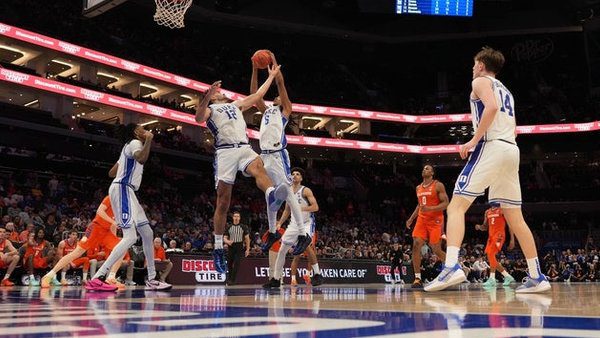
Bash is treating this as a lab experiment—Duke already dissected Virginia’s defense two weeks ago, and the metrics say nothing has changed to flip the script in Charlotte.
Duke’s laying a number we don’t have yet against Virginia in the ACC Tournament semifinals at Spectrum Center on Saturday night, March 14, 2026, at 8:30 ET. The total sits at 138. Look, I get the temptation to back the Cavaliers after they’ve won four straight since that 77-51 beatdown at Cameron Indoor. But when you dig into the collegebasketballdata.com numbers, this isn’t a rivalry game where recent history gets erased—it’s a style mismatch that Duke has already solved.
The Blue Devils sit #1 in KenPom’s adjusted defensive efficiency at 88.7, and Virginia’s offense—ranked #28 at 122.3—couldn’t crack 52 points in their last meeting. Duke shot 49% from the floor in that game while holding UVA to a ghastly 29.09% clip. This is a conference tournament semifinal, which means we’re looking at a battle-tested spot for both teams, but the quality gap is real.
Why the Market Respects Duke’s Defensive Dominance
The market set this total at 138, and that’s a direct reflection of what happens when two slow-tempo teams meet in a high-stakes environment. Duke’s adjusted tempo ranks #289 nationally at 65.4 possessions per game. Virginia’s even slower at #270 (65.8). KenPom projects 64 possessions for this matchup, which means we’re looking at a grind-it-out affair where every possession matters.
Duke’s net rating advantage is massive: +41.9 compared to Virginia’s +27.4. That’s a 14.5-point gap in adjusted efficiency, and it shows up in every facet of the matchup. The Blue Devils rank #4 nationally in adjusted offensive efficiency (128.0) while maintaining the nation’s best defense (87.4). Virginia’s defense is elite too—#16 at 95.6—but their offense (#31 at 123.0) doesn’t have the firepower to exploit Duke’s rare defensive lapses.
Warren Nolan’s RPI data adds context: Duke checks in at #2 overall with a strength of schedule ranked #6 nationally. They’re 15-2 in Quadrant 1 games, which means they’ve been battle-tested against elite competition all season. Virginia’s #9 RPI and #58 SOS are solid, but their 8-3 Q1 record shows they’ve struggled more against top-tier opponents. Duke’s 77-51 win over UVA on February 28 was a Quadrant 1 game for both teams, and it wasn’t competitive after halftime.
Injury Report and Rotation Concerns
Duke’s dealing with a significant injury: guard Caleb Foster (9.2 PPG, 2.9 APG) remains out with a fractured foot. Foster’s a key rotation piece who provides secondary ball-handling and perimeter shooting, but the Blue Devils have won their last five games without him, including blowouts over NC State (93-64) and the first Virginia matchup. Jon Scheyer’s adjusted his rotation, and the results haven’t suffered.
Virginia enters healthy with no significant injuries reported, which should give them full access to their defensive identity. The Cavaliers rank #1 nationally in blocks per game (6.3) and #13 in opponent field goal percentage (39.6%). Their rim protection, led by forward Thijs De Ridder (16.4 PPG, 6.0 RPG), is elite. But Duke’s interior presence—Cameron Boozer (23.0 PPG, 9.9 RPG) and Patrick Ngongba II (11.9 PPG, 6.4 RPG)—dominated that matchup two weeks ago, combining for efficient scoring in the paint.
The Matchup Contrast: Shooting Quality Decides This
Duke’s effective field goal percentage (57.2%, #14 nationally) is significantly better than Virginia’s (54.7%, #49). That 2.5-percentage-point gap might not sound massive, but in a 64-possession game, it’s the difference between 73 points and 68 points. The Blue Devils shoot 60.8% on two-pointers compared to Virginia’s 55.3%, and that interior efficiency is where Duke built their 26-point win last time.
Virginia’s three-point shooting (36.0%, #61) is actually better than Duke’s (35.2%, #109), but the Cavaliers attempted just seven triples in the previous meeting and made only two. Duke’s perimeter defense (30.4% opponent three-point percentage, #25 nationally) has been stout all season, and they’re not going to let UVA’s guards—Malik Thomas (12.1 PPG) and Chance Mallory (11.9 PPG)—get comfortable from deep.
The rebounding battle is essentially a wash. Virginia averages 40.5 boards per game (#13 nationally) compared to Duke’s 40.2 (#15). But Duke’s defensive rebounding rate (24.6%, #8) is elite, which limits second-chance opportunities for a Virginia offense that struggles to generate clean looks in the halfcourt. The Cavaliers’ offensive rebounding rate (38.0%, #10) is excellent, but Duke’s length and discipline have neutralized that advantage in recent matchups.
Comparative Metrics and Tournament Context
| Metric | Virginia | Duke |
|---|---|---|
| KenPom Rank | #13 | #1 |
| RPI Rank | #9 | #2 |
| Strength of Schedule | #58 | #6 |
| Q1 Record | 8-3 | 15-2 |
| Adj. Offensive Efficiency | 123.0 (#31) | 129.3 (#4) |
| Adj. Defensive Efficiency | 95.6 (#16) | 87.4 (#1) |
This is an ACC Tournament semifinal, which means both teams are playing with urgency. But Duke’s already a lock for a #1 seed in the NCAA Tournament, while Virginia’s resume—despite their #10 AP ranking—could use another quality win to solidify their seeding. The motivation edge might favor UVA, but I don’t trust their offense to execute against this Duke defense in a neutral-site environment.
The pace projection of 64 possessions means we’re looking at a game where Duke’s superior shooting efficiency compounds over time. Virginia’s turnover rate (15.9%, #128) is slightly worse than Duke’s (15.7%, #118), and in a low-possession game, those extra giveaways become costly. Duke forces turnovers at a higher rate (18.1%, #95) than Virginia (15.6%, #249), which creates transition opportunities for a Blue Devils team that’s scored 333 fast-break points this season.
The Betting Recommendation
I’m laying the number with Duke when it’s released. The model projects Duke by 4.8 points on a neutral floor, and KenPom gives the Blue Devils a 77% win probability. The total projection of 143.9 suggests the market’s 138 might be slightly low, but I’m more confident in Duke’s ability to control tempo and limit Virginia’s scoring than I am in the over.
The primary risk here is Virginia’s defensive identity. They’ve held four straight opponents under 75 points, and their rim protection could force Duke into contested jumpers. But Duke’s already proven they can score efficiently against this defense, and Cameron Boozer’s interior dominance (23.0 PPG, #3 nationally) gives them a consistent offensive anchor. Virginia’s 1-5 straight-up record in their last six games against Duke tells you everything you need to know about this matchup.
BASH’S BEST BET: Duke spread (when released) for 2 units. The metrics, the matchup history, and the tournament context all point to the Blue Devils covering in a game that stays under the total. This is a semifinal rematch where the better team has already shown you the blueprint.