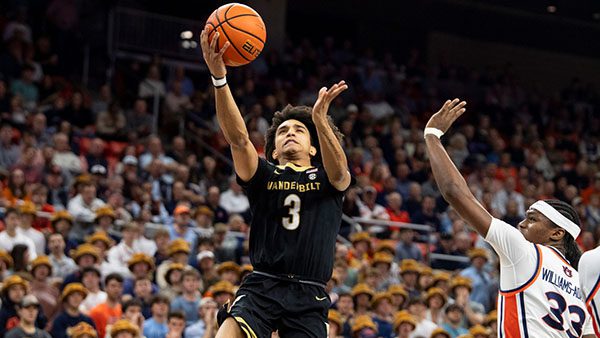
Bash is fading the public narrative and backing Vanderbilt to cover in a pace-clash SEC Tournament semifinal where the model sees 5.1 points of value against a Florida team that’s been overvalued by the market.
The Line and the Thesis
Florida’s laying 8 points against Vanderbilt in Saturday’s SEC Tournament semifinal at Bridgestone Arena, and I’m already hearing the chorus: “But Florida’s #4 in the country! They’re on a 10-game win streak!” Look, I get it. The Gators are elite. But when you dig into the collegebasketballdata.com numbers, this spread is inflated by poll position rather than actual efficiency separation.
Florida checks in at #4 in adjusted net efficiency with a +35.3 rating. Vanderbilt sits at #16 with +26.9. That’s an 8.4-point gap on a neutral floor, and the market just hung an 8-point spread. The math doesn’t support giving away free points here. This is a classic mid-major metric gap vs. Power 5 public perception spot—except both teams are Power 5, and Vanderbilt’s efficiency profile is being disrespected because they don’t carry the same brand recognition.
The model projects Florida by 2.9 points with a total around 151. The market disagrees by more than a full possession on the spread and nine points on the total. That’s not a minor discrepancy—that’s a market overreaction to recent results and poll rankings.
Why the Market Landed Here
Florida’s 10-game winning streak is real, and their 17-2 SEC record is dominant. But let’s talk about strength of schedule context from Warren Nolan. Florida’s SOS ranks #11 nationally, while Vanderbilt’s sits at #26. Both teams have been battle-tested, but Vanderbilt’s played a tougher non-conference slate (NC SOS #58 vs. Florida’s #14), and their efficiency metrics suggest they’re closer to Florida than the spread implies.
The Gators are #10 in adjusted offensive efficiency (125.5) and #5 in adjusted defensive efficiency (90.2). Vanderbilt counters with #8 offense (126.2) and #31 defense (99.3). Here’s the key: Vanderbilt’s offense is actually more efficient than Florida’s when you adjust for competition. The 0.7-point gap favors the Commodores.
The market’s pricing in Florida’s defensive dominance—and rightfully so. That 9.1-point defensive edge is real. But Vanderbilt’s not some plodding Big Ten outfit that’s going to struggle to generate quality looks. They rank #3 nationally in offensive rating (130.5) and shoot 78.5% from the free-throw line (#11). This is a team built to execute in the halfcourt.
Florida’s 72.2 pace (#11 nationally) is going to dictate tempo against Vanderbilt’s 64.7 (#283), but the blended projection sits around 68.5 possessions. That’s not a track meet. That’s a grind-it-out SEC semifinal where every possession matters, and Vanderbilt’s turnover rate (0.1, #34) gives them the ball security to stay within striking distance.
The Bubble Motivation Factor
Neither team is playing for their tournament life here—Vanderbilt’s #18 RPI and 7-4 Q1 record have them safely in the field, while Florida’s #4 RPI and 8-4 Q1 mark make them a lock for a top-three seed. But there’s a subtle bracketology motivation angle worth noting: Vanderbilt’s got more to gain from a signature win here. A neutral-court victory over a top-5 team would vault them into the top-15 RPI and potentially shift their seed line from 6/7 to 5/6.
Florida’s already cemented their resume. They’re playing for seeding, sure, but the urgency isn’t the same. I’m not saying they’ll sleepwalk—Todd Golden’s got them locked in—but Vanderbilt’s got the desperation edge in a spot where they can legitimize their season with one performance.
The other factor: experience-based closing ability. Vanderbilt’s rotation averages 2.45 years of experience compared to Florida’s 1.93. That half-year gap might not sound like much, but in a one-possession game in the final four minutes, I’ll take the team with more seasoned guards. Duke Miles (17.8 PPG) and Tyler Tanner (16.2 PPG) have been here before. They’re not going to panic if this game tightens up late.
The Matchup Contrast
This game comes down to one question: Can Vanderbilt’s elite offense generate enough quality looks against Florida’s suffocating defense to stay within a possession? I think the answer is yes, and here’s why.
Florida’s defensive identity is built on rebounding. They rank #1 nationally in total rebounds per game (45.5) and #20 in offensive rebounding percentage (34.9%). They’re going to dominate the glass—that’s a given. But Vanderbilt’s not a team that relies on second-chance points. Their offensive rebounding percentage sits at #202 nationally (30.2%), and they’re perfectly comfortable operating in the halfcourt with one shot per possession.
Where Vanderbilt creates separation is in turnover margin. They rank #27 nationally in turnovers per game (9.6) with a 1.68 assist-to-turnover ratio. Florida forces turnovers at a below-average rate (15.5%, #258 nationally) and commits them more frequently (16.3%, #157). That’s a 10-point turnover edge in Vanderbilt’s favor when you run the efficiency math, and it’s the primary reason the model sees value on the Commodores.
Florida’s Quadrant 1 record (8-4) is identical to Vanderbilt’s in terms of winning percentage, but Vanderbilt’s gone 7-4 in those spots with a tougher non-conference slate. Both teams know how to win big games. The difference is Vanderbilt’s been an underdog more often, and they’ve covered in those spots. Florida’s 8-17 ATS in their last 25 against Vanderbilt tells you the market consistently overvalues the Gators in this matchup.
The Numbers That Matter
| Metric | Vanderbilt | Florida |
|---|---|---|
| KenPom Rank | #12 | #4 |
| RPI Rank | #18 | #4 |
| Strength of Schedule | #26 | #11 |
| Q1 Record | 7-4 | 8-4 |
| Adj. Offensive Efficiency | 126.2 (#8) | 125.5 (#10) |
| Adj. Defensive Efficiency | 99.3 (#31) | 90.2 (#5) |
| Turnover Rate | 13.4% (#13) | 16.3% (#157) |
The pace clash is the wildcard here. Florida wants 72 possessions; Vanderbilt wants 65. The blended projection sits at 68.5, which favors Vanderbilt’s style more than Florida’s. Every possession the Gators don’t get is one less opportunity to exploit their rebounding advantage and one more chance for Vanderbilt to execute in the halfcourt.
KenPom’s got Florida winning 83-77 with a 71% win probability. That’s a 6-point margin, not 8. The model’s telling you the same story: this spread is too wide by at least a field goal.
The Bet
BASH’S BEST BET: Vanderbilt +8 for 2 units.
I’m not calling for the outright upset, though Vanderbilt’s got a legitimate 29% chance to win this game straight-up based on the efficiency math. What I’m saying is this: the market’s giving you 8 points in a game that should be priced closer to Florida -3 or -4. That’s a massive edge, and I’m not passing it up.
The primary risk is Florida’s rebounding dominance creating extra possessions and blowing this game open in the second half. If the Gators get out in transition off offensive boards, Vanderbilt’s not built to recover. But I trust Mark Byington’s team to limit those opportunities by taking care of the ball and controlling tempo.
This is a semifinal between two top-20 efficiency teams with nearly identical Quadrant 1 resumes. The spread should reflect that. It doesn’t. Take the points.