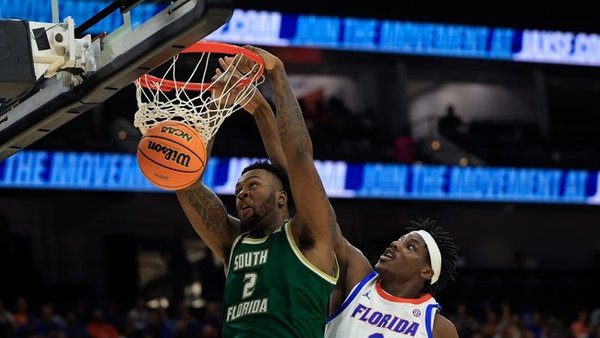
Bash is fading the blowout recency bias and backing Charlotte to cover a bloated number in a neutral-site conference tournament rematch that doesn’t reflect the underlying metrics.
The Line That Doesn’t Match the Metrics
South Florida is laying 14.5 points against Charlotte in Saturday’s American Athletic Conference tournament matchup at Legacy Arena, and I’m here to tell you the market has overshot this number by a significant margin. Yes, the Bulls dominated this exact matchup last week, winning 83-60 at home. But this is a neutral-site rematch with a completely different context, and when you dig into the collegebasketballdata.com numbers, the adjusted efficiency gap doesn’t support laying two touchdowns.
South Florida checks in at #52 in KenPom with a +15.2 adjusted efficiency margin, while Charlotte sits at #181 with a -1.1 margin. That’s a real talent gap—but it’s a 16-point gap in predictive power, not a 14.5-point spread on a neutral floor against a team that’s 18-14 ATS this season and 12-8 ATS in conference play. The 49ers have been one of the better covering teams in the American all year, and the market is pricing in last week’s beatdown without accounting for venue and variance.
Breaking Down the Spread
KenPom projects this game 83-72 South Florida, an 11-point margin. My CBB Edge Engine model has it even tighter at 76-70, a 5.9-point spread. The market is at 14.5. That’s an 8.6-point edge on Charlotte according to the model, and even if you split the difference with KenPom’s projection, you’re still looking at 3-4 points of value on the underdog.
The tempo here matters. South Florida plays at the 16th-fastest pace in the country (71.6 possessions per game), while Charlotte crawls at 348th nationally (63.5 possessions). The blended pace projects around 68 possessions, which favors the slower team in a spread context. Fewer possessions mean fewer opportunities for the favorite to separate, and Charlotte has the personnel to muck this up.
Warren Nolan’s data shows South Florida at #32 in RPI with a #66 strength of schedule, while Charlotte sits at #187 RPI with a #145 SOS. That’s a resume gap, sure—but it’s also a gap that’s already baked into the market. The Bulls are 2-3 in Quadrant 1 games and 5-1 in Q2, meaning they’ve been tested but haven’t exactly dominated elite competition. Charlotte is 0-4 in Q1 and 0-5 in Q2, but they’ve also played those games competitively enough to stay within the number more often than not.
Charlotte’s Structural Advantages
The 49ers don’t beat you with volume—they beat you (or stay close) by limiting possessions and controlling the glass. Charlotte ranks #72 nationally in offensive rebounding rate (33.8%), and while South Florida is elite on the offensive glass themselves at #8 (38.2%), the Bulls are vulnerable on the defensive boards, ranking just #236 in defensive rebounding rate. That’s a exploitable weakness.
Charlotte’s Ben Bradford (15.1 PPG) and Anton Bonke (10.9 PPG, 9.1 RPG) give them a legitimate inside-out punch, and Bonke’s presence as the #41 rebounder nationally means second-chance opportunities will be there. South Florida counters with Izaiyah Nelson (12.4 PPG, 9.3 RPG), the #32 rebounder in the country, but this becomes a board battle that Charlotte can compete in—and that keeps them within the number.
I also like the situational spot for Charlotte. This is a conference tournament game with no margin for error. The 49ers are 17-16 overall but 11-9 in conference play, and they’ve shown resilience after bad losses. They bounced back from last week’s 23-point drubbing by South Florida to beat UAB 83-78 on the road and Tulane 74-60 at home. That’s a team that doesn’t quit, and in a tournament setting where every possession matters, I trust them to compete.
The South Florida Counter
South Florida is 23-8 overall and 15-3 in the American, riding a 9-1 run in their last 10 games. They rank #8 nationally in scoring (88.4 PPG) and #26 in offensive rating (121.6), and their ability to force turnovers (#15 in steals at 9.0 per game) creates transition opportunities that Charlotte can’t match. The Bulls’ CJ Brown (13.7 PPG, 5.2 APG) is the #64 assist man in the country, and he orchestrates an offense that ranks #20 nationally in assists per game (17.3).
The concern here is South Florida’s defensive rebounding and their tendency to let opponents hang around in lower-possession games. They’re 14-16 to the over/under this season, meaning they’ve played under the total more often than not—a sign that their games don’t always turn into the track meets their pace suggests. Charlotte’s deliberate style could force South Florida into a half-court grind, and that’s where the Bulls have been less dominant.
Matchup Metrics and Resume Context
| Metric | Charlotte | South Florida |
|---|---|---|
| KenPom Rank | #181 | #52 |
| RPI Rank | #187 | #32 |
| Strength of Schedule | #145 | #66 |
| Q1 Record | 0-4 | 2-3 |
| Adj. Offensive Efficiency | 113.0 (#107) | 119.0 (#53) |
| Adj. Defensive Efficiency | 113.8 (#268) | 101.7 (#49) |
| Tempo | 63.5 (#348) | 71.6 (#16) |
The style clash here is real. South Florida wants to push pace and create 75+ possessions. Charlotte wants to grind this into the low 60s. The blended pace of 68 possessions favors the team trying to slow it down, because every possession South Florida doesn’t get is one less chance to separate. Charlotte’s 53.9% effective field goal percentage (#85 nationally) is actually better than South Florida’s 51.3% (#206), which tells you the 49ers can score efficiently when they get quality looks. The issue is volume—and in a lower-possession game, that volume gap shrinks.
South Florida’s defensive advantage is significant—#49 in adjusted defensive efficiency versus Charlotte’s #268—but the Bulls have also allowed 76.5 PPG this season (#253 nationally), which suggests they’re not locking teams down in the half-court. Charlotte’s deliberate pace and offensive rebounding should generate enough quality looks to stay within striking distance.
The Betting Recommendation
BASH’S BEST BET: Charlotte +14.5 for 2 units.
I’m not saying Charlotte wins this game outright. South Florida is the better team, and they’ve proven it. But 14.5 points is too many in a neutral-site conference tournament game between two teams that just played six days ago. The 49ers know what’s coming, they’ve shown the ability to bounce back from bad losses, and their pace control gives them a structural path to staying within the number. The model sees 8.6 points of value here, and even conservative projections have this closer to 10-11 points. I’ll take the points and trust Charlotte to compete.
The risk is simple: if South Florida’s transition game gets rolling early and they force Charlotte into turnovers, this could get ugly fast. The Bulls rank #15 in steals and #59 in forced turnover rate, and Charlotte is just #345 in forcing turnovers themselves. If the 49ers can’t protect the ball, the game script flips in South Florida’s favor. But at 14.5, I’m betting on Charlotte’s experience, their rebounding edge, and their ability to control tempo. This number is inflated by recency bias, and I’m fading it.