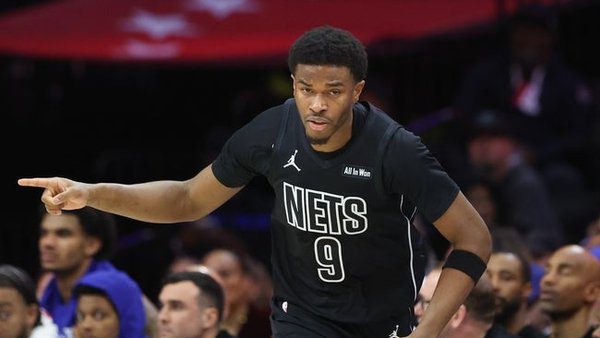
Bash sees a double-digit spread in a game between two lottery teams and finds himself asking whether Brooklyn’s injury situation has created a false floor—or if the Blazers’ road struggles and pace mismatch keep this closer than the market expects.
The Setup: Portland Trail Blazers at Brooklyn Nets
Portland rolls into Barclays Center on Monday night as 10-point road favorites over a Brooklyn squad that’s won just nine home games all season. The Blazers are 32-36 and clinging to play-in hopes. The Nets are 17-50 and operating a skeleton crew with Michael Porter Jr., Noah Clowney, and Egor Demin all sidelined. On the surface, this looks like a mismatch. Portland has the better record, the better efficiency profile, and the better roster. But laying double digits on the road against a team with nothing to lose? That’s where I start asking questions.
The projection has this game much tighter than the spread suggests—closer to a one-possession game when you account for home court. Brooklyn’s pace is deliberate, their defense is porous, and their offensive firepower is limited without Porter. But Portland is 14-20 on the road, and they’re coming off a loss in Philadelphia where they shot 32.7% from three. Shaedon Sharpe remains out with a fibula stress reaction, which continues to thin Portland’s perimeter depth. This is a situational spot where the favorite has to execute in a slow-paced environment against a team that has no pressure and nothing to protect.
Game Info & Betting Lines
Portland Trail Blazers at Brooklyn Nets
Date: March 16, 2026 | Time: 7:30 ET
Location: Barclays Center
TV: YES (Home), KUNP 16, BlazerVision, NBA League Pass (Away)
Current Betting Lines (Bovada):
- Spread: Brooklyn Nets +10.0 (-105) | Portland Trail Blazers -10.0 (-115)
- Total: 222.5 (Over -110 / Under -110)
- Moneyline: Brooklyn Nets +355 | Portland Trail Blazers -490
Why This Line Exists
The market is pricing in Brooklyn’s injury devastation and Portland’s superior talent. Porter is the Nets’ leading scorer at 24.2 points per game, and he’s out with an ankle sprain. Clowney, their second-leading scorer, is out for rest. Demin is done for the season with plantar fasciitis. That’s three rotation players unavailable, and it leaves Brooklyn relying heavily on Nicolas Claxton, Danny Wolf, and a collection of young wings who are still figuring out NBA spacing.
Portland, meanwhile, has Deni Avdija averaging 24.1 points, Jerami Grant at 18.8, and Jrue Holiday providing veteran steadiness at 16.4 points and 6.2 assists. The Blazers have the better offensive rating (112.4 vs 109.4) and the better defensive rating (114.9 vs 118.2). The net rating gap is 6.2 points per 100 possessions in Portland’s favor, which is a meaningful separation. But the market is also accounting for Portland’s road struggles and the fact that Brooklyn plays at the slowest pace in this matchup. The pace blend projects to just 99.6 possessions, which limits the number of scoring opportunities and keeps the game compressed. In a slower game, variance increases, and the underdog has more chances to stay within striking distance.
The 10-point spread reflects Brooklyn’s lack of firepower, but it also assumes Portland will capitalize consistently in a road environment where they’ve been inconsistent all season.
Portland Trail Blazers Breakdown
Portland is 32-36 overall and 14-20 on the road, which tells you they’re a different team away from home. They’re 10th in the Western Conference, still in the play-in picture, but they’ve been unable to string together the kind of road consistency that separates playoff teams from lottery teams. Offensively, they’re solid—112.4 offensive rating, 56.7% true shooting, and they move the ball well with an assist rate of 61.0%. Avdija has been their best player, filling the stat sheet with 24.1 points, 6.9 rebounds, and 6.7 assists per game. Grant is shooting 39.2% from three, which gives them spacing, and Holiday provides the kind of two-way veteran presence that stabilizes lineups.
The problem is Sharpe’s absence continues to hurt their perimeter depth. He was averaging 21.4 points before going down in early February, and without him, they’re leaning more heavily on Scoot Henderson, who’s still developing at 13.8 points and 41.0% shooting. Portland’s clutch record is 18-20, which suggests they’re competitive in tight games but not dominant. They shot just 32.7% from three in their last game against Philadelphia, and that kind of variance can be a problem when you’re favored by double digits on the road.
Brooklyn Nets Breakdown
Brooklyn is 17-50 and playing out the string. They’re 9-23 at home, which is brutal, but they’ve also been competitive in stretches when Porter has been healthy. Without him, they’re missing their primary shot creator and the guy who commands defensive attention. Claxton is averaging 12.0 points and 7.1 rebounds, but he’s not a volume scorer—he’s a rim-runner who needs others to set him up. Wolf has stepped up recently with 15 points and 10 rebounds in their last game, but he’s a rookie big who’s still adjusting to NBA physicality.
The Nets rank 13th in the Eastern Conference, and their defensive rating of 118.2 is one of the worst in the league. They give up second-chance points at a high rate—their offensive rebounding rate is just 24.6%, which is a 6.3-percentage-point disadvantage against Portland. That’s a strong edge for the Blazers, who crash the glass at 31.0%. Brooklyn’s clutch record is 6-23, and they shoot just 35.3% from the field in clutch situations, which tells you they don’t have the offensive firepower to close games. But in a slow-paced game where possessions are limited, they don’t need to be great—they just need to be competitive enough to stay within the number.
The Matchup
This is a pace and execution game. Brooklyn plays at 97.2 possessions per game, which is one of the slowest marks in the league. Portland is faster at 102.0, but the pace blend projects to 99.6, which is closer to Brooklyn’s comfort zone. In a slower game, the variance increases, and the favorite has fewer possessions to impose their will. Portland’s offensive rebounding advantage is real—6.3 percentage points is a strong gap that should translate to second-chance opportunities. But Brooklyn’s defense, while porous overall, can pack the paint and make Portland work for clean looks.
The offensive matchup slightly favors Portland. When you compare Portland’s offense (112.4 offensive rating) to Brooklyn’s defense (118.2 defensive rating), the Blazers have a 5.5-point advantage per 100 possessions. When you flip it—Brooklyn’s offense (109.4) against Portland’s defense (114.9)—the Nets have a 5.8-point disadvantage. That’s a medium-level mismatch in both directions, which suggests Portland should have the edge but not a dominant one. My model projects Portland by 1.1 points when you include home court, which is a far cry from the 10-point spread the market is offering. The model also projects a total of 226.6, which is 4.1 points higher than the posted 222.5. That’s a strong lean toward the over, driven by the pace and the offensive rebounding edge Portland brings.
Portland’s clutch win rate is 47.4%, which is nearly league average. Brooklyn’s is 20.7%, which is bottom-tier. That’s a 26.7% gap, and it matters if this game stays close late. But the question is whether Portland can build enough of a lead to avoid a clutch scenario altogether.
Bash’s Best Bet & The Play
I’m staying away from the spread. The projection has this as a one-possession game, and the market is asking me to lay 10 with a road favorite that’s 14-20 away from home. Portland should win this game, but asking them to cover double digits in a slow-paced environment against a team with nothing to lose feels like a trap. Brooklyn doesn’t have the offensive firepower to run with Portland, but they don’t need to—they just need to stay within the number, and in a 99-possession game, that’s entirely possible.
The total is where I see value. The projection is 226.6, and the market is sitting at 222.5. That’s a 4.1-point edge toward the over, and it’s driven by Portland’s offensive rebounding advantage and the fact that both defenses are below league average. Brooklyn gives up 118.2 points per 100 possessions, and Portland isn’t far behind at 114.9. Even in a slower game, the offensive rebounding gap should create enough extra possessions to push this total higher. Portland crashes the glass, Brooklyn doesn’t rebound well, and that’s a recipe for second-chance points that inflate the final score.
The Play: Over 222.5 (-110)
Risk note: If Portland builds a big lead early and Brooklyn waves the white flag, the pace could slow even further in garbage time, which would threaten the over. But I’m betting on Portland’s offensive rebounding to create enough extra possessions to get us there.