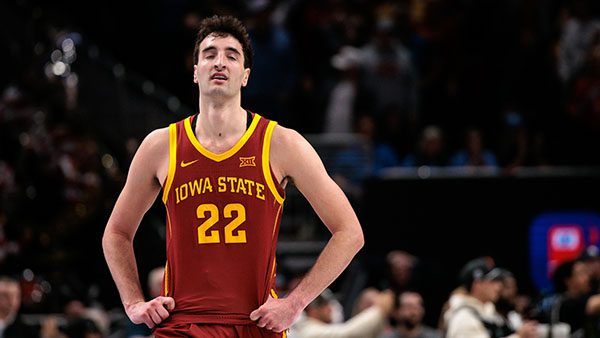
Bash is respecting the metrics but questioning whether the market has overshot this NCAA Tournament first-round spread. The efficiency gap is real, but the pace dynamic and Tennessee State’s defensive rating create a narrow backdoor window.
The Line and the Ledger
No. 2 seed Iowa State is laying 24.5 points against No. 15 seed Tennessee State in Friday’s NCAA Tournament first-round clash at the Enterprise Center in St. Louis, and I can already hear the “it’s March, anything can happen” crowd warming up. Look, I get the appeal of the underdog story. But when you dig into the collegebasketballdata.com numbers, this isn’t some coin-flip 5-12 game. Iowa State sits at #6 in adjusted net efficiency with a staggering +33.7 net rating, while Tennessee State checks in at #187 with a -1.6 net rating. That’s a 35.3-point chasm in the advanced metrics. The Cyclones rank #14 in adjusted offense and #7 in adjusted defense out of 363 Division I programs. Tennessee State? #171 offense, #204 defense. This is a classic NCAA Tournament talent mismatch on paper, and the market knows it.
The total sits at 149.5, with Iowa State installed as a prohibitive -6500 moneyline favorite. This is a power-versus-mid-major bracket spot where the committee expects the chalk to advance comfortably. The question isn’t whether Iowa State should win—it’s whether they cover a number that demands they win by four possessions in a neutral-site NCAA Tournament environment where motivation and variance live.
Why the Market Landed Here
The spread reflects the efficiency reality and the tournament seeding gap. Iowa State’s 125.0 adjusted offensive rating ranks #14 nationally, powered by elite shooting metrics: 56.5% effective field goal percentage (#19) and 59.1% true shooting (#41). They’re hitting 38.6% from three-point range (#13) and assisting on nearly 60% of their made baskets. This is a modern, ball-movement offense that generates quality looks.
Tennessee State’s 110.5 adjusted defensive rating (#204) is the weak link here. The Tigers allow 51.2% effective field goal percentage (#175 nationally), and while they force turnovers at a solid clip—20.0% forced turnover rate (#24)—they struggle to defend without fouling. Opponents shoot 41.6% free throw rate against them (#317), which is a disaster against a disciplined Iowa State squad that doesn’t beat itself. The Cyclones rank #66 in turnover rate and force you to defend for the full shot clock.
The pace projection is critical. Iowa State plays at 66.6 adjusted tempo (#226), while Tennessee State pushes at 70.3 (#36). The blended projection lands around 69 possessions, which favors the more efficient team. In a slower game, variance decreases and talent wins. That’s why the market isn’t afraid of this number—Iowa State’s #20 RPI and #31 strength of schedule dwarf Tennessee State’s #94 RPI and #325 strength of schedule. The Cyclones have been battle-tested in the Big 12 gauntlet. The Tigers haven’t seen anything close to this level of defensive intensity.
The Cyclones’ Structural Edge
Iowa State’s 91.4 adjusted defensive rating (#7) is the trump card. They rank #4 nationally in forced turnover rate (22.4%) and #83 in opponent effective field goal percentage (49.5%). Head coach T.J. Otzelberger has built a program identity around suffocating ball pressure and transition defense. Tennessee State’s offense isn’t built to handle that. The Tigers rank #234 in assists per game (13.2) and #217 in effective field goal percentage (51.0%). They’re a high-turnover, low-assist offense that relies on individual creation from guards Aaron Nkrumah (17.1 PPG) and Travis Harper II (15.3 PPG). Iowa State’s defensive scheme will force them into contested twos and long possessions.
The Cyclones also have the experience edge. Iowa State’s 2.56-year average experience dwarfs Tennessee State’s 1.68 years, and that gap matters in March. Iowa State’s core—Joshua Jefferson (17.6 PPG, 5.4 APG), Tamin Lipsey (16.8 PPG, 5.7 APG), and Milan Momcilovic (18.3 PPG)—has played in high-leverage Big 12 games all season. Tennessee State’s best win is a neutral-site victory over… nobody in Quadrant 1. They’re 0-2 in Q1 games and 1-0 in Q2. This is an OVC champion that feasted on a weak schedule and earned their way in, but they haven’t proven they can hang with elite defenses.
The Tigers’ Narrow Path
Tennessee State’s only real edge is pace and offensive rebounding. They rank #41 in offensive rebound rate (34.3%) and #7 in steals per game (9.4), which means they can create extra possessions if Iowa State gets careless. The Tigers also shoot 76.5% from the free throw line (#39), so if they can draw fouls and get to the stripe, they won’t waste trips. But that’s a big “if” against a defense that ranks #33 in opponent free throw rate (27.9%). Iowa State doesn’t foul.
The other concern for Iowa State backers is motivation. The Cyclones are a #2 seed playing a #15 in a game everyone expects them to win by 20-plus. Is there a letdown risk after grinding through the Big 12 Tournament? I don’t think so. Iowa State went 6-6 in Quadrant 1 games and has the defensive discipline to lock in regardless of opponent. Tennessee State’s 23-9 record looks nice, but 13 of those wins came in Q4. This isn’t a dangerous 15-seed with upset potential—it’s a team that earned its way in through conference dominance but lacks the talent to compete with a top-10 efficiency program.
Matchup Matrix: Style Clash Breakdown
| Metric | Tennessee State | Iowa State | Edge |
|---|---|---|---|
| KenPom Rank | #186 | #6 | Iowa State |
| RPI (Warren Nolan) | #94 | #20 | Iowa State |
| Strength of Schedule | #325 | #31 | Iowa State |
| Q1 Record | 0-2 | 6-6 | Iowa State |
| Adj. Offensive Efficiency | 108.9 (#171) | 125.0 (#14) | Iowa State |
| Adj. Defensive Efficiency | 110.5 (#204) | 91.4 (#7) | Iowa State |
| Pace (Adj. Tempo) | 70.3 (#36) | 66.6 (#226) | Tennessee State |
| True Shooting % | 55.7% | 59.1% | Iowa State |
The pace differential is the only category where Tennessee State holds an edge, but that’s not enough to overcome a 16.1-point adjusted offensive gap and a 19.1-point adjusted defensive gap. In a projected 69-possession game, Iowa State’s efficiency advantage compounds. The model projects Iowa State to score 81.7 points and Tennessee State to score 69.5 points, which would result in a 12.2-point Cyclones victory. That’s 12.3 points short of the 24.5-point spread, which is where the value conversation begins.
The Verdict: Respect the Gap, Fade the Blowout
I’m not here to tell you Tennessee State is winning this game. They’re not. Iowa State is the better team by every objective measure, and the Cyclones’ defensive discipline and offensive firepower should carry them to the Round of 32. But 24.5 points in a NCAA Tournament game is a massive number, even for a talent mismatch. Tennessee State’s 51st-ranked defensive rating in adjusted metrics is respectable, and their ability to force turnovers and crash the glass gives them multiple-possession upside. Iowa State’s 67.2% free throw shooting (#342) is a legitimate concern in a close-and-late scenario, and the Cyclones’ slower tempo limits the total number of scoring opportunities.
The biggest risk is Iowa State’s three-point shooting variance. If the Cyclones shoot 40%-plus from three and Tennessee State goes cold, this could be a 30-point game. But I’m betting on regression in a neutral-site NCAA Tournament environment where Tennessee State has nothing to lose and Iowa State has everything to protect. The Tigers will pack the paint, slow the game down, and make the Cyclones earn every bucket. That’s enough to keep this inside the number.
BASH’S BEST BET: Tennessee State +24.5 for 1.5 units. The efficiency gap is real, but the market has overshot this spread by a full possession. I’m fading the blowout and trusting the Tigers to stay competitive into the second half. Iowa State wins, but Tennessee State covers in a game that finishes in the 15-18 point range.