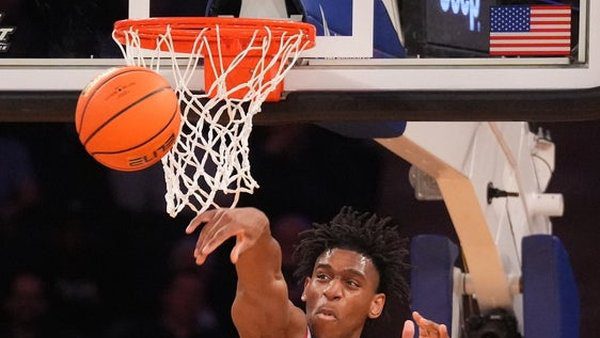
Bash is backing the double-digit underdog in this NCAA Tournament matchup, seeing the market overreacting to seed differential while Furman’s shooting efficiency and UConn’s recent struggles create genuine value on the Paladins.
The Line That Doesn’t Add Up
No. 2 seed UConn is laying 20.5 points against No. 15 seed Furman in Friday’s NCAA Tournament clash at Wells Fargo Center, and I’m here to tell you the market has this wrong. The Huskies are sitting at #7 in both polls with a 29-5 record, but when you dig into the collegebasketballdata.com numbers, this isn’t the mismatch the seed differential suggests. UConn just dropped back-to-back games to St. John’s (52-72) and Marquette (62-68) in their last three outings, and now we’re supposed to believe they’re going to steamroll a Furman squad that ranks #37 in effective field goal percentage and #45 in field goal percentage? This is a classic NCAA Tournament spot where the public overvalues the higher seed without accounting for the actual metrics that drive March outcomes.
The Paladins come in at 22-12 overall, winners of four of their last five, including a dominant 72-51 victory over The Citadel. More importantly, they bring legitimate shooting quality to Philadelphia—their 47.6% field goal mark ranks #45 nationally, and their 55.3% effective field goal percentage matches UConn’s exactly. When a 15-seed can match a 2-seed’s shooting efficiency, we’ve got a spread problem.
Why the Market Landed Here
The 136.5 total tells you everything about how oddsmakers are framing this matchup. They’re projecting a low-possession grind—my model has it at 63.9 possessions based on UConn’s glacial 62.6 pace (#343 nationally) and Furman’s methodical 65.1 tempo (#261). That’s fewer than 64 trips down the floor for each side, which means every possession carries massive weight in a tournament elimination game.
UConn’s defensive credentials are legitimate. Their 94.1 adjusted defensive rating ranks #11 nationally, and they’re holding opponents to just 40.2% from the field (#19) and 30.3% from three (#22). The Huskies also rank #12 in blocks per game at 5.3, which should theoretically disrupt Furman’s interior attack. But here’s the disconnect: Furman’s strength of schedule sits at #217 according to Warren Nolan, meaning they haven’t faced this level of defensive intensity consistently. The market is pricing in complete shell shock from the Paladins.
I’m not buying it. Furman’s 107.3 adjusted offensive efficiency (#202) isn’t elite, but their shooting percentages suggest they can score when they get clean looks. The question is whether UConn’s defense forces enough chaos to create the 20-point margin the spread demands.
The Bubble Motivation Factor
This is an NCAA Tournament game, which means we’re operating in a different motivational universe than the regular season. For No. 15 seed Furman, this is their season—there’s no tomorrow, no moral victories, just one chance to shock the bracket. The Paladins didn’t win the Southern Conference tournament to roll over in Philadelphia. Bob Richey’s squad knows they’re playing with house money, and that psychological edge matters when you’re getting three touchdowns.
For No. 2 seed UConn, the pressure is entirely different. They’re expected to win, expected to cover, and coming off losses in two of their last three games. The St. John’s beatdown (20-point loss) and the Marquette stumble suggest this isn’t a team hitting its peak at the right time. I’m not saying UConn won’t win—they should—but laying 20.5 in a tournament setting against a team that can shoot requires dominance the Huskies haven’t shown lately.
Alex Wilkins leads Furman at 17.1 points per game (#132 nationally) with 4.2 assists (#144), giving the Paladins a legitimate lead guard who can manage possessions in a tight game. Charles Johnston provides 9.7 rebounds per game (#26 nationally), which could help Furman stay competitive on the glass despite UConn’s 31.8% offensive rebounding rate advantage.
The Matchup Contrast
The style clash here favors the team that can execute in the halfcourt, and both squads prefer to slow things down. UConn’s 122.8 adjusted offensive efficiency (#31) gives them a significant edge in scoring capability, but Furman’s defense isn’t a sieve—their 104.9 defensive rating (#99) and 42.5% opponent field goal percentage (#76) show they can get stops when needed.
The Warren Nolan resume data reveals the experience gap: Furman’s RPI sits at #145 with a 0-0 record in Quadrant 1 games and 0-4 in Quadrant 2. They haven’t beaten anyone of UConn’s caliber this season. But that same data shows UConn hasn’t been tested in low-possession tournament environments against teams with nothing to lose. The Huskies’ 29-5 record is built on Big East competition, not NCAA Tournament survival mode.
UConn’s offensive attack runs through Tarris Reed Jr. (15.5 PPG, 8.2 RPG) and Solo Ball (14.6 PPG), but Furman’s interior presence with Cooper Bowser (12.1 PPG, 6.2 RPG) and Johnston on the boards means the Paladins can compete in the paint. The key number: UConn averages just 1,218 points in the paint compared to Furman’s 1,142—not a massive gap given the difference in competition level.
The Numbers Table
| Metric | Furman | UConn |
|---|---|---|
| KenPom Rank | #188 | Not provided |
| RPI Rank | #145 | Not provided |
| Strength of Schedule | #217 | Not provided |
| Q1 Record | 0-0 | Not provided |
| Adj. Offensive Efficiency | 107.3 (#202) | 122.8 (#31) |
| Adj. Defensive Efficiency | 108.8 (#165) | 94.1 (#11) |
| Pace | 65.1 (#261) | 62.6 (#343) |
The projected possession count of 63.9 means we’re looking at roughly 32 offensive trips per team. In that environment, UConn needs to score nearly 1.16 points per possession while holding Furman under 0.85 to cover this spread. My model projects UConn winning by 9.6 points, which creates 10.9 points of value on Furman at +20.5. That’s not a small edge—that’s a canyon.
The style clash amplifies this value. Both teams want to play in the 60s possession-wise, which compresses the scoring range and makes blowouts less likely. UConn’s defensive excellence can limit Furman’s scoring, but the Paladins’ shooting efficiency means they won’t go quietly. In a tournament setting where every possession is magnified, the team getting 20.5 points with legitimate shooting credentials is the right side.
The Bottom Line
BASH’S BEST BET: Furman +20.5 for 2 units.
I’m not calling for the upset—UConn should win this game. But 20.5 points in an NCAA Tournament matchup between a capable shooting team and a defense-first favorite coming off recent losses? The market is giving us too many points based on seed differential alone. Furman’s 47.6% field goal percentage and 55.3% effective field goal percentage give them the offensive foundation to stay within this number, especially in a 64-possession game where variance is limited.
The primary risk is obvious: UConn’s elite defense forces Furman into contested shots all night, and the Paladins’ 32.7% three-point shooting (#257) becomes a liability when the Huskies pack the paint. If UConn’s 5.3 blocks per game disrupt Furman’s interior attack and force them into perimeter-heavy offense, this could get ugly. But I’m betting on Furman’s shooting efficiency and tournament desperation to keep this closer than three touchdowns. In March, that’s enough for me to back the Paladins with the points at Wells Fargo Center on Friday night at 10:00 PM ET.