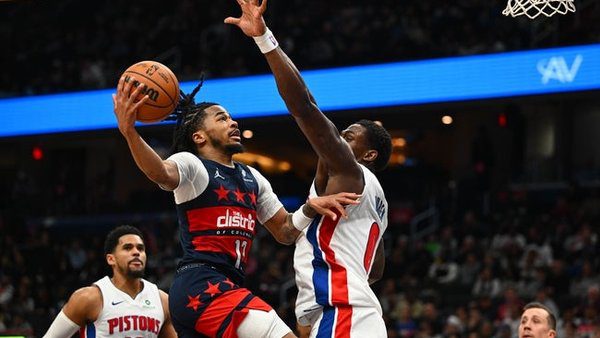
Bash sees a depleted Warriors squad walking into a buzzsaw in Detroit, but the total projection tells a different story than the market suggests—and that’s where the edge lives Friday night.
The Setup: Golden State Warriors at Detroit Pistons
Detroit is laying six points at home Friday night against a Golden State squad that’s been gutted by injuries, and on the surface, this looks like a mismatch. The Pistons sit atop the Eastern Conference at 50-19, while the Warriors limp in at 33-36 and 6-13 since Stephen Curry went down with a right knee injury. The projection has Detroit covering by a half-point, putting the spread basically in line with the market at -6.0. But the total at 217.5? That’s a different conversation entirely.
Here’s the angle: The market has priced this total like it’s a defensive grind, but both teams push pace right around 100 possessions per game, and the offensive rebounding gap gives Detroit second-chance scoring opportunities that should inflate possessions even further. My model projects 227.1 total points—nearly 10 points higher than the posted number. That’s not a small gap. That’s a structural mispricing.
Game Info & Betting Lines
Golden State Warriors at Detroit Pistons
When: Friday, March 20, 2026, 7:30 ET
Where: Little Caesars Arena
TV: FanDuel SN DET, NBC Sports BA
Spread: Detroit Pistons -6.0
Total: 217.5
Moneyline: Detroit -238 | Golden State +190
Why This Line Exists
The spread makes perfect sense when you look at the season-long efficiency gap. Detroit holds a +7.4 net rating edge per 100 possessions, which is the foundation of the margin projection. The Pistons run a 116.9 offensive rating against a 109.0 defensive rating—elite on both ends. Golden State checks in at 114.1 offensive rating and 113.5 defensive rating, which is basically league average when you’re healthy. But they’re not healthy.
Without Curry and Jimmy Butler (out for the season after ACL surgery), the Warriors are down their two primary shot creators. Moses Moody is still wearing a brace on his right wrist and hasn’t played since March 2. That’s a rotation stripped to the studs, relying on Brandin Podziemski, De’Anthony Melton, and Kristaps Porzingis to carry the offensive load. They just got smoked 120-99 in Boston on Wednesday, with Gary Payton II and Pat Spencer leading the team with 14 points each. That’s not a sustainable offensive hierarchy.
The total, though—that’s where the market is off. At 217.5, books are pricing this like a methodical, half-court game. But the pace blend sits at 100.1 possessions, and Detroit holds a massive +5.4 percentage point edge in offensive rebounding rate. That’s not just extra possessions—that’s extra high-efficiency possessions in the paint, where Jalen Duren feasts. The Pistons just outrebounded Washington 55-33 and scored 66 points in the paint in their last outing.
Golden State Warriors Breakdown
The Warriors are 14-21 on the road and have lost six of seven overall. In their last game, they cut a 21-point deficit to 11 early in the fourth against Boston before the Celtics responded with a 17-6 run to put it away. That’s a team that can hang around for stretches but doesn’t have the firepower to sustain offense against elite defenses.
Porzingis is averaging 17.0 points and 4.8 rebounds while shooting 45.1 percent from the field and 34.2 percent from three. He gives them size and floor spacing, but he’s not a primary creator. Podziemski (12.9 points, 5.2 rebounds, 3.8 assists) and Melton (13.1 points, 2.4 assists) are solid complementary pieces, but asking them to run an offense against Detroit’s length is a tall order.
The Warriors do have one thing working in their favor: Golden State holds a +5.1 offensive/defensive mismatch advantage when you match their offense against Detroit’s defense. That suggests they can score in spots, especially if they get out in transition and avoid Detroit’s half-court pressure. But without Curry’s gravity or Butler’s ability to get to the rim, the shot creation is limited.
Detroit Pistons Breakdown
The Pistons are 25-8 at home and just handled their business in Washington without Cade Cunningham, who’s out with a collapsed left lung. Duren went for 24 points and 11 rebounds in just 25 minutes, notching his 37th double-double of the season. That’s two straight dominant performances from Duren, who dropped a career-high 36 points two nights earlier against the same Wizards squad.
Even without Cunningham, Detroit has enough depth to overwhelm a depleted Warriors rotation. Duncan Robinson (11.9 points, 40.1 percent from three) gives them elite floor spacing. Tobias Harris (13.1 points, 5.2 rebounds) provides veteran scoring. Paul Reed added 17 points in the last game, and Caris LeVert and Kevin Huerter each chipped in 14. That’s five guys in double figures without their best player on the floor.
Isaiah Stewart remains out, but Paul Reed has stepped into expanded minutes and delivered. Detroit’s rebounding advantage is massive—they average 46.0 boards per game compared to Golden State’s 42.8, and the offensive rebounding gap is where this game could get out of hand. The Pistons grab 13.4 offensive rebounds per game at a 31.1 percent rate, while the Warriors sit at 11.5 and 25.7 percent. That’s a structural mismatch that creates extra possessions and easy buckets.
The Matchup
This game sets up as a pace-and-space contest where Detroit controls the glass and dictates tempo. Both teams want to play fast—Detroit at 100.0 pace, Golden State at 100.2—but the Pistons have the personnel to win the possession battle on the offensive glass. That’s where the total projection climbs.
Golden State’s best path to keeping this competitive is hitting threes and avoiding turnovers. They shoot 35.6 percent from deep as a team, and if Podziemski and Robinson (the other one, not Duncan) can get hot, they can stay within striking distance. But Detroit’s defense allows just 109.0 points per 100 possessions, which ranks among the league’s best. The Warriors’ offense, even when healthy, isn’t built to grind through elite half-court defenses without Curry’s shot creation.
The clutch numbers tell you everything about how this season has gone for both squads. Detroit is 25-12 in clutch situations with a 67.6 percent win rate. Golden State is 13-18 with a 41.9 percent win rate. That’s a 25.7 percent gap in close-game execution, which matters if this stays within one possession late. But I don’t think it does.
Detroit’s offensive rebounding creates second-chance points that inflate the total beyond what the market expects. The Pistons just hung 66 points in the paint on Washington while grabbing 55 boards. Golden State doesn’t have the interior presence to slow Duren down, and without Curry’s perimeter gravity, the Warriors can’t force Detroit’s defense to rotate out of the paint. That’s a recipe for a high-scoring game where Detroit controls the flow but both teams get their possessions.
Bash’s Best Bet & The Play
The Play: Over 217.5 (-110)
I’m taking the over in a game where the pace and rebounding dynamics point to more possessions than the market is pricing. Detroit’s offensive rebounding edge creates extra trips, and Golden State’s offense—while limited—should still find enough transition buckets to keep this total climbing. The projection sits at 227.1, which gives us nearly 10 points of cushion against a 217.5 number.
The risk here is if Detroit blows this open early and both teams empty the bench for the final eight minutes. But even in that scenario, I like the math. Both teams push pace, Duren is feasting on the glass, and the Warriors don’t have the defensive personnel to slow down Detroit’s second-chance scoring. This total feels like it was set for a grind-it-out game, but the matchup tells a different story.
Lay the points if you want—Detroit should win this game. But the value is on the total, where the structural rebounding edge and pace blend create a path to 220-plus points. That’s where I’m putting my money Friday night.